
Al Nahda Localization Award 2025 Honors UN Women Jordan
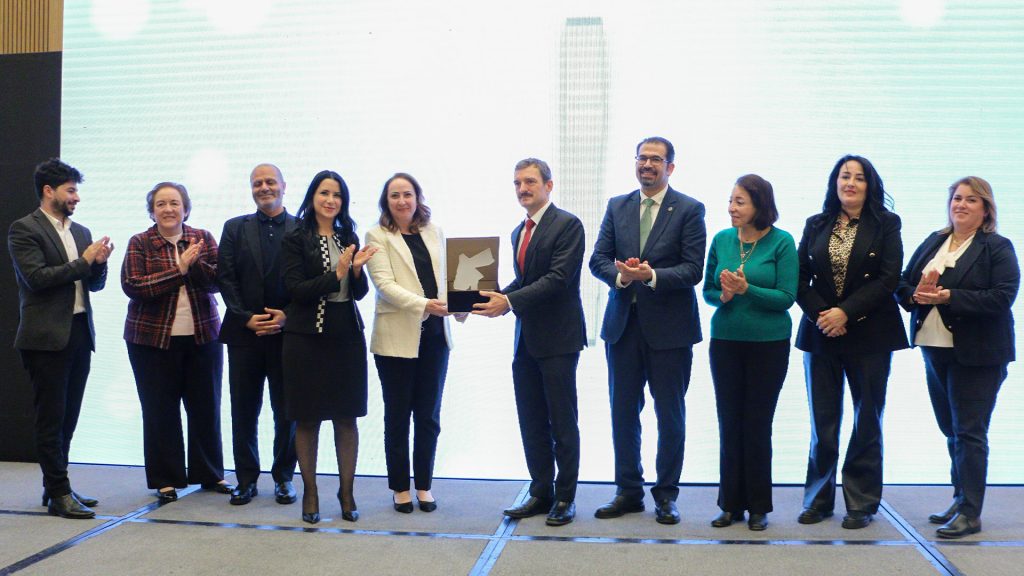
Amid accelerating political, economic, and humanitarian transformations, the theme of the Al Nahda Localization Award 2025 is titled “Localization of Humanitarian Action: From Theory to Practice in Times of Transformation.” The theme underscores that localization is no longer merely a theoretical framework, but a practical, community-led approach that integrates humanitarian response, development, and resilience building. This year’s theme celebrates organizations and individuals who have translated the principles of partnership, equity, and trust into tangible practices, despite challenges such as shrinking funding and instability, while safeguarding the independence of local actors and their central role in leading change within their communities. In this context, the Arab Renaissance for Democracy and Development (ARDD), in partnership with the Jordan National NGO Forum (JONAF), honored UN Women Jordan, led by Mr. Nicolas Burniat, by awarding it the Al Nahda Localization Award 2025, in recognition of its pioneering efforts in advancing local leadership and promoting the localization of humanitarian and development action in Jordan. The award recognizes UN Women’s sustained contributions, including its leadership of the Humanitarian Localization Working Group in Jordan, its role in supporting the implementation of the National Action Plan for UN Security Council Resolution 1325, and its systematic support to national and women-led organizations,including many JONAF members. It also acknowledges UN Women’s role in strengthening women’s empowerment and promoting local ownership of humanitarian and development efforts. This recognition further reflects ARDD’s and JONAF’s shared commitment to equitable partnerships, a strong civil society, and positioning local actors at the forefront of humanitarian and development action at national and regional levels. The award was presented during a meeting held on Sunday, 14 December 2025, where Mr. Nicolas Burniat, Representative of UN Women in Jordan, received the award. In his remarks, he emphasized that the localization of humanitarian action is essential to ensuring sustainable impact and enhancing the effectiveness of responses, highlighting the importance of investing in national capacities and building partnerships grounded in trust and shared responsibility. During the award presentation, Ms. Sawsan Al-Majali, Senior Advisor at Durat Al-Manal for Development and Training and a Board Member of JONAF, noted that this recognition reflects the pioneering role played by UN Women in strengthening local leadership, fostering trust-based partnerships, and supporting the participation of women and national organizations in developing sustainable solutions. Ms. Louise Piel Mckey, Programme Manager /Team leader at the European Regional Programme for Development and Protection, emphasized that localization is gaining increasing importance amid rapid political and economic transformations in the region. She stressed the need for a genuine collective commitment to move from theoretical acknowledgment of localization toward practical, sustainable, and community-led implementation. In turn, Dr. Walid Al-Tarawneh, CEO of Partners for Better and a member of JONAF, affirmed that the award reflects one of the alliance’s core values and underscores the importance of localization as an integrated humanitarian and development approach. He noted that JONAF has become one of the leading models of collaborative engagement between government and civil society in Jordan. Ms. Samar Mohareb, Executive Director of ARDD and a Board Member of JONAF, stated that the award serves as an annual platform to recognize efforts that strengthen local leadership and reinforce a nationally rooted approach to humanitarian action. She highlighted that UN Women has set a strong example by adopting localization as both a strategic direction and a daily practice in Jordan. She added that this year’s theme reflects the profound regional and global transformations underway, affirming that localization has become a strategic necessity that moves beyond discourse to action, particularly at a time when humanitarian and development agendas are increasingly interconnected. The Al Nahda Localization Award was launched in 2021 to honor individuals or organizations that have made exceptional contributions to advancing the localization of humanitarian and development action at the national and regional levels, based on criteria that include innovation, inspiring leadership, collaborative practice, and the highest standards of integrity. The fifth edition of the Award was held as part of the project “ Future Forward: Unlocking sustainable local opportunities ,” implemented by the ARDD and funded by the European Regional Programme for Development and Protection, in partnership with JONAF.
ARDD and JONAF honor AECID–Jordan with the Al Nahda Localization Award 2024
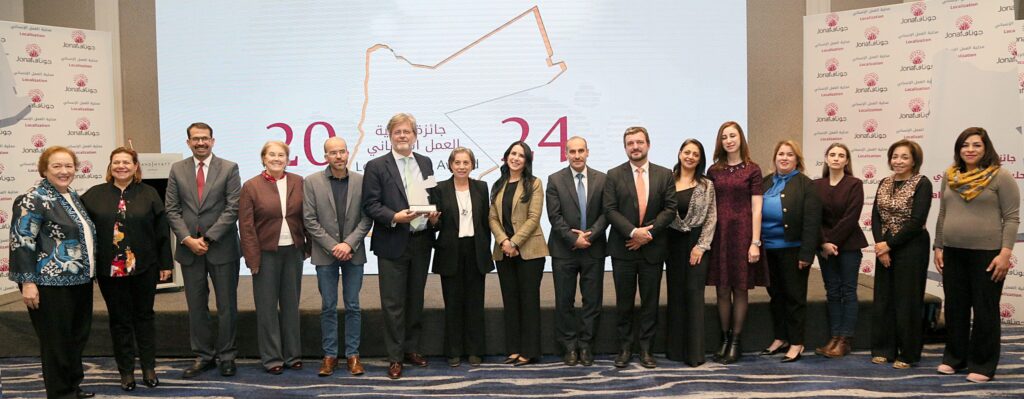
To emphasize the importance of localization of humanitarian and development work in Jordan and effective partnership between civil society and international institutions in strengthening it, especially in times of peace and crises, conflicts, and unrest in the region, the Arab Renaissance for Democracy and Development (ARDD) and the Jordan National NGO Forum (JONAF) honored the Spanish Agency for International Development Cooperation (AECID) – Jordan with the Al Nahda Award for the localization of humanitarian action for the year 2024. The award was presented during a ceremony on Tuesday, December 10, 2024, on Human Rights Day, titled “Bridges of Light: Prioritizing Local Actors in War and Peace. ” It was received by the Spanish Ambassador to Jordan, Miguel de Lucas González, who emphasized that activating the localization of humanitarian work in Jordan requires genuine collaboration and engagement with local civil society. He expressed his appreciation and pride in receiving the award, highlighting the depth of the partnership between Spain and Jordan. Ambassador González pointed out that the AEICD – Jordan has for many years supported the independence of decision-making of local actors, showing understanding of the local context in all areas of work, in addition to its continuous support for building the capacity of local organizations and giving them priority in all its decisions. In line with this year’s theme, the award seeks to recognize leaders who have supported their local partners during times of turbulence and uncertainty at the regional level. These leaders have strived to maintain the independence of their partners, respected their sense of justice, amplified their voices, brought attention to their issues, and adapted their programs to align with the local context. Dr. Sawsan Al-Majali, a member of the JONAF Steering Committee, said: “This year, we come together amid enormous regional and global challenges. The dire situation in Palestine and our region, with its devastating impact on civilians and humanitarian workers, underscores the importance of the localization of humanitarian action as the cornerstone of building resilience and promoting justice and sustainable development.” She also pointed out that AEICD – Jordan was selected by the JONAF Steering Committee from a pool of 11 nominations, with 3 candidates making the final shortlist. On behalf of Jordanian organizations, the Secretary-General of the Jordanian National Forum for Women, Dr. Ruba Matarneh, saw that supporting the prioritization of local actors consolidates the paths of resilience and development, and contributes to raising and amplifying the voices of women, youth, and marginalized communities, giving them the ability to actively contribute to social cohesion and local leadership commending AEICD- Jordan in this regard. For his part, UN Women Jordan country representative, Nicholas Burniat, expressed his pride in Jordan’s great progress in the field of localization of humanitarian work, stressing the need to find proper ways to activate partnerships between all local actors to achieve a comprehensive renaissance and better responses to the needs of communities targeted by humanitarian and development agenda services. The Executive Director of ARDD, Samar Muhareb, emphasized that the Award´s fourth the importance of activating the localization of Human Rights and ensuring the localization of this agenda, particularly in communities that need them most, indicating that the localization of humanitarian work is not about slogans and speeches, but rather a basic requirement for humanitarian and development work and the development of societies. The Al Nahda Localization Award was launched by ARDD and JONAF in 2021 to recognize and appreciate individuals and organizations that champion localization and play a critical role in advancing and strengthening local civil society organizations at both local and international levels. As part of the Ceremony, Petr Kostohryz Special Advisor / Partnership Manager at The European Regional Development and Protection Program (RDPP), was also honored with a certificate of appreciation in recognition of his efforts over the years to support the local agenda of humanitarian action.
JONAF and ARDD present Al Nahda Localization Award 2023 to Dominik Bartsch, UNHCR Jordan Representative
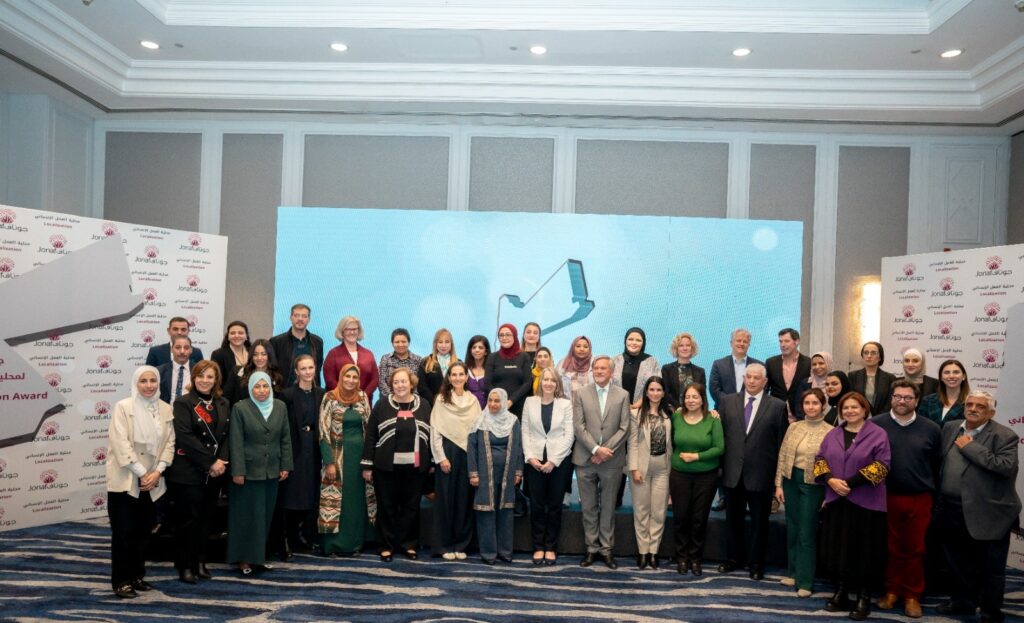
Emphasizing the importance of the localization of humanitarian and development work in Jordan and the role of effective partnership between civil society and international institutions in strengthening it, especially in light of the current circumstances plaguing the region, and under the title “Partners through thick and thin”, the Jordan National NGOs Forum (JONAF) organized its annual event for the Al-Nahda Localization Award for Humanitarian Action of 2023, which was awarded to the Representative of the United Nations High Commissioner for Refugees (UNHCR) in Jordan, Dominic Bartsch, in recognition of his contributions and achievements in supporting this important agenda to advance development plans and strategies in Jordan. In this context, Dr. Sawsan Majali, a member of the JONAF Administrative Committee, said: “Upholding basic humanitarian principles is essential under the current circumstances.” She then added that “Now more than ever, we need to highlight the need to activate the localization of humanitarian action and call on various stakeholders to work together and extend the hands of cooperation to overcome global and local crises and challenges.” She also pointed out that supporting the capabilities of local and national bodies works to raise the efficiency of the humanitarian response and the sustainability of development efforts. Eng. Mai Abu Addad, member of the JONAF and President of the Step of Hope Association in Irbid, praised the essential and pivotal role of the JONAF Alliance in gaining the support of decision-makers in promoting the localization of humanitarian and development work, in addition to the Forum’s efforts in developing the work of local organizations and associations. Moreover, she stated that unemployment, health, education, and the challenges of refugees are among the most pressing issues at the local level, and that these challenges can be addressed through local approaches to humanitarian action and the continued support for those working to meet these needs in different governorates. The United Nations Resident Coordinator in Jordan, Sheri Anderson, stressed Jordan’s pivotal role in maintaining stability in the region and its tireless efforts in the refugee file, saying: “We acknowledge Jordan’s continued support for the refugee issue.” She then added: “I am delighted to be here with you today to celebrate the recognition of the courageous figure represented by Dominique Bartsch, as localization of humanitarian action has often been a top priority for the United Nations, including UNHCR”. In his speech, Bartsch expressed his contentment that Jordan has made significant progress in the field of localization of humanitarian action, pointing out that there is still a lot for UNHCR to offer to empower local actors, as well as the need to find appropriate ways to activate partnerships between all local actors to achieve a comprehensive renaissance and better responses to the needs of communities targeted by humanitarian and development agendas. “I accept this award on behalf of the UNHCR team,” he said, adding: “I pledge to all of you to continue to provide support to all those who need our support.” In turn, CEO of ARDD, Samar Muhareb, pointed out that the award is announced annually in conjunction with the International Day of the United Nations Charter on Human Rights, to emphasize the importance of these charters and rights at the local level, and the need to work to make them more relatable in order to respond to the reality of all peoples of the world, by working to support their localization, and adhering to them by the most needy communities everywhere, as they represent humanitarian gains and achievements for all, although the current circumstances have limited their application in our region, but that this will push us further to protect them and demand their application. Furthermore, Muhareb expressed her deep gratitude for the efforts of the United Nations and its partnership with Jordanian civil society and standing side by side with local civil society organizations through all crises, stressing the need for local, national, and international institutions to unite to activate the localization of humanitarian action, saying: “We believe in the localization of humanitarian action and the bridges it builds. Our mission is to stand united through thick and thin and to do what we can, despite our limited resources, to enhance the response and sustain our development goals.” In 2021, ARDD, the coordinator of JONAF, along with the Forum’s Steering Committee, launched the “Al-Nahda Localization Award for Humanitarian Action” in recognition of the tremendous efforts of distinguished individuals and/or prominent international organizations who advocate and support the localization of humanitarian action, and in recognition of their role in advancing civil society organizations at both the local and international levels. The award also considers outstanding courage, creativity, and the ability to inspire others, as well as leadership side by side with action as part of the community of humanitarian workers, and adherence to the highest standards of integrity in critical contexts.
JONAF presents the Al-Nahda Award for localization of humanitarian action 2022, to Baptiste Hancorat, JIF’s coordinator
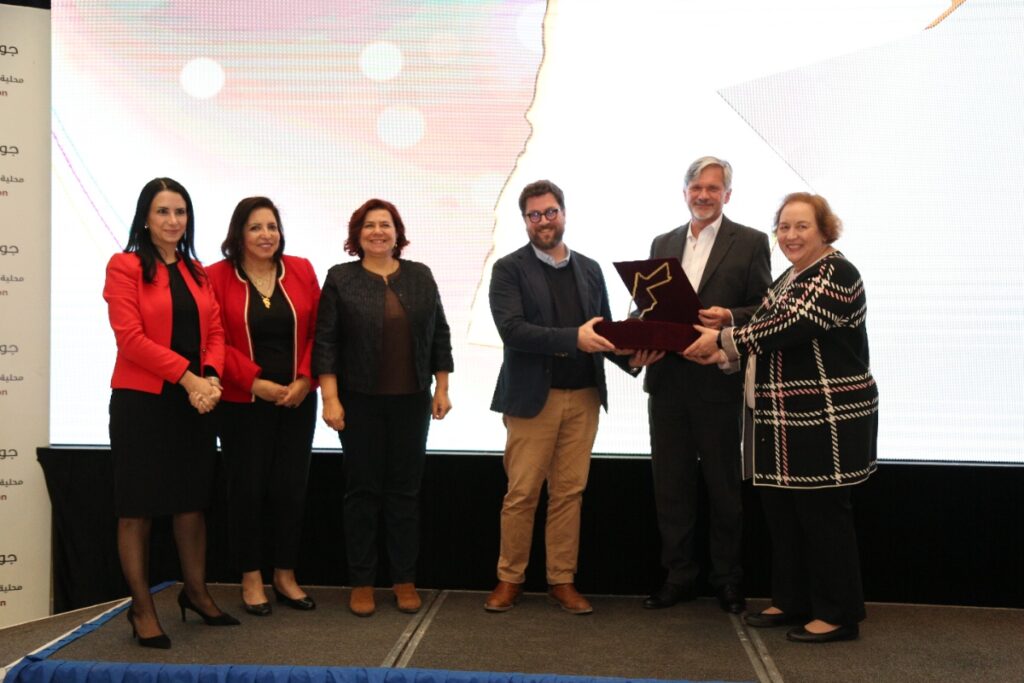
As part of Human Rights Day activities whose motto is “Dignity, Freedom, and Justice for All” and in acknowledgement of his efforts in localizing the humanitarian action in Jordan and advocating for local actors and civil society, the Arab Renaissance for Democracy and Development (ARDD) and the Jordan National NGOs Forum (JONAF) presented the Al-Nahda Award for Localization of Humanitarian Action 2022 to Baptiste Hancorat, Coordinator of Jordan INGO Forum (JIF). The award, launched last year, comes in recognition of the efforts of prominent individuals and/or organizations to promote and advocate for the localization of humanitarian action and to acknowledge their role in the promotion of local actors and civil society organizations on the local and international levels. Hancorat, whose professional experience in international and regional humanitarian work exceeds 20 years, said that the localization of humanitarian work should be the main pillar of international organizations’ work. Local organizations are best equipped to support their communities and should be better represented in international conferences and internal discussions aiming at setting the priorities of Jordan’s civil society. He expressed the special meaning of the award for him and his opinion about the “courage” of the Jordanian civil society and its clear role in supporting decision-makers. Dr Sawsan, Al Majali, Senior Consultant at Durrat Al-Manal and member of JONAF’s Administrative Committee, commended Hancorat’s work in contributing to “guiding the collective leadership of international organizations into providing more effective and comprehensive support by working with actors and partners in Jordan to promote local action that is based on human rights and the national ownership of these efforts.” Al Majali said that localizing humanitarian action is not limited to aid and emergency work but is essential to achieving sustainable development. The partnership between JONAF and JIF resulted in the establishment of the National Platform for Donors and Civil Society to address the consideration that localizing humanitarian action is a contractual one between international and local actors and move towards a more comprehensive approach. Senate and JONAF member, Asia Yaghi stressed the importance of partnership building and the continuation of dialogue between local and international civil society. This could increase the chances of success and development of local organizations. Dominik Bartsch, UNHCR’s Representative and Resident Coordinator in Jordan, stressed the importance of developing partnership mechanisms between states and civil society organizations. He noted Jordan’s strong civil society, which requires some empowerment and capacity development. ARDD’s CEO, Samar Muhareb said: “we acknowledge your continuous support to JONAF towards improving the participation of actors in decision-making and the humanitarian sector, your efforts in mobilizing resources to support local actors, and your advocacy for the international civil society to adopt the Grand Bargain’s principles and commitments. This all helped motivate us and encourage other actors in the region to do more in support of localizing humanitarian action.” The Al-Nahda Award for localization of humanitarian action was launched in 2021 in recognition of the exceptional and meaningful efforts of individuals and organizations in localizing humanitarian action on the national and regional levels. The selection considers courage, creativity, ability to inspire, leadership, and commitment to integrity, as well as being a worker in the humanitarian field. The award could be offered to any individuals who work in the humanitarian or development sectors including staff and volunteers of local and international organizations, vendors, donors, community organizations, and governmental organizations.