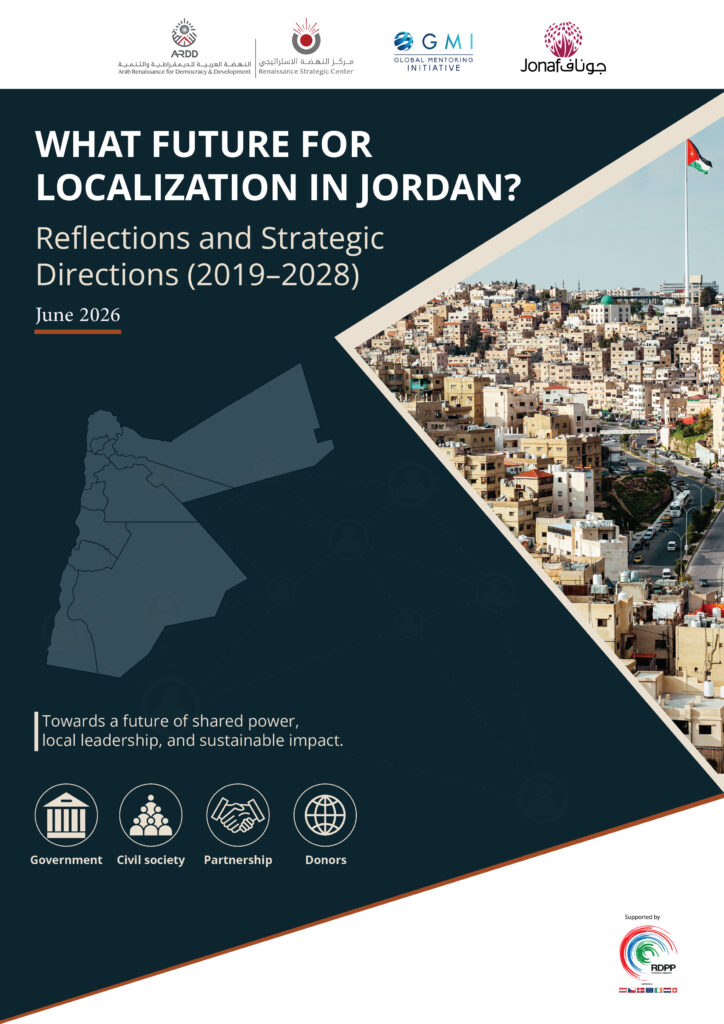
Localization has become one of the defining debates shaping the future of development and humanitarian action worldwide. In Jordan, years of policy commitments, dialogue, and partnership-building have contributed to growing recognition of the role of local and national actors in responding to humanitarian needs and advancing sustainable development. Yet important questions remain regarding leadership, decision-making, financing, and the extent to which localization has translated from aspiration into practice.
This publication examines the state of localization in Jordan between 2019 and 2028, reflecting on progress achieved, persistent challenges, and emerging opportunities in a rapidly changing aid landscape. Drawing on a national baseline survey, stakeholder consultations, interviews, and a review of key initiatives and experiences, the report explores how localization is understood, implemented, and experienced by different actors across Jordan.
Beyond assessing the current situation, the publication adopts a forward-looking perspective. It considers possible future scenarios for localization in the context of shifting donor priorities, evolving humanitarian needs, growing pressures on civil society, and increasing calls for locally led development. The analysis highlights the importance of equitable partnerships, quality funding, local leadership, and enabling policy environments as critical foundations for a more sustainable and effective ecosystem.
Developed as part of ARDD’s localization agenda by the Renaissance Strategic Center (RSC) in collaboration with the Jordan National NGOs Forum (JONAF) and the Global Mentoring Initiative (GMI), this publication forms part of the Future Forward: Unlocking Sustainable Local Opportunities project, implemented with support from the Regional Development and Protection Programme (RDPP).
The report seeks to contribute to ongoing dialogue among policymakers, donors, civil society organizations, international actors, researchers, and practitioners on the future of localization in Jordan and the pathways toward a more locally led, equitable, and resilient development and humanitarian system.
This document has been produced with the financial assistance of the European Regional Development and Protection Program (RDPP III) for Jordan and Lebanon, which is supported by Austria, the Czech Republic, Denmark, the European Union, Ireland, the Netherlands, and Switzerland. The content of this document is the sole responsibility of ARDD and can under no circumstances be regarded as reflecting the position of the RDPP or its donors.