Access to social protection is a fundamental human right and plays a central role in ensuring dignity at work, income security, and social justice. However, millions of workers worldwide remain partially or entirely excluded from national social protection systems or are unable to benefit from them adequately due to legal restrictions, administrative barriers, difficulties in transferring benefits when moving between jobs, weak oversight mechanisms, and the widespread prevalence of informal forms of employment.
The social security system is one of the most important tools used by states to achieve social protection
and promote economic stability for individuals and communities. In Jordan, the social security system has
developed gradually since the establishment of the Social Security Corporation in 1978, becoming one of
the most prominent social protection institutions in the region and covering a broad segment of workers
and employees.
However, the economic and demographic changes Jordan has experienced over the past two decades,
including refugee influxes and the expansion of the informal economy—which accounts for approximately
54% of the labour force and is estimated to have a financial value of around JOD 30 billion—have generated
new challenges concerning the system’s ability to provide broad social insurance coverage and ensure that
all groups, including Jordanian workers, migrants, and refugees, can access their rights and social
protection.
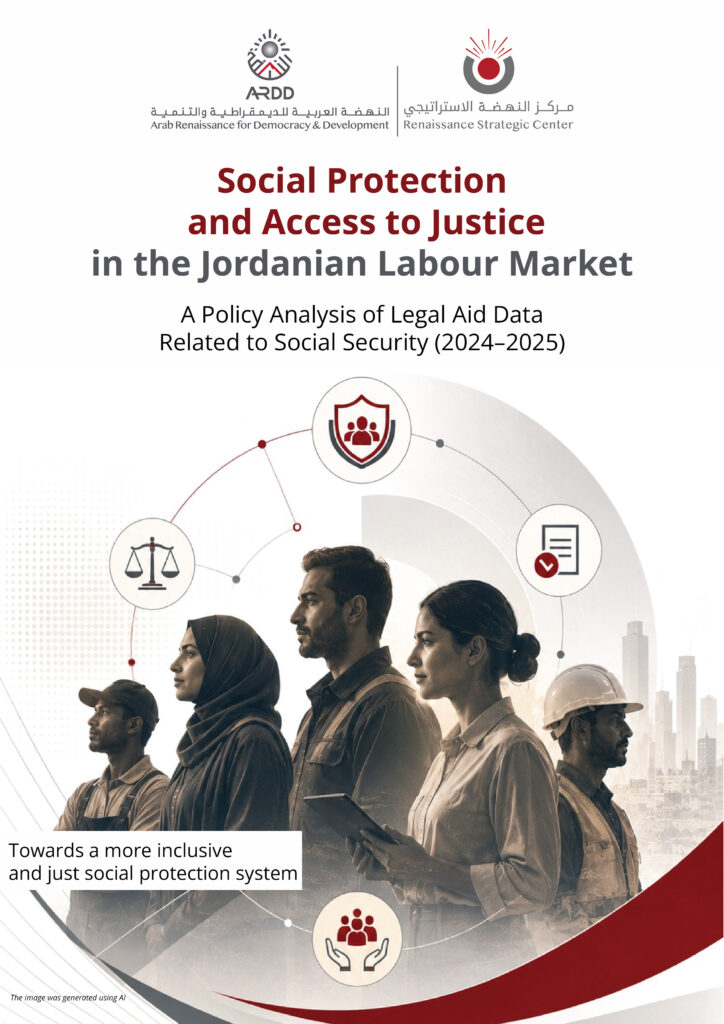
This paper draws on an analysis of labour and social security-related cases handled by the Arab
Renaissance for Democracy and Development (ARDD) through its Legal Aid Department during 2024 and
2025. The dataset comprises 1,156 labour cases distributed across 28 locations and involving 10 different
nationalities, providing a comprehensive picture of the obstacles workers face in accessing their rights and
social protection.