Klaas Jacob Willem Hogerbrugge, RSC Intern
Every year, World Maritime Day passes by largely unnoticed outside the shipping industry, a fitting irony, since maritime trade is the invisible infrastructure that moves the vast majority of goods that the world consumes. In 2026, this infrastructure became impossible to ignore. When the US went to war with Iran in February, Iran’s retaliation reached the Strait of Hormuz, one of the world’s most critical energy chokepoints. Daily ship crossings collapsed from roughly 130 to as few as eight, causing oil prices to spike by 65% within weeks.
For most of the world, that meant higher prices at the pump. For the Middle East, it meant something closer to an economic disaster, and for one country, an unplanned opportunity. Jordan’s Red Sea port of Aqaba has absorbed a surge of cargo once bound for Hormuz, and the numbers are compelling enough to question whether Jordan is being handed an opportunity to reshape its economy and political position in the region, or has merely received a wartime windfall it cannot hold onto. That is why this moment matters, and should matter to those who care how war reshapes trade, livelihoods and power far from the frontlines.
The Collapse of Hormuz
In 2025, approximately 25% of the world’s maritime trade in crude oil and petroleum products, including about 19% of LNG, transited through the Strait of Hormuz. Since the US and Israel started military actions against Iran on the 28th of February 2026, Iran has repeatedly threatened and carried out attacks on commercial shipping in the strait. This has caused the collapse of normal maritime traffic patterns. By early August only about 8-15 vessels were crossing the strait a day, compared to roughly 130 vessels before the war. The latest estimates of early September by Kpler have put daily traversals at an average of just 10 ships a day over a duration of 10 days. Brent prices had surged about 65% by the end of March 2026, in what the World Bank called “the largest oil market shock in history”. Prices eased slightly due to the temporary ceasefire in April, but then swung repeatedly with the fighting. As of 7 September the prices of Brent hover near $97 a barrel, and crude oil approaches $103 a barrel as of the 13th of September after Saudi Arabia shut its East-West pipeline following drone attacks. Due to the conflict oil prices have been incredibly volatile, they briefly fell back to pre-conflict levels after a fragile truce in June, before rising again. The conflict does not only affect oil and LNG trade, but also severely hampers the traversal of cargo ships whose destination is past the Strait of Hormuz.
Aqaba’s Rise
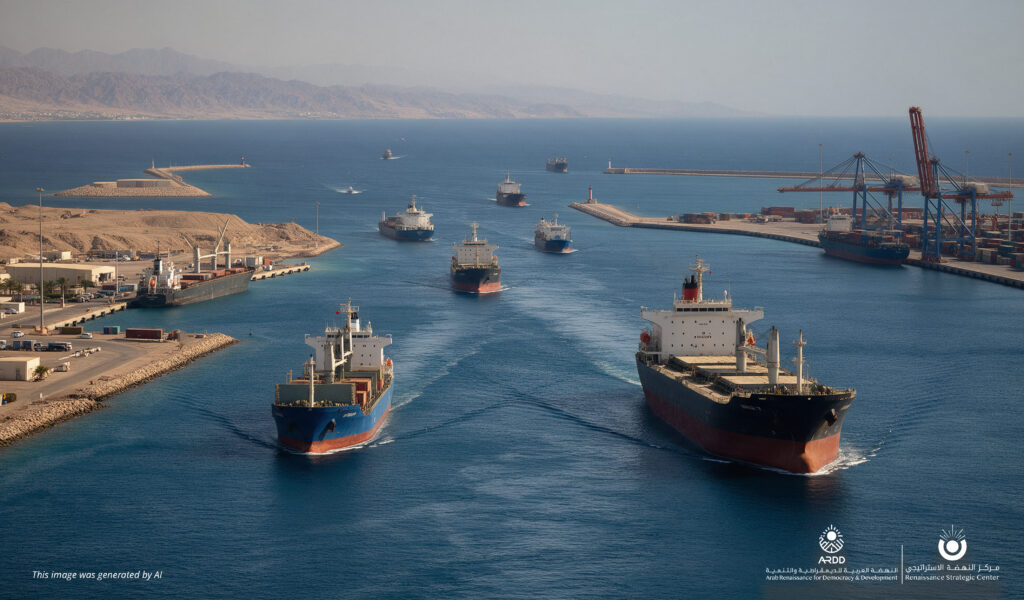
As ships avoid the Strait of Hormuz, cargo bound for Iraq and the wider Levant region is being rerouted through Jordan’s Red Sea port at Aqaba, entering by sea and continuing overland to their final destinations. Container arrivals were up 15.1% in January to February of 2026, transit container traffic was up 137% in the first quarter of 2026, and transit cargo up 155.1% in the first half of 2026. This is a clear accelerating pattern rather than a simple spike.
The infrastructure backing this trend suggests that this may be a more durable trend, rather than an emergency detour. Aqaba is already an established trade hub for Jordan, it handles 80% of their exports and 65% of its imports, and hosts the 1200km Arab Gas Pipeline connecting Egypt, Jordan, Syria, Lebanon and Israel. The rerouted cargo route is travelling through a port with existing critical national infrastructure and capacity, with room to grow.
In line with this, Jordan and Iraq are reviving an $18 billion pipeline plan linking Basra to Aqaba, which would allow Iraq to export crude oil while bypassing Hormuz entirely. A capital commitment of such magnitude is not a lightly made governmental decision. This is a sign that some in the region believe this to be a durable shift in the trade geography and not a wartime solution.
The Case for Caution
Although the trend shows Aqaba’s rerouting is growing at a steady pace, obstacles stand in the way of it becoming permanent. Shipping a container from East Asia to Aqaba jumped from $1500 at the start of the war to $6000, costs eased slightly during the April ceasefire but rose back to $6000 near the end of July. Due to unrest in the region Jordan is facing an uncertain future, “The chain of logistics across the region is in turmoil. We are facing a vague, even unknown future.”, one shipper in Aqaba said. Businesses in Aqaba have also argued that Iran’s strikes near the Red Sea appear to double as a message, an attempt to threaten investment and disrupt economic momentum, not just to hit military targets. Furthermore, the increase in shipping traffic has created bottlenecks at the port and land border crossing with Iraq, and shipping lines have layered on emergency conflict fees of roughly $2000 per 20-foot container and $4000 per 40-foot container.
These barriers provide a friction that could send shipping back through the Strait of Hormuz once conflict dies down. Nevertheless, the recovery of normal Hormuz traffic is unlikely to occur quickly: elevated insurance costs, lingering mines and ever present attack risks in the strait could prolong a temporary crisis workaround, giving Aqaba time to lock in long-term growth.
Jordan’s Underlying Momentum
Despite the war, Jordan’s national trade figures were already climbing before this rerouting. Exports were up approximately 10% in 2025, with the momentum carrying into Q1 of 2026, and the export-to-import coverage ratio improving to 57-60%. This shows that the Jordanian economy has become more self-sufficient and has kept its competitive edge even when regional logistics remain under pressure. Jordan is investing massively into its infrastructure, with the Aqaba Port Railway and the planned Amman-Aqaba High-Speed Train designed to lower operational costs and integrate the kingdom into a regional market worth $4 trillion. These are long-term investments that only make sense if Jordan believes that Aqaba can function as a new regional trade hub. Although Jordan has increasingly become a target of Iranian missiles, the Hashemite kingdom’s economy has become incredibly resilient against shocks, the rerouting of regional trade through Aqaba is an additional support to its growth.
The momentum is reinforced by deepening economic ties with Europe. Under the EU-Jordan Strategic and Comprehensive Partnership, Brussels has committed a €3 billion support package for 2025-2027. Roughly €1.4 billion of which is earmarked directly for investment and channelled through de-risking instruments aligned with the EU’s Global Gateway strategy, targeting water security, renewable energy, digital infrastructure and strategic minerals. The Chairman of the European Chamber of Commerce in Jordan, Mohammad Smadi, affirmed that holding the conference in Jordan sends a “clear” message of confidence in the kingdom as a reliable economic and political partner, and as a stable platform for investment and business in a region that is undergoing significant changes. Nevertheless, the fact that the conference was pushed back from its original spring date to the 19th of November because of the security situation is telling. It shows the war has slowed, but not derailed Jordan’s efforts to lock in long-term Western capital, which will only happen if investors believe in Jordan’s trajectory beyond the current conflict; this conference is a crucial turning point and will determine Jordan’s course for the years to come.
A Job Market Beyond Aqaba
Much of the coverage of Aqaba’s rise focuses on ports, ships and pipelines, but the more consequential effect may be on the Jordanian job market. According to the Jordan Phosphate Mines Company, the Aqaba Port Railway alone, a $2.3 billion project developed to move phosphate and potash to the port, is expected to generate around 5,000 jobs in the south. Aqaba’s ports recorded cargo-handling growth of 35-38% year-on-year at points during 2026, and Jordan’s transport ministry has pointed to this growth as a driver of direct employment opportunities in construction, logistics and services well beyond the port itself.
This matters because Jordan’s labour market has little room to absorb further strain. Unemployment stood at 16.1% overall in the first quarter of 2026, and reached 21.1% among Jordanians specifically, while youth unemployment stood at 38.9% in 2025, among the highest in the world. A trade corridor generating thousands of jobs in a chronically underemployed south may be the most direct channel through which the Hormuz crisis could translate into tangible benefits for Jordanian households.
Jordan’s Political Position
The economic perspective of this shift, however, is only half the story. The rise of Aqaba as a potential trade hub is especially compelling due to what increasing economic centrality means for Jordan’s political weight in the region.
Jordan’s position has always rested on three key pillars: its security cooperation with the US and Israel, the economic backing that cooperation attracts, and the domestic stability that backing helps sustain. The war hasn’t simply strained each of these pillars, it has tightened the interdependency such that growing pressure on one increasingly surfaces in the others. The kingdom has become more strategically indispensable than it has been at any point in recent history due to strategic location and partnerships. Aqaba’s rise as a trade corridor reinforces its strategic position: the more of the region’s commerce flows through Jordanian territory, the harder it becomes for outside powers to treat Jordan as a peripheral actor.
Greater strategic value has not, however, translated into great freedom of action. Due to the conflict, Jordan has simultaneously become more valuable and more vulnerable. It has become a frontline state that cannot walk away from the security role that makes it a target as stepping away would mean losing the protection and investment that Jordan currently profits from. Aqaba’s potential economic growth, then, cuts two ways: it strengthens Jordan’s hand as an indispensable transit and security partner, while doing nothing to resolve the underlying vulnerability that makes the kingdom a repeated target.
The tension that exists between having an opportunity to gain a central maritime hub, and the political consequences that come with it, is a crucial factor in Jordan’s future. A more economically resilient Jordan has more capacity to weather shocks and more leverage to negotiate more favourable terms with the partners that rely on it. Nevertheless, such a position in the region comes with risk as this conflict escalates. Additionally, resilience built on wartime rerouting is not the same as durable, autonomous development, and a state whose growing importance stems from its neighbours’ misfortune faces the question of how sustainable the growth ultimately is once the war ends.
Conclusion
The closing of the Strait of Hormuz has hit people across the world, but it has hit the Middle East hardest of all. Aqaba, a small Red Sea port, has been thrust into geopolitical relevance, with growing volumes of commercial shipping rerouted through it. On balance, the evidence points toward a durable shift rather than a purely temporary one. The growth trend has accelerated steadily rather than spiked and faded, and the scale of infrastructure investments being made is the kind of long-horizon commitment that only makes sense if planners expect Aqaba’s new role to outlast the war.
Aqaba, and therefore Jordan, has been handed a rare set of compounding opportunities: closer economic ties with the European Union, a plausible manner to lower unemployment, and a chance to politically reposition itself in an unstable region. What remains uncertain is not whether Aqaba’s importance will persist, but how Jordan converts that importance into lasting benefit rather than renewed vulnerability. On a World Maritime Day defined by a broken chokepoint, Jordan’s choice about how to build on its unplanned moment at the centre of regional trade may end up reshaping the region’s political map as much as its shipping lanes.
References:
Agnolucci, P., Makarenko, N., & Temaj, K. (2026, May 8). Strait of Hormuz disruption sends oil prices surging. World Bank Group. World Bank Blogs. https://blogs.worldbank.org/en/opendata/strait-of-hormuz-disruption-sends-oil-prices-surging
Baker, N. (2026a, March 13). Aqaba Port maintains stable operations despite higher fees. Logistics Middle East. https://www.logisticsmiddleeast.com/news/aqaba-port-maintains-stable-operations-despite-higher-fees
Baker, N. (2026b, September 1). Aqaba port emerges as alternative route to Hormuz. Logistics Middle East. https://www.logisticsmiddleeast.com/news/aqaba-port-emerges-as-alternative-route-to-hormuz
Hirschfeld, A. (2026, September 7). Oil prices surge as US-Iran strikes intensify in Strait of Hormuz. Al Jazeera. https://www.aljazeera.com/economy/2026/9/7/oil-prices-surge-as-us-iran-strikes-intensify-in-strait-of-hormuz
Jordan Times. (2026, May 31). Unemployment rate declines to 16.1% in Q1 2026 — DoS. The Jordan Times. https://jordantimes.com/news/local/unemployment-rate-declines-to-161-in-q1-2026-dos
Leask, H. (2026, June 29). Oil prices near pre-war levels — But persistent supply risks could spark a rebound, analysts warn. CNBC. https://www.cnbc.com/2026/06/29/strait-of-hormuz-shipping-iran-oil-war-us.html
Pasquali, V. (2026, September 14). Gulf investment gives Jordan vital support during war. Agbi.Com. https://www.agbi.com/analysis/economy/2026/09/gulf-investment-gives-jordan-vital-support-during-war/
Power, J. (2026, August 10). Oil prices climb as Iranian demands cloud outlook for Strait of Hormuz. Al Jazeera. https://www.aljazeera.com/economy/2026/8/10/oil-prices-climb-as-iranian-demands-cloud-outlook-for-strait-of-hormuz
Rahman, F. (2026, July 21). Why Port of Aqaba matters to Gulf energy and logistics. The National. https://www.thenationalnews.com/business/energy/2026/07/21/why-port-of-aqaba-matters-to-gulf-energy-and-logistics/
Ratner, M., Rosen, L. W., & Clayton, T. (2026, August 7). The Strait of Hormuz: Security Developments and Impacts on Oil, Gas, and Other Commodities. Congress.Gov. https://www.congress.gov/crs-product/R45281
The Jordan News Agency. (2026a). Jordan’s Trade Resilience Tested as Global Supply Chains Shift. The Jordan News Agency. https://petra.gov.jo/offiria/index.php/en/news/jordans-trade-resilience-tested-as-global-supply-chains-shift
The Jordan News Agency. (2026b, April 15). Aqaba port railway project to create 5,000 jobs in southern Jordan, JPMC chairman says. The Jordan News Agency. https://petra.gov.jo/en/news/aqaba-port-railway-project-to-create%C2%A05000-jobs-in-southern-jordan-jpmc-chairman-says
The Jordan News Agency. (2026c, May 14). Transport Minister Outlines Strategy to Position Jordan as Regional Logistics Hub. The Jordan News Agency. https://petra.gov.jo/bin/index.php/en/news/transport-minister-outlines-strategy-to-position-jordan-as-regional-logistics-hub
The Jordan News Agency. (2026d, May 19). Economic Forum Sees Strategic Opportunity for Jordan in Shifting Global Trade Routes. The Jordan News Agency. https://petra.gov.jo/en/news/economic-forum-sees-strategic-opportunity-for-jordan-in-shifting-global-trade-routes
The Jordan News Agency. (2026e, August 15). Jordan-EU Investment Conference 2026 a ‘key’ platform to launch partnerships, projects: EuroCham. The Jordan News Agency. https://petra.gov.jo/en/news/jordan-eu-investment-conference-2026-a-key-platform-to-launch-partnerships-projects-eurocham
The Jordan Times. (2026, June 12). Jordan: Aqaba ports record 38% growth in handled cargo volume. Zawya. https://www.zawya.com/en/business/transport-logistics/jordan-aqaba-ports-record-38-growth-in-handled-cargo-volume-333511
Trading Economics. (2026, September 13). Crude oil. Trading Economics Website. https://tradingeconomics.com/commodity/crude-oil
Vij, S. (2026, August 26). The Iran conflict makes Jordan more valuable and more vulnerable – ORF Middle East. ORF Middle East. https://orfme.org/expert-speak/the-iran-conflict-makes-jordan-more-valuable-and-more-vulnerable/
World Bank. (2025). Jordan Youth Unemployment Rate. Statistics of the World. https://statisticsoftheworld.com/country/jordan/youth-unemployment
Yacoub Oweis, K. (2026, July 24). Iran war casts shadow over Jordan’s economic hopes for Aqaba. The National. https://www.thenationalnews.com/news/mena/2026/07/24/aqaba-jordan-us-iran-war/
Yom, S. (2026, May 6). Jordan’s new security dilemma. Arab Reform Initiative. https://www.arab-reform.net/publication/jordans-new-security-dilemma/