In Jordan, women pursue education, graduate from universities, build skills and ambitions, and seek opportunities in the labor market. Yet the vast majority remain outside it. This is a paradox that deserves closer attention.
According to Jordan’s Labor Market Information System, women’s economic participation rate stood at only 14.8% in 2025, while 85.2% of women were economically inactive. Unemployment among Jordanian women reached 34.8% in the final quarter of the same year, compared with 17.2% among Jordanian men.
More strikingly, education alone does not appear to explain this gap. Data from Jordan’s Department of Statistics for the third quarter of 2025 show that 50.6% of women in the labor force hold a bachelor’s degree or higher.
The question, then, is: What is preventing qualified women from entering the labor market and staying in it?
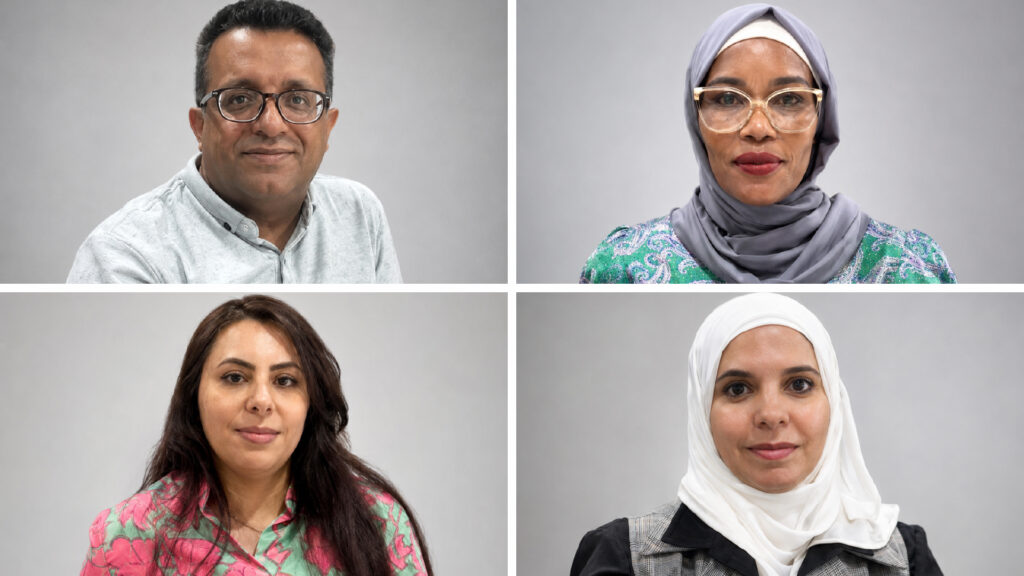
This question was at the heart of the perspectives shared by members of the Al-Nahda Women Network on women’s economic realities in Jordan and what needs to change.
Many Efforts, but Are They Making a Real Difference?
The message from participants in an opinion survey conducted by the Arab Renaissance for Democracy and Development (ARDD) was clear. Programs, initiatives, and efforts exist, but they remain insufficient in relation to the scale of the challenge.
93.8% of participants considered the current response to women’s economic challenges limited or inadequate. Half believed that efforts were moving in the right direction, but too slowly, while 43.8% said they had seen no tangible change.
The challenge is not only the number of programs, but also how well they connect with one another. 68.8% of participants considered coordination among relevant stakeholders insufficient or entirely inadequate.
A woman may receive training, but what happens if there is no job at the end of it? She may find employment, but what if her salary does not cover transportation and childcare? She may start a small business, but how can it grow or even survive if she cannot access finance or markets?
This is why 87.5% of participants viewed improving women’s economic situation as a shared responsibility, with government leading on policy and civil society, the private sector, and other stakeholders playing an active role.
Women Are Not Asking for Temporary Assistance, but for Opportunities That Last
One of the clearest messages from participants was that women need more than short-term programs. They need the ability to earn a sustainable income and achieve greater economic independence.
Decent and sustainable employment, support for businesses and entrepreneurship, better wages and working conditions, social protection, and affordable childcare therefore emerged as key priorities.
Care, for example, is not simply a family matter separate from the economy. When a mother cannot access safe and affordable childcare, her ability to accept a job or remain in employment becomes limited, regardless of her qualifications.
Jordan’s planned expansion of childcare services, including the establishment of 700 new facilities and the creation of around 1,000 jobs, therefore represents an important step if it is effectively linked to the needs of working women. The same applies to safe and affordable transportation, fair wages, contracts, insurance, and labor rights.
Not All Women Face the Same Reality
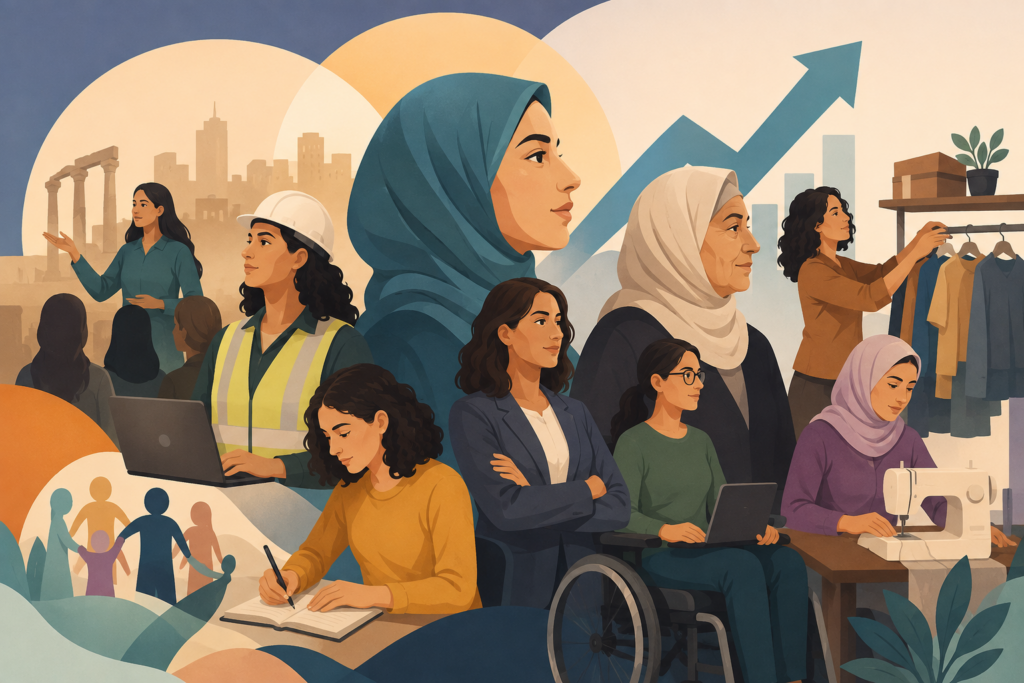
Women cannot be treated as a single group with identical needs.
Participants identified women who are the primary breadwinners for their families as the group most affected by economic challenges, at 93.75%, followed by women with disabilities at 68.8%, and women working in the informal sector at 56.25%. Half of participants also highlighted women seeking employment and those working for low wages or in insecure jobs.
This means that a one-size-fits-all approach will not be enough.
A woman supporting her family has different needs from a graduate looking for her first job. A woman working in the informal economy faces different barriers from a small business owner or a woman with a disability trying to access the labor market.
Meaningful empowerment begins by recognizing these differences and designing solutions around them.
The Digital Economy Opens a Door, but Does Not Guarantee Access
62.5% of participants also pointed to an opportunity that should not be overlooked. They saw digital transformation as having contributed, to some extent, to women’s economic empowerment.
Yet owning a smartphone or having access to the internet does not automatically mean being able to participate in the digital economy. Women need digital skills connected to real opportunities, as well as access to e-commerce, digital marketing, platforms, markets, and digital finance.
When these conditions are in place, technology can help women overcome barriers related to location, mobility, and market access. But when skills, opportunities, and resources are not equally accessible, technology itself risks creating a new divide.
No Solutions for Women Without Women
This is perhaps one of the most important messages raised by participants.
Women do not simply need programs designed for them. They need to be partners in shaping programs and policies from the outset.
Women themselves understand the everyday barriers most clearly, from transportation costs and care responsibilities to low wages, limited access to finance, poor working conditions, and training that does not match the jobs actually available.
Members of the Al-Nahda Women Network therefore call for a shift from treating women primarily as beneficiaries to recognizing them as partners in identifying problems, designing solutions, monitoring implementation, and evaluating results.
This also requires better data on the women facing the greatest barriers, so that resources can reach those areas where they can make the greatest difference.
From Fragmented Programs to a Real Ecosystem for Economic Empowerment
Jordan does not necessarily need more stand-alone initiatives. What it needs is to connect existing efforts within a coherent approach.
Employment is linked to wages. Wages are linked to transportation and care. Small businesses need finance and access to markets. Training should lead to real opportunities. And employment must come with social protection and rights that allow women to remain in the workforce.
The perspectives of Al-Nahda Women Network members point to a connected set of priorities: decent and sustainable employment, stronger social protection, support for women-led businesses and access to finance and markets, better wages and working conditions, more accessible childcare and transportation, and digital skills linked to labor-market opportunities, with greater attention to women facing heightened vulnerability.
Ultimately, perhaps the simplest way to measure the success of any economic program targeting women is to ask:
What happened to the woman after the program ended?
Did she find a job?
Was she able to stay in it?
Did her income become more stable?
Did she gain access to markets or finance?
Did she gain greater control over her economic decisions?
If these outcomes do not change, then a response may have been delivered, but meaningful empowerment has not yet been achieved.
The transition women need today is not simply from one program to another. It is a shift from temporary assistance to real and sustainable opportunities for employment, economic independence, and meaningful participation in shaping Jordan’s economic future.
About the Al-Nahda Women Network
The Al-Nahda Women Network operates under the umbrella of the Arab Renaissance for Democracy and Development (ARDD). It brings together women from diverse sectors and professional backgrounds to strengthen women’s leadership, exchange experiences, and create spaces for dialogue and collective action.
In this context, the Network surveyed its members on women’s economic conditions and needs in Jordan, with the aim of listening to their experiences and translating them into priorities for dialogue, advocacy, and action in the period ahead.
The survey findings provide important qualitative insights into participants’ perspectives and priorities. They are not intended to statistically represent all women in Jordan or all members of the Network.