Rooted in the Land: Resilience on Palestine Land Day
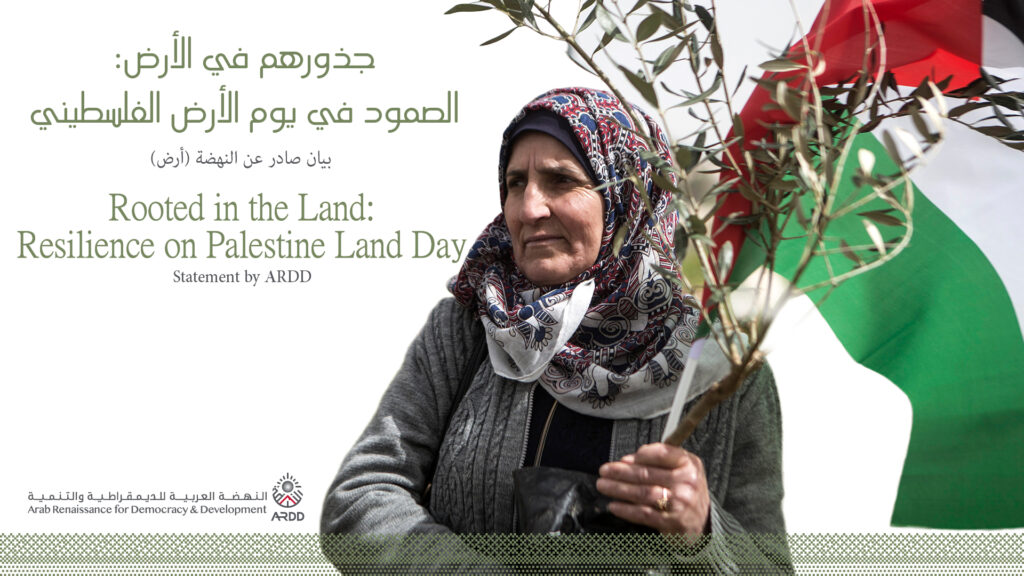
Statement by ARDD On 30 March, Palestinians everywhere commemorate Land Day: a defining moment in the history of Palestinian struggle, collective resistance, and attachment to the land. Land Day marks the events of 1976, when Palestinians inside historic Palestine rose against Israeli plans to confiscate thousands of dunums of Palestinian land in the Galilee. The protests, met with deadly force, resulted in the killing of six Palestinians, the injury of hundreds, and the arrest of many others. Since then, Land Day has become far more than an anniversary. It is a symbol of steadfastness, rootedness, and the enduring Palestinian refusal to be separated from the land. This year, again, Palestinians commemorate Land Day under especially devastating circumstances. In Gaza, Israel’s ongoing genocide has produced unprecedented destruction, mass killing, and starvation. Agricultural land has been destroyed, and water systems, electricity networks, schools, hospitals, and shelters have been systematically attacked. The destruction of land and the means of life is not incidental; it is central to a broader process of displacement and erasure. At the same time, in the occupied West Bank, Palestinians face escalating land confiscation, settlement expansion, settler violence, home demolitions, and forced displacement. Palestinian communities in villages, refugee camps, and cities are increasingly subjected to military raids, closures, arbitrary restrictions on movement, and attacks aimed at making life unlivable. Families are being forced from their homes in areas across the Jordan Valley, Masafer Yatta, Jerusalem, and elsewhere. Refugee camps in the northern West Bank, including Jenin and Tulkarm, have witnessed repeated incursions, destruction of infrastructure, and growing efforts to fragment and displace communities, with more than 60000 people being forced to leave their houses and villages. Control over land has always been inseparable from control over natural resources, particularly water. For decades, Israel has maintained a system of unequal access to water resources that privileges settlements while restricting Palestinian communities. These dynamics are part of a broader regional reality in which control over land, water, energy, and movement has become central to political power and inequality, and it is at the basis of the current war and land invasion in Lebanon. At a time when the wider region faces growing pressures related to climate change, environmental degradation, and resource scarcity, the systematic control of water and land resources as a systematic colonial practice imposed on Palestinians and throughout the whole region further deepens vulnerability and injustice. Land Day reminds us that the struggle over Palestine is not only about borders or territory. It is also about dignity, rights, resources, memory, and the ability of a people to remain on their land and shape their future. It is about opposing policies of annexation, fragmentation, dispossession, and forced transfer. It is about affirming that Palestinian life, presence, and belonging cannot be erased. Today, as Palestinians continue to endure genocide in Gaza, intensified annexation and displacement in the West Bank, and ongoing violations of their most basic rights, Land Day stands as a reminder of both the scale of injustice and the enduring strength of Palestinian resilience. ARDD reaffirms its solidarity with the Palestinian people everywhere, and calls for urgent international action to end the assault on Gaza, halt settlement expansion and forced displacement in the West Bank, protect Palestinian rights, and uphold the fundamental principles of justice, dignity, and self-determination. Palestinian attachment to the land has survived decades of occupation, colonization, and displacement. It remains unbroken. On this Land Day, we honor the sacrifices of those who came before, stand with those resilient today, and affirm that the Palestinian struggle for land, rights, and freedom continues.
From Lebanon to the Region: Preventing the Next Wave of Forced Displacement
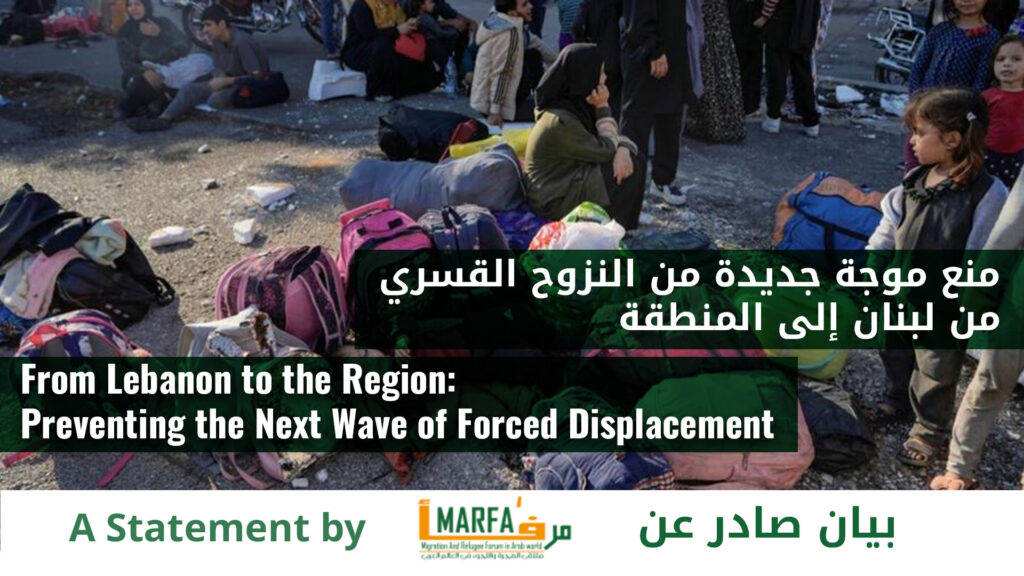
Statement by MARFA The region is running out of space and capacity to handle another displacement crisis. As violence escalates across Lebanon, the country is rapidly entering what could become one of the most significant displacement emergencies in the region in recent years. In just a matter of weeks, humanitarian and government sources estimate that between 700,000 and 740,000 people have already been forced to flee their homes, a staggering figure that continues to rise. Families are escaping bombardment and insecurity with little warning, seeking refuge in overcrowded shelters, schools, unfinished buildings, and temporary accommodations. Many lack access to basic services, protection, and livelihoods, while local infrastructure, already severely weakened, is struggling to absorb the shock. This crisis is unfolding at a moment when humanitarian resources are shrinking, and host communities across the region are already under severe strain. Countries that have carried the burden of successive refugee crises for more than a decade are now confronting new pressures while international funding for humanitarian response continues to decline. Simply put, the systems designed to respond to displacement are themselves under increasing stress. Lebanon itself has long been at the center of regional displacement dynamics. The country currently hosts around 1.7 million refugees, primarily from Syria and Palestine, making it one of the countries with the highest refugee-to-population ratios in the world. Years of economic collapse, political paralysis, and institutional fragility have already placed immense pressure on public services and host communities. The unfolding displacement in Lebanon must also be understood within a wider regional crisis. Across South-West Asia and North Africa, forced displacement has reached historic levels. In Sudan alone, the war that began in April 2023 has displaced more than 11.6 million people, while tens of millions across the region remain displaced or stateless as a result of protracted wars, occupations, and unresolved political conflicts. For many societies in the region, displacement is no longer an exceptional humanitarian event but a recurring structural condition. Each new conflict compounds existing vulnerabilities and places additional strain on countries that have already absorbed successive refugee crises with limited international support. The escalation in Lebanon, therefore, carries serious regional implications. Neighboring countries such as Jordan and Egypt, already facing significant economic and social pressures, could face renewed displacement flows at a time when global humanitarian funding is declining, and international commitment to refugee protection is weakening. MARFA stresses that displacement cannot be addressed solely through emergency relief. Forced displacement is not simply a humanitarian accident—it is the political outcome of unresolved conflicts, violations of international law, and the failure to protect civilian populations. Preventing a wider regional crisis requires: Immediate protection of civilians and strict adherence to international humanitarian law. Sustained support for host communities and national institutions managing displacement. A renewed international commitment to political solutions that address the root causes of conflict. Without decisive action, the region risks entering another prolonged cycle of mass displacement, one that will deepen instability, fragment societies, and further erode the prospects for a just and sustainable peace.
Women’s Day in a Burning Region No more slogans. Just one demand: stop destroying our world.
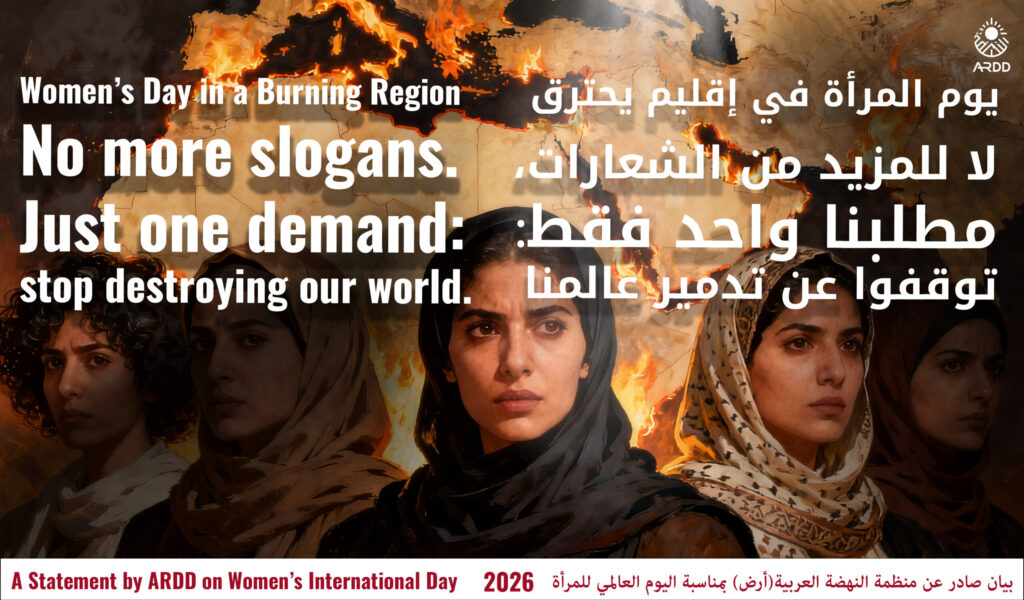
A Statement by ARDD on Women’s International Day 2026 Each year, Women’s International Day arrives with speeches, conferences, and renewed commitments to gender equality, justice, and the well-being of women. Yet for millions of women and girls in our region, this day has become a painful moment of confrontation with a reality that grows harsher year after year. Since the last Women’s International Day, tens of thousands of women and girls have lost their lives, with over 28,000 of them in Gaza alone. At the same time, more than 20 million people across the Arab world remain displaced, mostly women and children. Behind these numbers are stories of shattered families, interrupted education, and futures that have been violently cut short. Regionally, tragedies continue to remind us how fragile the protection of girls remains. In Iran, more than 150 schoolgirls were reportedly killed in a strike on their school, yet meaningful accountability has yet to follow. In Kuwait, an 11-year-old girl was killed when a rocket struck her home, another reminder that children continue to pay the highest price in conflicts they did not create. At the same time, the global public sphere remains dominated by men competing over power, territory, and resources. The daily news is filled with images of male leaders confronting one another, while the voices that have long called for peace, dialogue, and human security struggle to be heard. Women across societies have spent decades advocating for social protection, dignity, and equality. and sustainable peace, yet these priorities remain overshadowed by geopolitical rivalries. The failures are not limited to war zones. Scandals such as the Epstein files, which exposed powerful networks exploiting young girls, remind the world how deeply systems of power have failed to protect the most vulnerable, and how difficult it remains to secure justice for victims when power intersects with impunity. Meanwhile, the international system designed to protect human life appears increasingly unable to enforce accountability or stop wars. Communities across our region are consumed by daily crises—displacement, economic collapse, and insecurity, leaving little room to consider long-term commitments to equality and rights. In the Arab world, we are now losing even the modest progress made over decades in the women’s rights movement. For many of our societies today, International Women’s Day risks becoming a symbolic date disconnected from reality. When families are struggling to survive, when war and instability dominate daily life, these global observances begin to mean little to people whose primary concerns are safety, dignity, and the chance to live another day in peace. Therefore, on this Women’s International Day, the Arab Renaissance for Democracy and Development (ARDD) calls on the international community to move beyond merely renewing rhetorical commitments to women’s empowerment. Before any meaningful discussion of women’s rights can take place, the protection of human life itself must come first. Women’s rights cannot flourish in the midst of war. Equality cannot be realized in a world that tolerates impunity. And human dignity cannot endure while entire societies are being destroyed.
ARDD Strongly Condemns Israel’s Forced Demolition of UNRWA’s Jerusalem HQ and is Gravely Concerned that the Agency is Forced to Scale down Operations
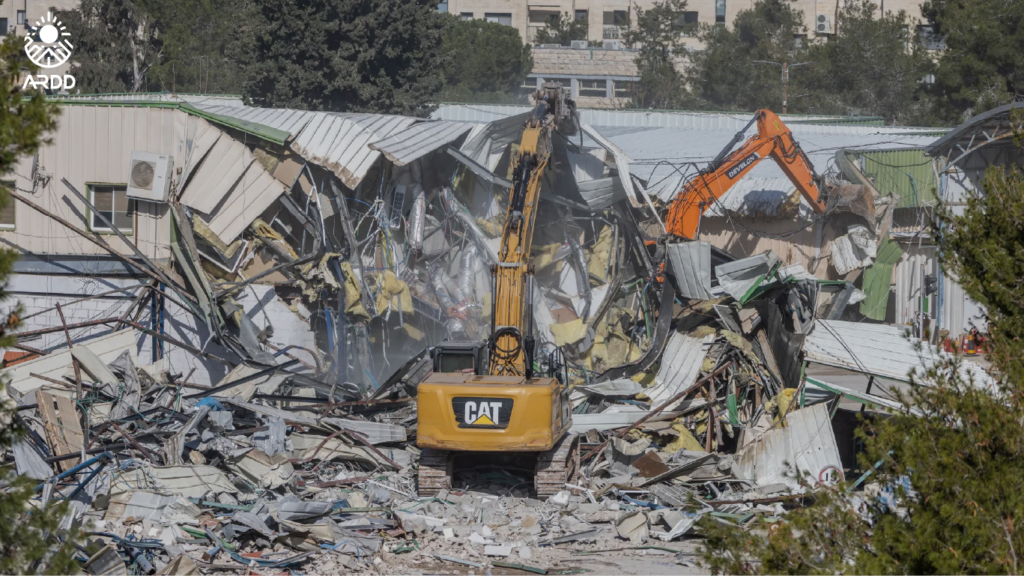
Israel started to demolish UNRWA’s headquarters in Jerusalem days after the agency’s leadership announced that, due to the unprecedented financial crisis it is facing, it is forced to reduce the opening hours of its schools and clinics to four days per week to avoid agency collapse. Israel’s anti-UNRWA campaign reached another level of open and deliberate defiance of international law on 20 January 2026 when the Israeli government started demolishing UNRWA’s headquarters in Jerusalem. The compound, which UNRWA has leased from the Government of Jordan since 1952, housed the agency’s offices through which it managed its operations in the West Bank, along with several huge warehouses, cold storage facilities, a vehicle repair workshop, and a petrol station. It is now being seized in blatant breach of international law. Israel’s latest attack on the agency has been widely condemned by Lazzarini as well as the UN Secretary General Guterres, the EU Foreign Affairs Chief Kallas, the EU Commissioner Lahbib, and others. It comes in the wake of other steps taken by Israeli authorities to erase the Palestinian refugee identity. On January 12, Israeli forces stormed into an UNRWA health centre in East Jerusalem and ordered it to close. Water, power supplies to UNRWA facilities – including health and education buildings – are also scheduled to be cut in the coming weeks. This is a direct result of legislation passed by the Israeli parliament in December, which stepped up existing anti-UNRWA laws adopted in 2024. Israel’s anti-UNRWA campaign has been contributing to the severe financial crisis, which has now prompted the agency’s management to reduce its staff budget by 20%. In a message to staff sent on January 14, 2026, UNRWA Commissioner-General Philippe Lazzarini states that he is “fully cognizant that this cost control measure compounds the extraordinary hardships of the past two years, but to allow the Agency to collapse would be even worse,” he writes. “I must stress that this is a measure of last resort, taken to preserve the Agency and its mandate. If adequate funding is received in the coming period to cover the Agency’s 2026 programme budget shortfall, senior management will review the decision. The dilemma at the heart of UNRWA’s financial crisis is that it has a mandate to provide public-like services to a vulnerable population, but no guaranteed source of income to finance these operations. Every three years, UN member states vote overwhelmingly to renew UNRWA’s mandate, but then do not provide the voluntary contributions necessary to carry it out. In other words, there is no direct correlation between political support for the mandate and financial support for the agency. According to Lazzarini, the financial crunch that the agency is facing at the start of 2026 is “fundamentally different from crises of past years.” In addition to the anti-UNRWA campaign by the Israeli government, he points to two other contributing factors that explain the severity of the current crisis: the suspension of funding by the United States and Sweden, which together accounted for nearly one-third of the programme budget, and the overall reductions in official development assistance during 2025. ARDD calls on the UN Secretary-General to refer Israel’s unprecedented violation of the 1946 Convention on the Privileges and Immunities of the United Nations to the International Court of Justice, as has been under consideration for some time. ARDD also urges the donor community, including Arab governments, to urgently increase their contributions to UNRWA to restore services and stabilize the agency.
Silence Is Complicity: A Call for Immediate Action to Stop the Atrocities in Al Fashir, Sudan
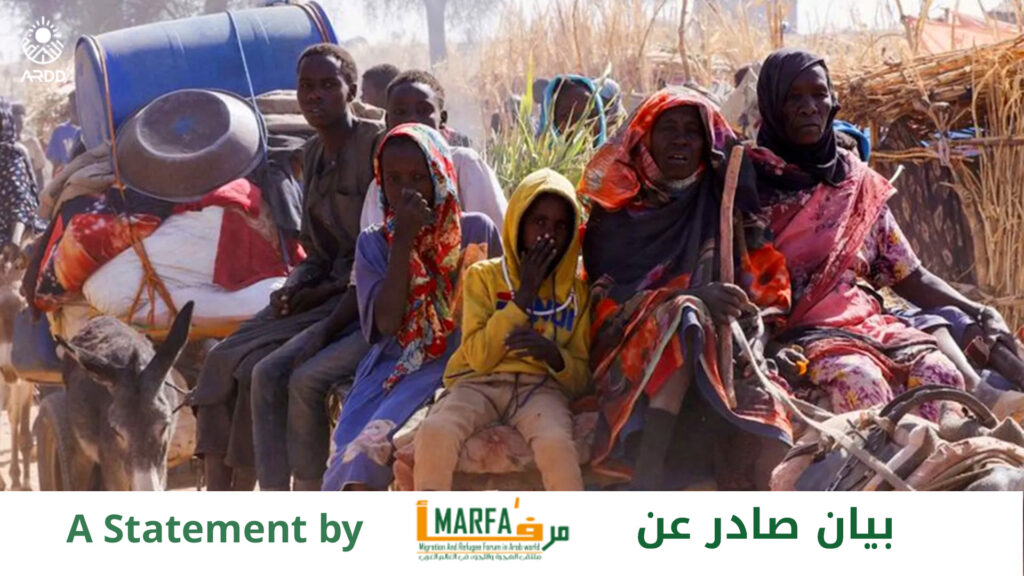
The Migration and Refugee Forum in the Arab World (MARFA) strongly condemns the ongoing atrocities unfolding in Al Fashir, North Darfur, Sudan. The recent seizure of the city by the Rapid Support Forces (RSF), following an 18-month siege, has plunged the region into a catastrophic humanitarian crisis, with scores of people killed in just a few days and many trying to seek safety in surrounding areas. The Office of the United Nations High Commissioner for Human Rights (OHCHR) reports alarming accounts of summary executions, mass killings, and serious violations occurring in the capital of North Darfur, leaving appalling humanitarian consequences. Eyewitness accounts and videos circulating on social media report brutal acts against civilians, including those seeking refuge in medical facilities, underscoring the urgency of the situation. Thousands are feared to be trapped in El Fasher, facing dire conditions exacerbated by acute shortages of food, water, and medical supplies. This takeover marks one of the most tragic episodes in Sudan’s ongoing conflict, reviving the systematic violence and ethnic cleansing reminiscent of past atrocities. The international community must recognize the gravity of this crisis in Darfur, as warnings of a further genocide in the Arab region loom larger. The region is already hosting over a million of Sudanese refugees who live in conditions of deep marginalization and neglect across neighboring countries, with extremely limited access to protection, services, or resettlement opportunities. This situation risks leaving entire communities further behind and stranded, compounding the human cost of a crisis that has already shown its dramatic impact on Sudanese society, its refugees and the whole region. It is imperative that we do not act indifferently to the unfolding horrors. Hence, we call upon the global community to act decisively to protect civilians in Al Fashir and across Sudan, provide humanitarian assistance, and push for a peaceful resolution to this crisis. The time for action is now; we cannot afford to remain silent in the face of such blatant violations of human rights. We urge all humanitarian organizations, civil society groups, and international NGOs to join our call for immediate intervention to: Prevent further ethnic cleansing episodes and acts of genocide. Guarantee protection for the civilian population. Facilitate the access of humanitarian aid and guarantee safe escape routes. Ensure that critical infrastructures, including healthcare facilities, are protected and operational. The continued suffering of the people of Sudan is a shame on humanity. We must collectively stand against the horrors of violence, displacement, and genocide, ensuring that history does not repeat itself. About MARFA: The Migration and Refugee Forum for the Arab World (MARFA) is an independent network of Arab academics, human rights activists, and lawyers that emerged in response to the dire need for a collective approach to championing the rights of migrants and refugees and raising awareness about related pressing issues in the region, including statelessness and the Arab diaspora.
Euro-MENA Initiative: Europe Must Match Recognition of Palestine with Action
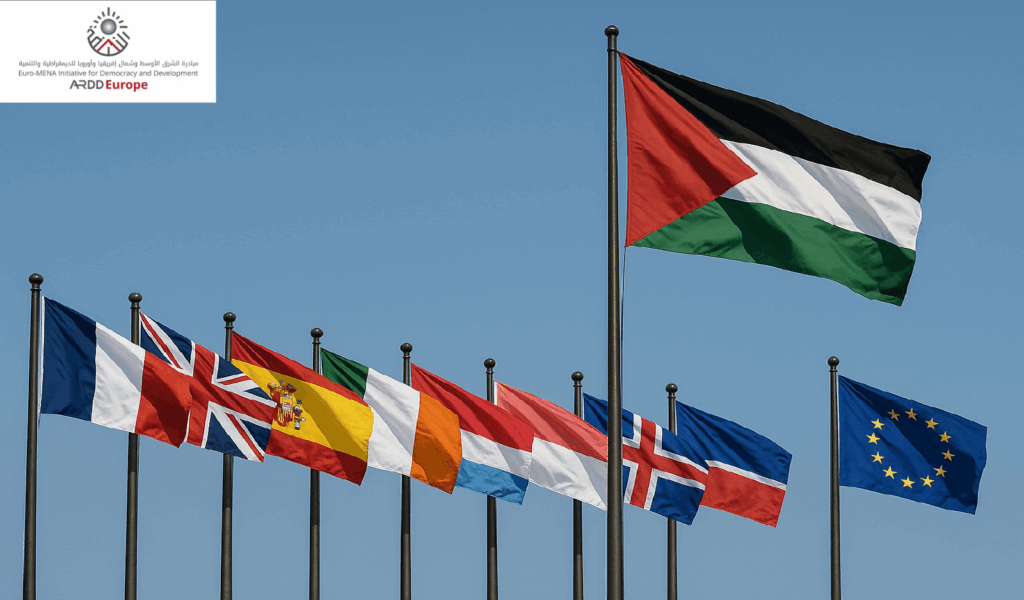
Recognition risks becoming a distraction if not acted upon. Symbolism cannot replace real measures, because a State on paper is meaningless while its people are being destroyed and its territory continually annexed. The Euro-MENA Initiative (ARDD Europe) warmly welcomes the growing number of European states that have taken the historic step of recognizing the State of Palestine. France, Belgium, Luxembourg, Malta, Andorra, Monaco, and Portugal have now joined Sweden, Ireland, Spain, Norway, and Slovenia in affirming Palestine’s statehood, alongside the United Kingdom, Canada, and Australia. With these recognitions, Europe is no longer a bystander: it is becoming a decisive arena in the struggle to translate recognition into justice, accountability, and self-determination for the Palestinian people In welcoming these steps, ARDD Europe also affirms that recognition must be a policy, not a posture: it carries concrete third-state obligations and must be paired with steps that protect civilians, end unlawful practices, contribute to justice and accountability, and uphold international law more generally. Yet here lies the central tension: Europe is moving, but the European Union as a whole is not. While a growing number of states recognize Palestine, others, including Germany, Italy, the Netherlands, and Hungary, continue to hold back, leaving the Union divided at a decisive moment. This hesitation reflects a broader pattern: the EU as an institution has too often been reactive rather than principled, responding to the genocidal assault on Gaza and the relentless expansion of settlements in the West Bank with late condemnations and short-term humanitarian appeals. Since October 2023, Gaza has been subjected to ethnic cleansing and destruction on a catastrophic scale. The ICJ’s provisional measures in South Africa v. Israel (26 January, 28 March, 24 May 2024) confirmed a plausible risk of genocide and imposed binding obligations on all states. The International Criminal Court’s arrest warrants (November 2024) reinforced the principle that accountability cannot be deferred. European publics, courts, and parliaments have pressed their governments to act. However, like recognition now, these steps will be meaningful only if they are elevated to the EU level, transforming isolated actions into a coherent European policy of justice and accountability. On settlements, despite clear legal rulings by the World’s highest court, the EU has delayed decisive measures. It has failed to adopt a coordinated arms embargo, to enforce a ban on settlement goods and investments, and to give full effect to the ICJ’s advisory opinion of 19 July 2024 and the acceptance thereof by the vast majority of the UN General Assembly in September 2024, which obliges states not to recognize or assist Israel’s unlawful annexation of Palestinian territory and its various other international wrongful acts. The EU has yet to ban settlement trade, suspend the EU–Israel Association Agreement, or halt arms and technology transfers that entrench annexation. This gap between recognition and responsibility undermines Europe’s credibility and weakens the force of its words. For Europe, and the European Union, recognition of Palestine at this moment of the worst genocide of the 21st century is a test of whether states are willing to act in defense of the principles they proclaim: the universality of human rights, the rule of law, and the rejection of impunity. If matched by policy, embargoes, sanctions, and other accountability measures, and genuine support for Palestinian governance, Europe can help shift the balance toward justice. If not, Europe’s role on the world stage made fade into oblivion. The Euro-MENA Initiative for Democracy and Development represents a forward-thinking strategic framework aimed at deepening understanding and fostering cooperation between Europe and the Middle East and North Africa (MENA). It addresses pressing regional and global challenges in the context of rapid societal and geopolitical transformations. Established in 2024 in Brussels, Belgium, by the Arab Renaissance for Democracy and Development (ARDD), the initiative aspires to build strategic partnerships that drive stability, prosperity, and sustainable development across these interconnected regions.
Statement in Support of the United Nations Special Rapporteur on the situation of human rights in the occupied Palestinian territories
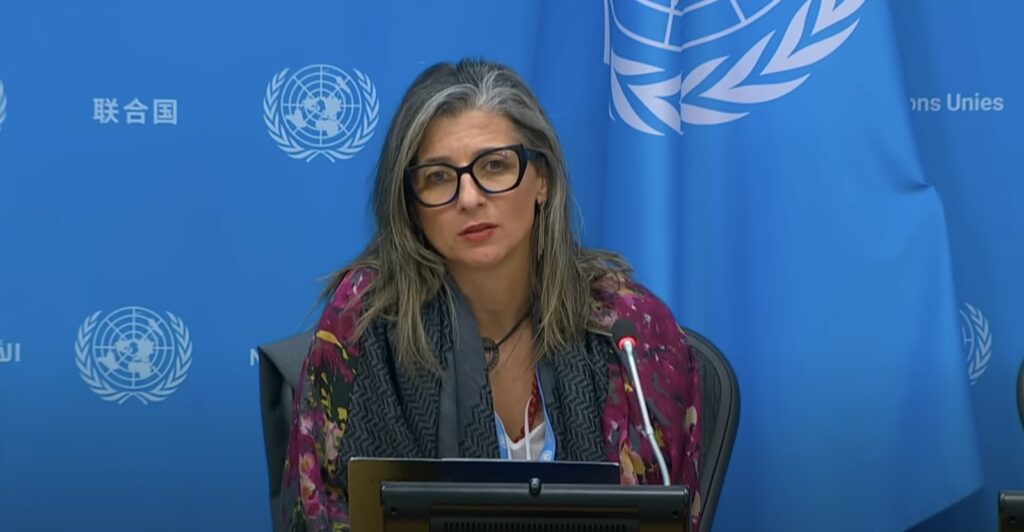
The Global Network on the Question of Palestine (GNQP) condemns in the strongest possible terms the 9 July 2025 sanctions imposed by the United States against Francesca Albanese, the United Nations Special Rapporteur on the situation of human rights in the Palestinian territories occupied since 1967. These sanctions are politically motivated and legally indefensible. They represent a direct threat to the integrity and independence of international human rights mechanisms. The timing of these sanctions is especially alarming. They were announced soon after Francesca Albanese published her report to the Human Rights Council, in which she analyses and documents corporate complicity throughout Israel’s genocide in Gaza. This is an apparent breach of international law, including by 60 named corporations profiting from the ongoing genocide. In keeping with her mandate, Ms. Albanese formally recommended that the ICC investigate and possibly prosecute such complicit corporate actors. The system of Special Procedures is a central component of the United Nations human rights system within which Special Rapporteurs play an indispensable role. In 1999, the International Court of Justice held that UN Special Rapporteurs are to be considered “experts on missions for the United Nations”, within the definition provided by section 22 of the 1946 Convention on the Privileges and Immunities. As such, they are entitled to the Convention’s privileges and immunities, including immunity from “legal process of every kind” for statements and actions carried out in the exercise of their functions. In 2011, the Human Rights Council adopted HCR/Res/16/21 (Document Viewer), which: reaffirmed the obligation of States to “cooperate with and assist special procedures in the performance of their tasks” (para. 23); noted that the “integrity and independence of the special procedures and the principles of cooperation, transparency and accountability are integral to ensuring a robust system of the special procedures that would enhance the capacity of the Council to address human rights situations on the ground.” (para. 24) Cooperation by States is imperative for Special Rapporteurs to implement their mandates without fearing retaliatory and diversionary moves by governments whose actions they have criticised. Furthermore, States must refrain from mobilising and encouraging others to criticise and incite action against Special Rapporteurs. As a condition of membership, all 193 UN member states have agreed to respect international law, the UN Charter, and to protect UN personnel in their course of discharging their formal duties. An added responsibility exists for the over 150 states, including the United States, the United Kingdom, France, and Germany, that are parties to the Convention on the Prevention and Punishment of the Crime of Genocide. Ms. Albanese has been sanctioned for upholding most effectively the responsibilities entrusted to her by the Human Rights Council, which has recently reaffirmed its confidence in her by extending her mandate for a second three-year term. The justifications for the sanctions lack all merit in international law besides containing errors of fact and demonstrably false allegations demeaning of the person and reputation of Ms. Albanese. These sanctions violate international legal norms and threaten the well-established rules of functional immunity that protect UN experts from reprisals while carrying out their official duties, in particular immunity from “legal process of every kind” under section 22(b) of the 1946 Convention on the Privileges and Immunities. Such measures against Ms. Albanese as Special Rapporteur may constitute an unlawful act of extraterritorial coercion, for which the U.S. should itself be held internationally accountable. The attack on Ms. Albanese follows the February 2025 imposition of U.S. sanctions against the International Criminal Court’s Chief Prosecutor and four of its judges. These actions exhibit an unacceptable pattern of disregard for international law and established international procedures and institutions. The ICC measures are designed to protect victims of human rights abuses and should be respected by Israel and United States even though they are not parties to the Rome Statute that provides a legal framework for ICC operations. Rather than abide by their obligations and engage with the extremely significant conclusions and related recommendations of the Special Rapporteur’s latest report, the US has resorted to reprisals which it has effectively admitted are motivated by prioritizing its economic and political strategic interests over its obligations under international law. This unilateral action is part of a broader effort to weaken and control the UN and other international accountability and reporting mechanisms that seek to protect vulnerable populations and uphold justice, including when they contravene strategic interests. The United States’ sanctions seem deliberately designed to undermine the essential work of Special Rapporteurs in highlighting the flagrant, severe, and prolonged crimes committed by Israel against Palestinians in Gaza as well as well as to shield complicit states and corporations from all forms of accountability. In effect, these actors facilitate the commission of the most serious of international crimes, not only by funding and supplying the perpetrator, Israel, but also by their visible and back-channel efforts to discredit and dilute efforts to expose such international crimes and recommend punitive responses. As the International Court of Justice’s findings have made clear, stopping such crimes engages the legal responsibility of all states, not just those accused of perpetrating the crime. Special Rapporteur Ms. Albanese has been a highly praised mandate holder in what is perhaps the most controversial position within the Special Procedures framework of the Human Rights Council. She has carried out her difficult role in a thoroughly professional manner, celebrated worldwide as an influential and expert advocate of human rights for decades, particularly on behalf of those most victimized. Prior to becoming Special Rapporteur, she worked for a decade as a human rights expert for the United Nations, including in the Office of the High Commissioner for Human Rights and with the Relief and Work Agency for Palestine Refugees. Her record bears eloquent witness to her exceptional competence, experience, and integrity under fire, undoubted factors in her selection as Special Rapporteur for this ultra-sensitive position by the Human Rights Council. Unwarranted attacks on and punitive actions directed at a Special Rapporteur that appear motivated by the geopolitical interests of states are unacceptable
War Breeds Refugees: A Region on the Brink of Mass Displacement
A Statement by MARFA On World Refugee Day
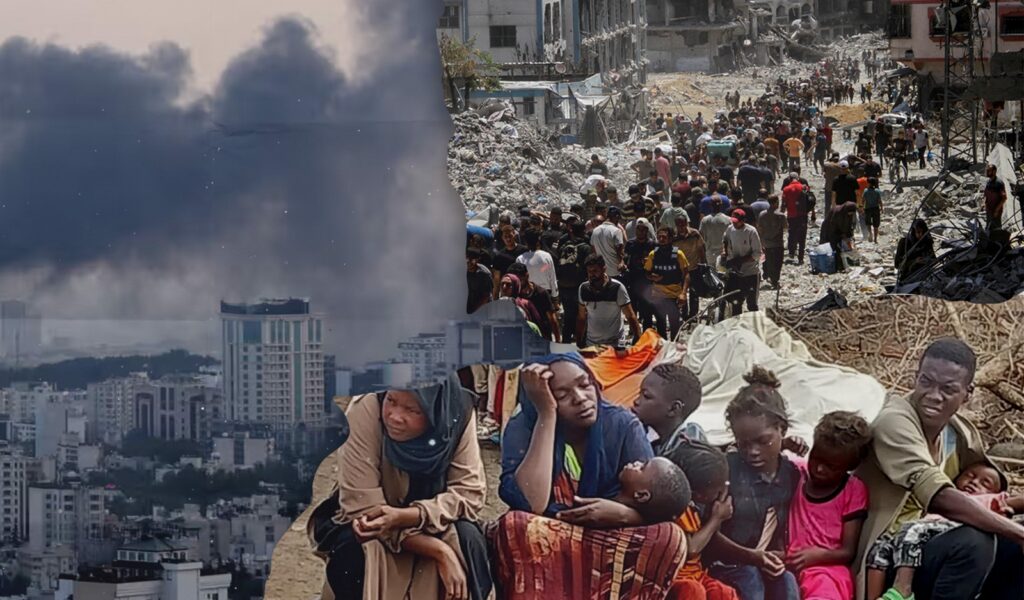
This World Refugee Day comes at a time of grave escalation and deepening danger. As the region teeters on the edge of yet another catastrophic conflict, this time between Iran and Israel, the threat of mass displacement looms larger than ever. The drums of war are not only echoing through Gaza, Lebanon, and Syria, but also shaking the very foundations of neighboring states and faraway nations. With each missile launched and each border crossed by violence, the number of refugees is destined to surge. Let there be no mistake: wars create refugees, and we are now standing on the verge of an era-defining humanitarian crisis. The Migration and Refugee Forum for the Arab World (MARFA) issues an urgent call to action. As conflicts ignite and compound across the Arab region, the already staggering numbers of forcibly displaced persons are set to rise, pushed not only by bombs and bullets but by the collapse of political solutions, the erosion of international protection frameworks, and the continued failure of global powers to uphold justice. From the relentless bombardment of Gaza to the fragmentation of Sudan, from the smoldering frontlines in Yemen and Syria to the intensifying pressure in Lebanon and Jordan, the region is at a breaking point. Communities that have borne the weight of refugee protection for years, with dwindling resources and vanishing support, are now being asked to brace for yet another wave of displacement, this time on a potentially unprecedented scale. The violence currently unfolding is not an isolated flare-up. It is the result of decades of impunity, geopolitical manipulation, and disregard for human life. The targeting of civilians, the weaponization of siege, and the slow annihilation of entire populations, most visibly in Gaza, have become normalized, while accountability remains absent. As threats escalate between Iran and Israel, a regional war could unleash new, large-scale displacement that will overwhelm fragile states, destabilize neighboring societies, and send shockwaves across the Mediterranean and beyond. Let us be clear: the international community is not just failing to respond, it is complicit in the conditions producing this displacement. Refugees are not an accidental byproduct of conflict, they are the human face of failed diplomacy, ignored warnings, and abandoned peace. Despite this bleak reality, it is local communities (families, neighbors, schools, clinics) who continue to shoulder the burden of dignity and protection. Their solidarity is heroic, but it is not infinite. They are not substitutes for international action. Nor should they be left to manage the fallout of wars they did not start, or crises they did not create. MARFA calls for immediate and decisive measures. Stop the wars. Protect civilians. End forced displacement. Provide host communities with the tools, funding, and political backing they need, not just to survive the next influx, but to build just, inclusive futures. This means real investment in infrastructure, legal protections, and social cohesion. It also means dismantling the structures of occupation, exclusion, and violence that are at the root of displacement. On this World Refugee Day, we refuse to speak in neutral terms. This is not a time for reflection, it is a time for alarm. The risk of a new regional war, with mass refugee flows stretching from the Middle East to North Africa and Europe is real, and it is imminent. We urge governments, international institutions, civil society, and concerned individuals: Act now. Speak out. Invest in peace, not just aid. Treat displacement not as a symptom, but as a warning. Refugees are not crises to be managed, they are lives to be protected. And their protection begins with political will. The future of the people of the region and of a shared global humanity, depends on what we choose to do in this moment.
Urgent Appeal to the World: End Israel’s Reckless Wars and Ensure Accountability for its Crimes
A Statement by ARDD
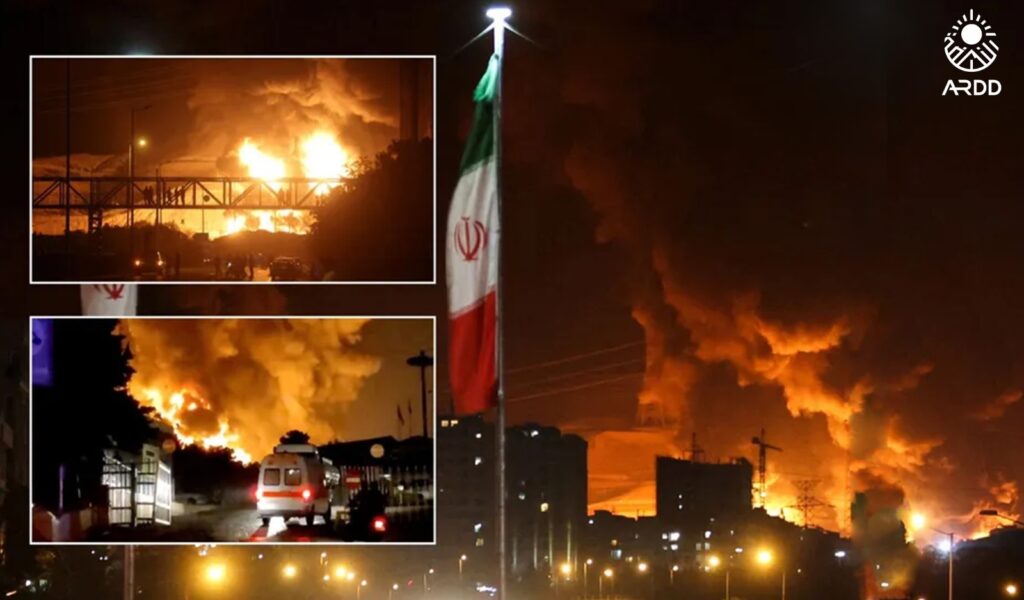
The international community should immediately pull Israel back from its ongoing campaign of starvation and elimination in Gaza and its unprovoked aggression against Iran, and take all measures necessary, individually and collectively, in line with international law and the Charter of the United Nations, to ensure compliance by Israel with its international obligations. The ongoing Israeli military campaigns against the Gaza Strip, the West Bank, Lebanon, Syria and Yemen were expanded dramatically, last Friday, with an unprovoked assault on Iran constituting an act of aggression in fragrant violation of the UN Charter. Not only does this add a sixth’ theater of war, inflicting unprecedented death and destruction on the Iranian people, Israel’s latest onslaught also served to deflect attention away from the ongoing genocide on the Palestinian population in Gaza and the ever more aggressive attacks on the West Bank. Only hours before initiating its attack on Iran, on June 12th, the UN General Assembly adopted resolution A/ES-10/L.34 with an overwhelming majority of 149 Member States in favour, 12 against and 19 abstentions. The resolution, entitled Protection of civilians and upholding legal and humanitarian obligations, not only reiterates earlier demands for an immediate, unconditional and permanent ceasefire, but also demands the unconditional release not only of the hostages held by Hamas and other groups but also of those “arbitrarily detained”, a reference to the thousands detained by Israel without charge. The resolution strongly condemns “any use of starvation of civilians as a method of warfare and the unlawful denial of humanitarian access”. Critically, the resolution “Stresses the need for accountability in order to ensure Israel’s respect of international law obligations, and in this regard calls upon all Member States to individually and collectively take all measures necessary, in line with international law and the Charter of the United Nations, to ensure compliance by Israel with its obligations.” Although the resolution as such is not binding, this call for accountability is grounded in peremptory norms of international laws that create binding obligations for all Member States. Except for Hungary voting against, and the Czeck Republic, Romania and Slovakia abstaining, all EU Member States voted for the resolution, signifying the strongest European commitment to date towards holding Israel accountable for the wide range of atrocity crimes it perpetrated against the Palestinian People. Against this backdrop, the expressions of support by leaders of many of the same European States for Israel’s unprovoked aggression against the Islamic Republic of Iran, in flagrant violation of the UN Charter, stand in stark contrast. Their stand is not just legally and morally indefensible, but outright dangerous as it might serve as encouragement to other states to join the war as is reportedly under consideration.
The Nakba Never Ended: History Repeats Itself, Justice is Denied, and the World is Silent
A Statement by ARDD
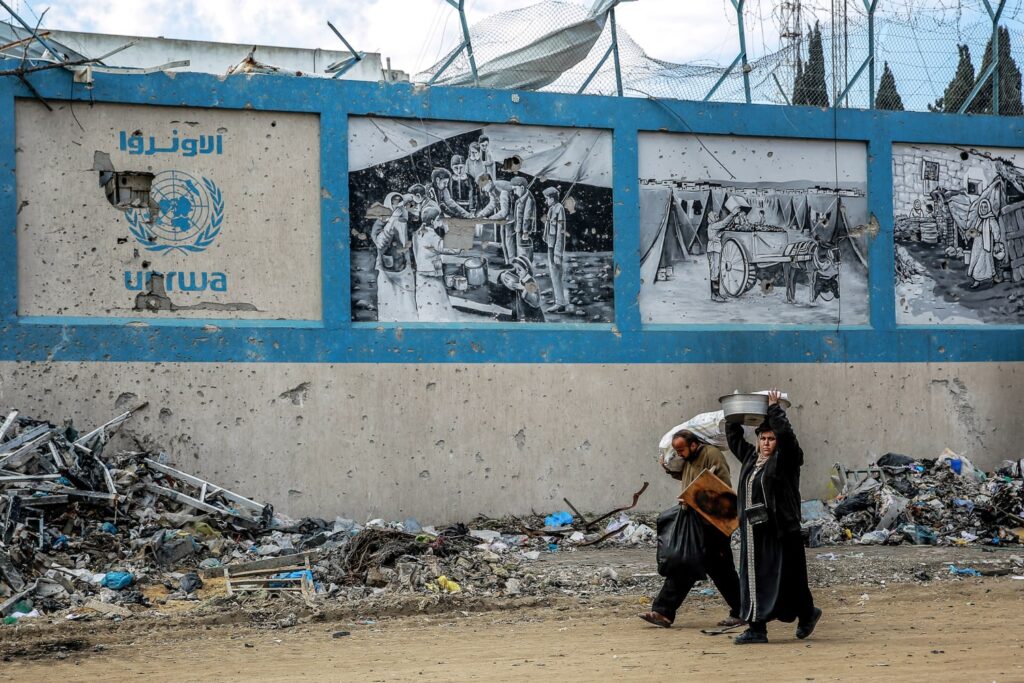
It is at this darkest hour that we commemorate the Nakba and pay tribute to its victims, not only those of 1948 but to all those who perished as a result of the ongoing Nakba up to the current Genocide in Gaza and atrocities in the West Bank (and Lebanon). We salute the steadfast survivors of the Nakba, in Gaza, in Al Quds, in the West Bank, and wherever they are – including the millions of Palestinian refugees and the tens of thousands languishing in Israeli prisons. We greet the 30,000 predominantly Palestinian UNRWA employees and other humanitarian workers, many of whom have risked their lives to support their compatriots under the most difficult circumstances. We extend solidarity to our sisters and brothers in the Palestinian solidarity movement around the world who, increasingly subject to persecution for the mere fact of speaking out against the genocide, continue to fight for justice and Palestinian liberation. This year’s commemoration of Nakba Day, the 77th anniversary of the ethnic cleansing of historic Palestine, takes place at a time when a large part of the population of Gaza is starving. The vast majority of children under two and breastfeeding mothers are not receiving adequate nutrition. Hospitals have run out of blood, the UN and other humanitarian agencies have exhausted their reserves, while Israel is attempting to dismantle the existing UN-run aid distribution system. Deaths from famine are already occurring and are expected to rise sharply if conditions persist. The ongoing famine is the result of Israel’s latest blockade preventing the entry of food, water, fuel, medicine, electricity, and other life-saving supplies following its unilateral decision to end the ceasefire with Hamas on 2 March 2025. Israel feels emboldened to use starvation as a weapon of war by the acquiescence and the silence of most political leaders in the West and elsewhere, in defiance of both the International Court of Justice and the International Criminal Court. This manufactured famine is part of Israel’s ongoing genocidal war in Gaza that has been raging for the past 19 months. In the process, it has killed at least 53,000 Palestinians, with many more feared dead under the rubble, injured tens of thousands, destroyed most of the Strip’s housing stock and public infrastructure, and to a large extent succeeded in inflicting conditions of life that will lead to the further destruction of its population. Over the same period, there has been a dramatic escalation of Israeli military and settler violence in the West Bank, resulting in an unprecedented spike in forced displacement. As another alarming escalation, the Israeli cabinet has decided to assume complete authority over land registration in Area C of the West Bank — which constitutes approximately 60% of the occupied territory and houses the majority of illegal Israeli settlements. This move paves the way for the formal annexation of the area and further entrenches Israel’s settler-colonial project, undermining the possibility of a viable Palestinian state. A key element of the war and violence since 7 October 2023 has been Israel’s attacks on UNRWA. Israel has had a conflictual relationship with UNRWA almost since the start of the Israeli occupation in 1967, even though the agency was initially encouraged by the Israeli government to continue its operations in the Gaza Strip and the West Bank. After a gradual increase in Israeli attacks on the agency over the years, the current Israeli government appears to have adopted a policy towards dismantling UNRWA, not just in the OPT but across the board. Israel has justified its attacks on UNRWA with reference to either antisemitism or terrorism, but its real objective appears to be the wholesale erasure of the issue of Palestinian refugees as part of its settler colonial endeavor. The recent legislation adopted by the Israeli parliament represents a critical escalation in that process, with the ban expected to have wide-ranging legal, political, institutional, humanitarian, financial, and other implications. The exact implications of this ban are still unclear, and UNRWA continues to operate. Beyond the operational and humanitarian implications in the occupied Palestinian territory, the Israeli attacks on UNRWA at large, with the help of Israel supporters in the US, threaten the very survival of the agency. We call on the world to break the silence and on every person of conscience to do what is in their power to put an end to the ongoing Nakba in all its manifestations: by speaking up and exposing falsehoods, by using the law to fight injustice, by demonstrating, by educating, by engaging political representatives and others with influence on their governments, or by simply bearing witness. Together, we can make a difference.