End the Suffering, End the Killing, Stop the Genocide
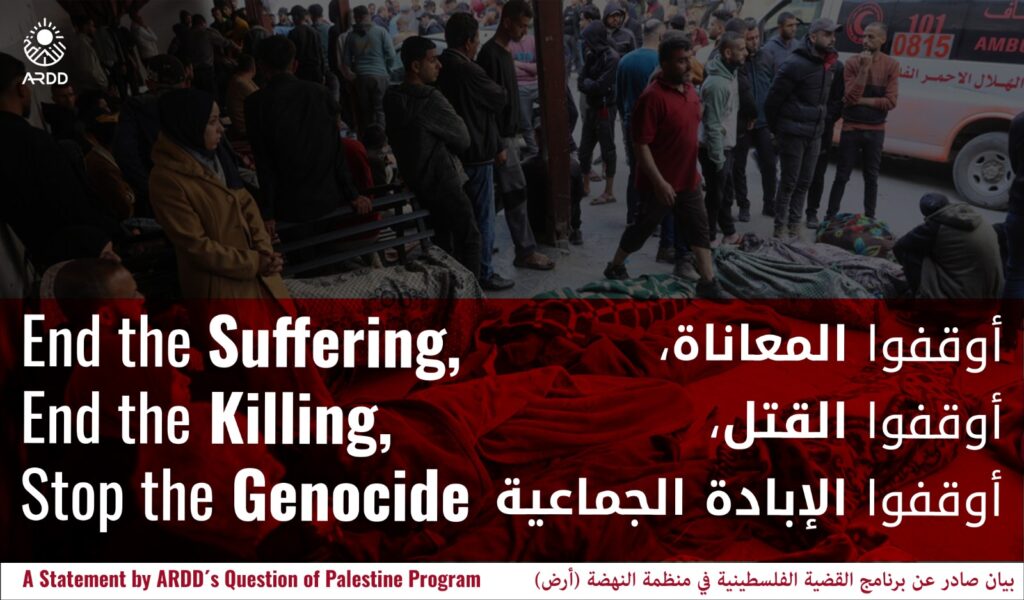
We unequivocally condemn the resumption of indiscriminate bombing and attacks against Gaza, on the night of Monday 17th March 2025, which has killed at least 410 Palestinians and injured over 500 in the span of one night only–with most of the casualties reaching hospitals being reportedly children. This represents Israel’s umpteenth refusal to abide by the ceasefire terms and underscores its commitment to the systematic destruction of Palestine and its people. Since the ceasefire agreement came into effect on January 19, 2025, the colonization authority has persistently violated its terms. In less than two months, it has killed more than 100 Palestinians in Gaza and restricted the entry of humanitarian aid and reconstruction materials. For the past 16 days, it has completely sealed off the flow of food, fuel, medical supplies, and other essential aid. This caused food prices to soar, community kitchens to shut down, and disease and starvation to spread at an alarming rate against the Palestinian people who had already endured 15 months of genocide. Meanwhile, the colonization authority has launched “Operation Iron Wall” against the West Bank, with a particular focus on the northern area. Refugee camps in Jenin, Tulkarem, and Nablus have borne the brunt of this annihilatory campaign, facing large-scale aerial bombardments, tank invasions, the destruction of vital infrastructure, and ongoing evacuation orders. Hundreds of Palestinians have been abducted by Israeli forces, exceeding the number of those released in agreed-upon prisoner exchanges. Through these tactics, Israel has extended its 17-month-long genocide: the war on the Palestinian people never ended—it only changed forms. The war on Palestine’s existence has been ongoing for over 100 years. At the core of this settler-colonial campaign of erasure is Palestinian refugeehood and the inalienable right of over 10 million Palestinians to return to their 611 villages and towns. This right existentially challenges Israel’s colonial reality, built on destruction and displacement. We reaffirm that the Palestinian people’s land rights are non-negotiable and that their right to self-determination must be upheld. No investor, development project, or real estate deal should override the will of the Palestinian people, their inalienable right to return and to remain as sovereign on their land. We call on the international community to rescind its expansionist ambitions and to take concrete steps to remedy its long-lasting injustice against Palestine. Specifically, we demand: An immediate two-way arms embargo on Israel: the continued arms sales and diplomatic cover provided by Western allies embolden Israel’s criminality against Palestinian Indigenous sovereignty. A shift from empty words of condemnation to concretely end complicity with Israel’s genocide: worldwide governments must recognize that colonization is not diplomacy and genocide is not security. The mobilization of global solidarity and popular pressure to isolate Israel economically, politically, and diplomatically. Grassroots solidarity movements are essential to ensure the Palestinian liberation struggle, return and justice is supported by meaningful action.
On the Edge: Urgent Action Needed to Safeguard Jordan’s Humanitarian and Development Workforce and Services
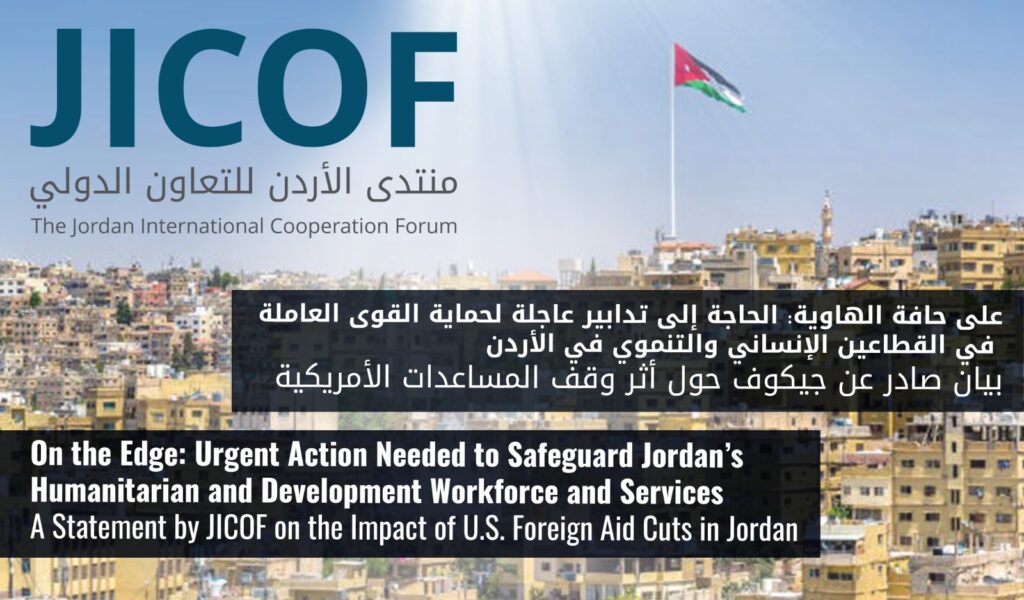
A Statement by JICOF* on the Impact of U.S. Foreign Aid Cuts in Jordan Jordan’s humanitarian and development sector is on the brink of a new crisis. The abrupt suspension of U.S. foreign aid has triggered a wave of mass layoffs, stripping livelihoods from hundreds and threatening the survival of thousands more. Already, 576 individuals have been laid off, with national estimates projecting at least 3,200 job losses by the end of 2025. The consequences extend far beyond job losses. Over 500,000 vulnerable individuals—including Jordanians, Syrian refugees, and other marginalized communities—are now at risk of losing access to essential services. 450,000 children face the collapse of their literacy and numeracy programs. 12,000 individuals with disabilities are left without vital services such as speech therapy and physiotherapy. 10,000 Syrians have already lost access to medical consultations, while 900 patients battling life-threatening Non-Communicable Diseases (NCDs) have been cut off from critical treatment. The economic ripple effect extends further beyond the immediate job losses and service disruptions. $8,759,457 in INGO funding is now frozen, affecting local businesses that provided training venues, IT services, printing, consulting, insurance, auditing, and other support functions. Families of terminated employees are struggling and facing financial instability, while essential humanitarian operations in Jordan are left in limbo. Women-led organizations are particularly impacted, with critical programs for women and girls being disrupted. So far, 2,500 women and girls with open case management for gender-based violence, along with 1,000 more affected by similar initiatives, are now left without support due to the termination of two major projects. The Jordan International Cooperation Forum (JICOF) recognizes and deeply appreciates the invaluable contributions of humanitarian and development professionals who have dedicated their careers to crisis response, poverty alleviation, and the advancement of Jordanian society. Their expertise and commitment have been instrumental in shaping Jordan’s development landscape. However, as they now face an uncertain future, we must take immediate and coordinated action to support them and safeguard their contributions to the country. Immediate Steps Are Essential This sudden shift has shaken Jordan’s aid sector, but it also presents an opportunity. A highly skilled, dedicated, and creative workforce is now available—one that should not be lost but rather integrated into Jordan’s economy. Now is the time for collective action to ensure that these professionals continue to contribute to Jordan’s development, whether through government institutions, the private sector, or alternative funding mechanisms. JICOF calls for immediate, coordinated action to address the challenges facing Jordan’s humanitarian sector: We urge the banking sector and government institutions to introduce temporary measures, such as freezing or reducing personal loan payments, to help affected individuals regain financial stability. We call on the Ministry of Labor to establish a dedicated database to connect laid-off professionals with open positions in the labor market, offering career coaching and skills matching to facilitate their transition into the private sector. The private sector should actively integrate these highly skilled professionals, leveraging their expertise in project management, humanitarian response, and development initiatives. We ask the Ministry of Planning and International Cooperation to seek alternative funding sources to resume critical projects left incomplete due to USAID funding cuts. The ministry should map and review all affected projects, prioritize their necessity, and mobilize regional and international partnerships to ensure their continuation. We call for joint efforts by the Ministry of Planning and International Cooperation (MoPIC), donors, the Ministry of Labor (MoLA) and civil society organizations to develop solutions to funding gaps, explore alternative sources of funding and coordinate actions that prioritize the protection of jobs and the continuation of critical humanitarian and development programs. We urge the Ministry of Foreign Affairs and the Ministry of Labor to engage with U.S. authorities to seek employment rights and potential compensation for staff terminated from USAID-funded projects. JICOF stands in solidarity with all those affected and remains committed to advocating for sustainable solutions that protect Jordan’s development gains. *The Jordan International Cooperation Forum (JICOF) Founded in 2022 by the Jordan National NGO Forum (JONAF), the Jordan INGO Forum (JIF), Donor’s civil society working group chair (US and Netherland) in Jordan, JICOF is a one-of-a-kind platform that brings together members of local civil society, INGOs, international institutions, and the donor community. JICOF fosters knowledge-sharing, strategic coordination, and open dialogue to maximize the impact of collective efforts in supporting Jordan’s long-term stability and socioeconomic progress.
UNRWA’s ban and the intensification of settler-colonial erasure
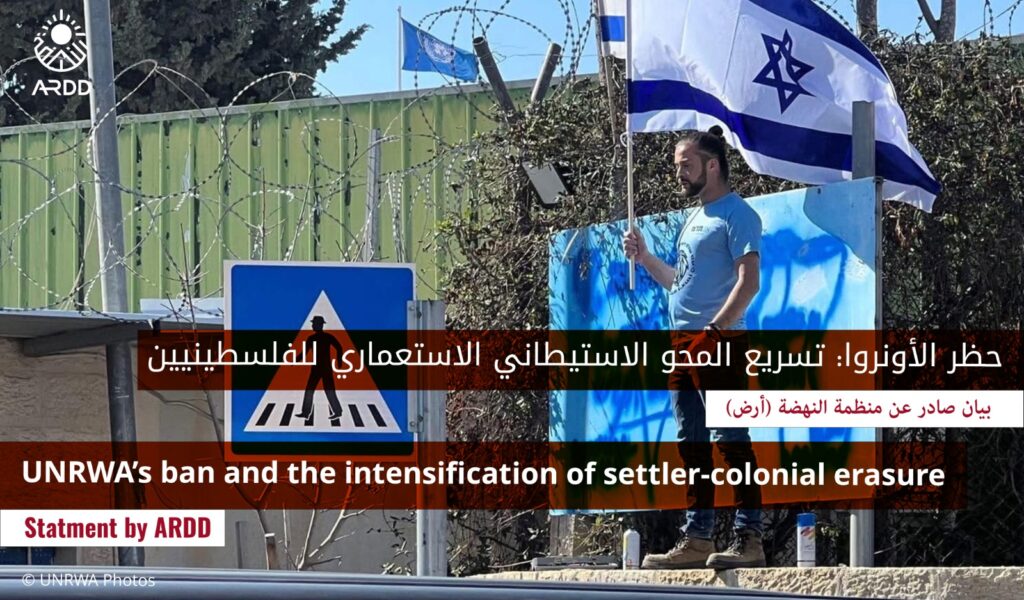
On Thursday, January 30th Israel’s ban on the United Nations Relief and Works Agency (UNRWA) took effect, prohibiting its services in east Jerusalem and severely impacting the agency’s operations in Gaza and the remainder of the West Bank. ARDD strongly condemns the implementation of the ban and warns against Israel’s intensification of settler-colonial erasure of Palestine. Part and parcel of the continuation of the historic and ongoing Nakba inflicted on the Palestinian people, the UNRWA ban underscores the urgency and necessity to address the root-causes of the settler-colonization of Palestine. The ban sees the implementation of the two bills that the Israeli Knesset passed in October: the first prohibits the agency from operating within the 1948 borders. The second bars Israeli officials from engaging with UNRWA in any capacity. For the 2.1 million Palestinians in Gaza, now cautiously breathing the absence of bombs amidst a man-poisoned environment, the ban will further obstruct the restoration of life through healing from nights spent beneath skies ablaze with fire and days suspended between slow and quick death in dwindling food rations. As the Agency is the backbone of large-scale humanitarian operations and distribution in Gaza, its dismantlement will cripple efforts to rebuild the warmth of homes and the safety of life-sustaining infrastructure that Israel’s annihilatory force has reduced to rubble. For the 1.1 million Palestinian UNRWA refugees in the West Bank and Jerusalem, the implementation of the ban will result in a marked acceleration in the deterioration of the conditions of life imposed by colonization. Forty-nine-thousand students will be forced out of UNRWA schools, and will be left either without education or, in Jerusalem, to the whims of Israeli curricula that distort, dehumanize and erase their history and culture. The denial of medical care to almost a million Palestinians undergoing treatment–adults and children alike– coupled with the loss of thousands of jobs will drive Palestinians into further economic precarity, dismantling family livelihoods, deepening the cycle of de-development, and ultimately eroding the native community’s ability to regenerate itself. While the humanitarian consequences are set to be catastrophic, the Israeli attempt to dismantle UNRWA is very much a political maneuver: it aims at undermining the Palestinian people’s inalienable right of return to their homeland and weakening their collective identity and right to self-determination. The status of Palestinian refugees and their collective and individual right of return are undeniable realities rooted in the ongoing settler-colonial project—an enduring injustice that remains unaddressed at its core. While this status and right do not, and cannot, depend solely on registration with UNRWA or any other international agency for legal recognition, it is clear that Israel’s, with international complicity, effort to dismantle UNRWA goes beyond targeting its role as a relief agency. It also seeks to eliminate an institutional space that could advance Palestinian refugees’ political claims within the UN framework. The UNRWA ban comes into effect as colonial violence has shifted to the West Bank, where colonization forces have launched a sweeping military campaign across Jenin, Tulkarem, and Tubas. This campaign mirrors the genocidal tactics used in Gaza, though at a different pace, employing airstrikes, sieges, destruction of vital infrastructure, mass arrests and detentions, and large-scale evacuation orders. As UNRWA international staff has been evacuated from the West Bank, including eastern Jerusalem, ARDD commends the resilience of UNRWA’s Palestinian and remaining international staff who have pledged to continue operating albeit the imminent threats posed by the colonial army. We stress that UNRWA’s historical mandate to advance the Palestinian right of return and its humanitarian role and aid capacity across the region is irreplaceable, and must be supported until all the Palestinian refugees –whether registered or not registered with the Agency– will be able to return to their original 1,193 towns and villages. Until then, we urge the international community to take concrete steps towards this end. In particular, we call on UN member states to: increase financial and political support to UNRWA; take effective political, diplomatic, and economic countermeasures against Israel, with a two-way arms embargo being the obvious highest priority; submit statements in support of UNRWA to the International Court of Justice in the framework of the advisory proceedings on the obligation of Israel in relation to the presence and activities of the United Nations initiated by Norway.
What Numbers Will Never Capture: Gaza Deep Wounds and Enduring Hope in Palestine

ARDD welcomes the beginning of a ceasefire in Gaza as a glimmer of hope in a sea of wrath. This ceasefire, if implemented, represents a necessary step towards the freedom of Palestine and the dismantling of colonial oppression. What numbers will never be able to capture is the profound human experience and the intergenerational trauma borne by those who will live: the grief over the irreplaceable breaths extinguished, shattered limbs, the warmth of homes turned to ash, the children’s smiles stolen forever, and the relentless cycles of uprooting that have deepened the severance of Palestinians from their homeland. Fifteen months of sleepless nights in makeshift tents, with the pitch-black darkness pierced only by bombs’ flames and screams, and the incessant hum of combat drones dictating the rhythm of days and seasons, have vaporized memories and dreams, and suspended life between quick and slow death. The ceasefire offers a long-overdue reprieve—a vital space to mourn the smiles forever lost to colonial violence, and to grieve for the shattered homes and life plans painstakingly built for their children, families, and future. It finally grants Palestinians the opportunity to process, seek out missing loved ones, bury them with dignity, and honor the countless precious moments shared with those who have been brutely taken away. For the imprisoned, it promises a return to the light of day, a life unguarded by jailers, free from roll calls, and the torment of sleep deprivation, starvation, and torture. The Palestinian prisoners will once again taste freedom—embracing the fresh air and the long-awaited touch of their loved ones. Beyond all else, the ceasefire is the first step to rebuilding, renewing strength, and continuing the unwavering struggle toward a free Palestine. In nearly 500 days, the colonization authority has ravaged the 365 square kilometers of Palestine, waging a calculated campaign to obliterate Palestinian existence in Gaza. Fifteen months of relentless bombardment and shelling have created an unquantifiable magnitude of casualties: colonial forces have killed between 47,000 to at least 389,000 Palestinians and wounded–mostly with life-changing injuries– between 110,012 and 221,760. A labyrinth of chaotic, contradictory orders has ensnared the entire population of Gaza, trapping them beneath relentless bombardment and forced displacement. This unfolded amidst a man-made famine, fuelled by Israel’s escalation of its 16-year-long blockade and deliberate attacks on UNRWA’s facilities and mandate. This onslaught has targeted every facet of life in Gaza, from civil servants and doctors to media workers, children, women, and men, fathers, mothers, and grandparents, as well as engineers, teachers and professors, artists, and students, with entire families wiped out of history’s record. Painfully reminiscent of the Nakba, every place that held the records of lives, the remnants, and the deep-rooted traces of Palestinian heritage has been deliberately reduced to rubble. The wholesale destruction has reached 92% of homes, 88% of educational facilities including all universities, and decimated 80% of commercial facilities, 68% of road networks, 68% of cropland, 52% of agricultural wells, and 44% of greenhouses, 72% of fishing fleet destroyed, all healthcare facilities leaving only 50% of hospitals partially functional, while 95% of the kettle has been killed. Meanwhile, a sweeping campaign of mass arrests has seized at least 4,000 Palestinians from Gaza, consigning them to lethal torture chambers—many of whose fates remain shrouded in uncertainty. As colonial officials relentlessly reaffirm their grim pledges, those who escaped death or arbitrary detention find themselves in a poisoned environment unfit for life. They are surrounded by over 40 million tons of debris, including unexploded ordnance and human remains, 140 temporary waste sites, and 340,000 tons of waste, with untreated wastewater and overflowing sewage choking what little remains of their homeland. ARDD salutes the steadfast Palestinians in Gaza, who have defied the goals of their colonizer: Gaza has not been cleansed of her Indigenous inhabitants, it has not been taken over and capsized to welcome foreign settlers, and the Palestinian cause has not been erased by the agenda of popular movements and the international community but continues to inspire Indigenous struggles worldwide. The terms of the ceasefire serve as a testament to the growing fragility of colonial oppression, and the vulnerability of systems of dispossession and apartheid worldwide. However, we must not revert to the untenable status quo of October 6, 2023. For over 76 years, Palestine has been subjected to a relentless, creeping colonial occupation that has systematically disenfranchised her people and denied their right to return to their homeland. The colonial authority has been increasingly besieging Gaza since 1948, with at least 12 major offensives waged against it until 2023, compounded by suffocating bureaucratic, economic, physical, and digital barriers erected throughout the 1990s, 2005, and 2007. Therefore, ARDD calls on the international community to take immediate and concrete actions to address the root causes of this long-lasting injustice. Specifically, we demand: The full implementation of the ceasefire that enters into force today, ensuring its terms are respected without delay and permanently. The pursuit of accountability for international crimes, including genocide and crimes against humanity, committed by Israel and complicit powers. Implementing boycotts, divestments, and sanctions (BDS) campaigns to end colonial occupation, apartheid, and genocide in line with international law and UN resolutions. The commitment to sustain the Palestinian people in their efforts to rebuild Gaza. The return of all Palestinians outside of Palestine, whose inalienable right of return has remained in abeyance for far too long. The release of all 10,400 Palestinian political prisoners, with guarantees of non-re-imprisonment, and the bodies of all martyrs. The autonomous unity of governance of Gaza with the rest of Palestine according to the will and wishes of Palestinians. These actions are not only essential to upholding the ceasefire but also to ensure that peace in Palestine premised on the presence of justice and not the mere absence of violence is realized. The ceasefire is just a step towards the realization of Palestinians’ right to live freely beyond survival without the constant fear of death and displacement hanging on their heads, to have independent control over their political
Israel’s UNRWA Ban: Undermining the Right of Return and Reinforcing Settler-Colonial Erasure

On 28 October 2024, the Israeli Knesset passed two bills aimed at banning the operations and functions of the United Nations Relief and Works Agency for Palestine Refugees (UNRWA) across all occupied Palestine. The Global Network of Experts on the Question of Palestine (GNQP) strongly condemns the adoption of this legislation. It marks a further significant stage in Israel’s institutionalized settler-colonial-erasure of Palestine and Palestinians. The two laws are the culmination of decades of Israeli attacks seeking to dismantle the Agency. They effectively terminate UNRWA’s essential services across all of Palestine and cut contact with the Israeli occupation authorities. For the 2.2 million Palestinians in Gaza, this will result in a further sharp decline in the conditions already created by Israel’s well-documented genocidal actions. For the 1.1 million Palestinian refugees in the West Bank and eastern Jerusalem, these laws will result in a marked acceleration in the deterioration of the conditions of life that they are already facing. For both groups, the threat is existential. Obstructing UNRWA across all occupied Palestine is designed to advance Israel’s genocidal goal of the destruction of the Palestinian people. The enactment of these laws coincides with Israel’s current intensified assault on Gaza. Following a year of unchecked genocide, northern Gaza has endured a heightened siege for 30 days that has increased the already grave deliberate food shortage that is starving the population. Relentless bombardments have resulted in multiple massacres, killing hundreds, wounding thousands, many suffering life-changing injuries, and leaving an unknown number dying under the rubble. These attacks have rendered all hospitals inoperative. Simultaneously, Israel has intensified its operations in the rest of occupied Palestine, where escalating levels of violence have become a daily reality, ranging from forced displacement, lethal military incursions, and settler attacks to extensive mass detention and torture, destruction of homes and property, and denial of food production. It is relevant that Israel’s actions in Lebanon are mirroring practices deployed in Gaza: in the last month, over 2,300 civilians have been killed, 1.9 million have been displaced, and hospitals, journalists, and healthcare workers have been systematically targeted. The creation of the State of Israel between 1947 and 1949 resulted in the Nakba, the crystallization of a systematized project of ethnic cleansing and annihilation of the Palestinian people that resulted in massacres as well as the forced expulsion of 750,000 Palestinians into permanent exile. UNRWA was established in 1949 by the United Nations General Assembly (UNGA) and mandated to deliver humanitarian assistance and protect Palestinian rights until a ‘just resolution of the question of Palestine refugees’ is achieved. Palestinian refugees have an inalienable right to return to their homeland. Reaffirmed annually since UNGA Resolution 194 in 1948, Israel has persistently denied the right of return to the 750,000 Palestinians it forcibly displaced during the Nakba, along with their descendants, who now exceed 9 million Palestinian refugees coerced to live outside their homeland. Preventing the exercise of this right has been a central objective of Israel’s attacks against UNRWA, as it represents a fundamental challenge to Israel’s illegal aims. This is especially so in Gaza, where 80% of Palestinians are refugees with legally justified claims to their homes and lands in Palestine, inside the so-called “Green Line”. Israel’s ban on UNRWA is thus part of Israel’s settler-colonial project to create “Greater Israel”, extending its control over all of historic Palestine and beyond, while erasing Palestinian Indigenous presence. UNRWA remains the sole organization equipped to provide essential humanitarian aid and relief to Palestinians, especially in Gaza, during this critical juncture in Palestine’s history of colonial dispossession. At the same time, a just solution to the ongoing eruption of genocidal violence requires addressing the root causes of the disenfranchisement of Palestinians: Israel’s settler-colonial occupation. It is necessary to move beyond treating Palestine as a humanitarian crisis to be managed in perpetuity. The international community must reckon with the colonial legacy that enabled Israel’s establishment as a settler colony in 1948 and has emboldened its expansion until today. This could not have happened without the unlimited political, military and financial outside support that has given Israel effective immunity from the consequences of its unlawful actions. The new legislation breaches Article 105 of the UN Charter, the Convention on the Privileges and Immunities of the United Nations, and UN Security Council resolution 2730 of May 2024 on the protection of humanitarian and UN personnel. Moreover, it defies the International Court of Justice’s ruling on the unlawfulness of Israel’s presence in Gaza and the West Bank, including eastern Jerusalem, and the subsequent UN General Assembly’s resolution calling for the withdrawal of Israel from these areas by September 2025. By adopting these laws, Israel violated the provisional measures issued by the International Court of Justice in South Africa v. Israel, which urged Israel to cease all its actions that create conditions of life calculated to bring about the destruction of the protected Palestinian group and to allow for unhindered and appropriate humanitarian aid into Gaza. By banning UNRWA, Israel leaves no doubt that it intends to erase the Palestinians as a people. The GNQP welcomes the global condemnation of Israel’s UNRWA ban. At the same time, the GNQP urges member states and private actors to take concrete, immediate, and pragmatic actions to put an end to Israel’s long-standing settler-colonial project and deliver justice to the Palestinian people. This necessitates increasing financial and political support to UNRWA, suspending Israel from the UNGA, and taking effective political, diplomatic, and economic countermeasures against Israel, with a two-way arms embargo being the obvious highest priority.
MARFA Condemns Israel’s Ban on UNRWA and Calls for the Protection of Palestinian Refugee Rights and International Law

The Migration and Refugees Forum for the Arab World (MARFA) strongly denounces Israel’s recent decision to ban UNRWA operations in occupied Palestinian territories and label the agency as a terrorist organization. This is a deliberate attack on the rights of Palestinian refugees and an egregious violation of the UN Charter (Article 105), the Convention on Privileges and Immunities, and UN Security Council Resolutions. This move not only blocks essential services—including education, healthcare, and humanitarian aid—for millions of Palestinian refugees across all occupied territories but also seeks to undermine their legal status and rights, particularly the inalienable right of return reaffirmed in UN Resolution 194 and others that followed. UNRWA, the United Nations Relief and Works Agency for Palestine Refugees, was the first agency established by the United Nations to provide specific protection and assistance to refugees, serving as a cornerstone of the international protection framework. Its services support over 5.9 million registered Palestinian refugees across Gaza, the West Bank, Lebanon, Syria, and Jordan, underscoring the scale of need and reliance on these essential resources as well as their political rights as a nation in exile. In the West Bank and Gaza alone, UNRWA operates 288 schools that provide education to over 298,000 students, and 30 primary healthcare facilities deliver over 2.5 million patient visits annually. Israel’s actions threaten to dismantle these critical protections and set a dangerous precedent that jeopardizes global frameworks for refugee support and endangers the principles on which the United Nations was founded. The systematic obstruction of UNRWA reflects Israel’s broader strategy to dismantle protections afforded to Palestinian civilians as well as their status, and their claims to the inalienable right of return, threatening not only Palestinian refugees but also the integrity of the global refugee support system. In light of this grave infringement of international law, MARFA urgently calls upon the United Nations General Assembly to take decisive action. We urge member states to consider and endorse the several calls of civil society worldwide to reject Israel’s credentials and unseat it from its position in the General Assembly. Furthermore, we call on member states to increase their financial and diplomatic support for UNRWA and to implement economic and diplomatic sanctions against Israel in line with the UN Charter. This necessary yet unprecedented move would send a clear message that international laws protecting refugees and the civil and political rights of Palestinians—and all refugees—cannot be violated with impunity. We at MARFA stand in solidarity with Palestinian refugees and call upon the global community to defend the sanctity of international protections by supporting the urgent continuation of UNRWA’s mission and upholding the rights of all exiled populations, regardless of political pressures. We implore the General Assembly to act now to protect these principles and to prevent further escalations that risk regional and global stability. About MARFA The Migration and Refugee Forum for the Arab World (MARFA) is an independent network of Arab academics, human rights activists, and lawyers that emerged in response to the dire need for a collective approach to championing the rights of migrants and refugees and raising awareness about related pressing issues in the region, including statelessness and the Arab diaspora. For more
TIME IS RUNNING OUT: THE MIDDLE EAST DISPLACEMENT CRISIS AT A BREAKING POINT

The Migration and Refugee Forum in the Arab World condemns the rapidly deteriorating situation in the Middle East, marked by new waves of forced displacement and the escalation of conflicts that are resulting in unprecedented levels of human suffering. The ongoing wars, political instability, and targeted acts of violence are displacing thousands of civilians, creating an urgent and deepening humanitarian crisis across the region. We are particularly alarmed by the ongoing genocide in Gaza, where continuous bombardments and systematic attacks have led to immense civilian casualties and widespread destruction. Thousands of families have been displaced, seeking refuge in overcrowded shelters with limited access to basic needs such as food, water, and medical care. The scale of devastation is unimaginable, and the international community must act swiftly to halt this atrocity and provide protection and aid to those in desperate need. In recent days, the brutal attacks on Lebanon with undiscriminated bombardments have added yet another layer of complexity to an already fragile situation. The renewed violence threatens to displace even more people, destabilizing the country further and exacerbating Lebanon’s own internal socio-political and economic crises. The Lebanese population, along with the significant refugee communities already residing within its borders, face new threats of displacement and instability. This new wave of violence is not only causing immediate harm to civilians but also endangers the broader stability of the region, which is already fragile under the weith of a year of war and international paralisis to end it, with long-term implications for peace and security. In addition to these acute crises, we cannot overlook the crisis in Sudan and the impact of ongoing colonial policies in other parts of the region, which continue to produce large numbers of refugees and internally displaced persons (IDPs). These protracted conflicts, coupled with economic collapse and environmental challenges, have left millions displaced and without adequate support. The cumulative impact of these crises has overwhelmed local resources and humanitarian efforts, pushing vulnerable populations to the brink of survival. We urge the international community, humanitarian organizations, and governments to take immediate and coordinated action to address this multifaceted crisis. The following steps are essential: Ceasefire and Protection of Civilians: Immediate cessation of hostilities in Gaza, Lebanon, and other conflict zones, and robust mechanisms to protect civilians, particularly women, children, and vulnerable groups, from further harm and displacement. Humanitarian Assistance: Swift and unhindered access for humanitarian aid to all affected areas. International donors must increase support for refugees and IDPs, ensuring that basic needs—such as shelter, food, medical care, and education—are met. Diplomatic Engagement and Conflict Resolution: Renewed efforts to find political solutions to the conflicts in the region, including addressing the root causes of violence and displacement, must be prioritized by regional and international actors. Support for Host Communities: Countries hosting large numbers of refugees, such as Lebanon and Jordan, must receive greater international assistance to manage the growing pressures on their economies and public services. Long-term Solutions: The international community must work towards durable solutions for displaced populations, including safe and voluntary return, local integration, or resettlement in third countries, in accordance with international legal frameworks. The time to act is now. The human cost of inaction is immeasurable, and the continued displacement of millions of people will only lead to further instability, insecurity, and human tragedy in the Middle East. We call upon all stakeholders to work together towards peace, justice, and the protection of human rights for all displaced persons across the region.
ARDD Calls for Urgent Action to Protect Civilians in Lebanon

ARDD is gravely concerned by the dramatic escalation of Israel’s brutal attacks on Lebanon since 17 September 2024 which according to the latest Lebanese government figures have left in excess of 1,000 people killed and 6,000 wounded with concerns that the number of forced displaced could reach 1 million. Prior to the recent displacement across Lebanon, the country was already in the grips of a protracted political and socio-economic crisis, with more than 3.7 million people in need of humanitarian assistance. ARDD strongly condemns the indiscriminate nature of Israel’s use of force, in violation of international humanitarian law, causing mass civilian casualties, and joins widespread calls for an immediate ceasefire, the road to which is ending the genocidal war in Gaza since October 2023. ARDD calls for urgent action to protect and support the civilian population in Lebanon, including large communities of Palestinian and Syrian refugees. WFP today announced it has launched an emergency operation to provide food assistance for up to one million people affected by the recent escalation of the conflict in Lebanon. IOM, UNRWA and others, supported by international and local NGOs, are providing shelter to displaced persons across the country and are preparing to upscale their efforts. ARDD is calling on the international community to support these and other ongoing relief efforts and reiterates calls for: Respect for the principles of International Humanitarian Law, which include the protection of civilians and civilian infrastructure Protection of humanitarian workers, medical teams, and humanitarian sites, including first responders, and the facilitation of humanitarian operations Provision of increased, flexible, and timely disbursement of emergency funding to enable humanitarians to respond to growing needs Prioritization of key interventions in the case of further escalation, including shelter, health, food and water ARDD finally follows with concern reports that the Israeli occupation army has reportedly decided to implement a military blockade on Lebanon, extending to both land, sea and air borders. We call on the international community to make sure that this blockade does not prevent the arrival of humanitarian goods, fuel and other supplies.
Joint-statement: Human Rights Organizations Call for Urgent Action Against Forced Displacement in Gaza
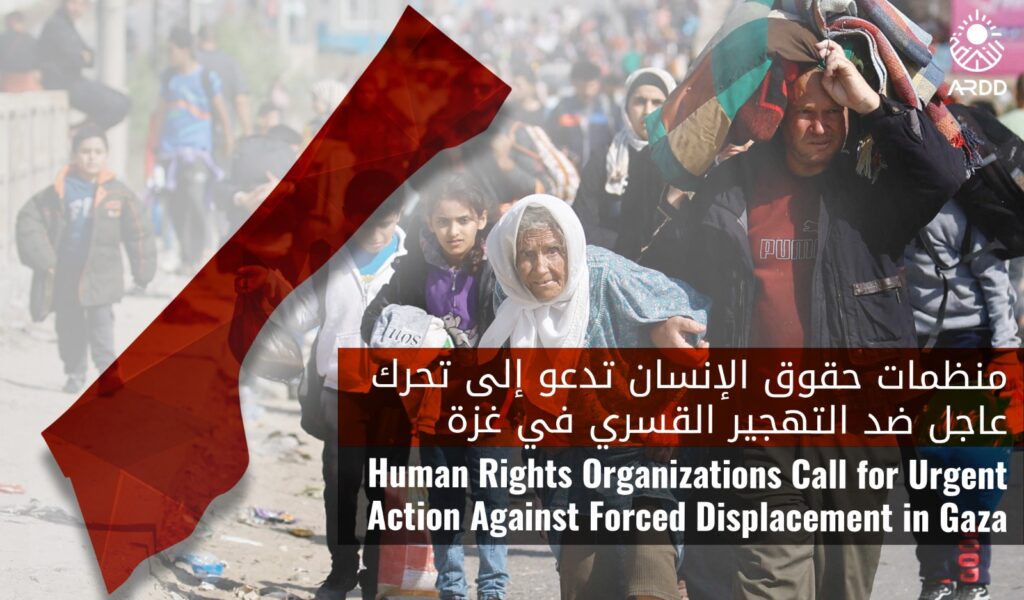
We, the undersigned human rights organizations, draw the attention of United Nations (UN) member states to Israel’s cataclysmic forced displacement of Palestinians in and from Gaza, the West Bank, and South Lebanon. There are 1.9 million internally displaced persons in Gaza, an estimated 100,000 who have fled to Egypt, and more than 3,477 Palestinians who have been forcibly displaced in the West Bank. The so-called ‘evacuation’ orders issued by Israel are causing catastrophic harm to the civilian population in Gaza, exacerbating the ongoing famine, and effectively besieging nearly 90 percent of the population in an area smaller than 11 percent of the total size of the Gaza Strip. We call for an end to these illegal displacement orders issued by Israel, the safe return of refugees and internally displaced persons at the earliest possible stage, urgent and unimpeded expansion of humanitarian aid, and an immediate and permanent ceasefire. The evacuation orders issued by Israel in Gaza since October 2023 have had disastrous effects on Palestinians in Gaza, cramming around 1.8 million people into an area of around 40 square kilometers causing severe overcrowding and, coupled with the lack of sanitation facilities, clean water, food, shelter and basic hygiene, have exacerbated the dire conditions, increased the spread of disease, thereby inflicting on Palestinians in Gaza conditions of life calculated to bring about their destruction. Importantly, the International Court of Justice (ICJ), in its first provisional measures order, demanded Israel to prevent and ensure with immediate effect that its military does not commit any genocidal acts, following its finding of the plausible right of Palestinians in Gaza to be protected against genocide by Israel. Since October 2023, at least 40,000 Palestinians – 2% of the entire population – have been killed, over 93,000 – 4% of the population – are injured, and nine out of ten people are displaced. More than half of buildings in Gaza have been destroyed, and around 20% are significantly damaged, rendering these areas uninhabitable. Fewer than half of Gaza’s hospitals are partially functioning. On 29 August 2024, the Acting Under-Secretary-General for Humanitarian Affairs and Emergency Relief Coordinator, Joyce Msuya, stated: “The situation in Gaza is beyond desperate… Civilians are hungry. They are thirsty. They are sick. They are homeless. They have been pushed beyond the limits of endurance – beyond what any human being should bear.” The inhumane and illegal displacement has been constant for almost an entire year. Starting on 13 October 2023, the Israeli military gave people in northern Gaza and Gaza city – some 1 million persons – 24 hours to ‘evacuate’ to the south of the Gaza Strip. Today, more than 86 percent of Gaza remains affected by over 40 evacuation orders issued since 1 January 2024. Paula Gaviria Betancur, UN Special Rapporteur on the human rights of internally displaced persons (IDPs) stated in March of 2024 that, “Israel’s evacuation orders have not made the people of Gaza safer; on the contrary, they have been used to forcibly transfer and confine the civilian population in unlivable conditions.” Two months later, in May 2024, the ICJ’s third provisional measures order stated that the Court was “not convinced that the evacuation efforts and related measures that Israel affirms to have undertaken to enhance the security of civilians in the Gaza Strip… are sufficient to alleviate the immense risk to which the Palestinian population is exposed.” On the contrary, the UN Special Rapporteur on the Occupied Palestinian Territory found that “[t]he total siege and near-constant carpet-bombing, along with draconian evacuation orders and ever-shifting “safe zones”, have created an unparalleled humanitarian catastrophe” in Gaza, and where “the sheer scale of evacuations, amidst an intense bombing campaign, […] increased levels of panic, forced displacement and mass killing.” Israel’s evacuation orders cannot be considered effective warnings, considering the appalling conditions and limited number of shelters, the lack of safe routes for displaced persons, and the ongoing severe threat of attack. They violate international humanitarian law and may be considered war crimes. The forced displacement is ongoing and relentless. More recently, in August of 2024 alone, Israel issued 16 evacuation orders, many of them targeting locations that were previously designated as part of the so-called ‘humanitarian safe zone’ in central Gaza, and particularly in and around Deir al-Balah. These so-called ‘evacuation’ orders obstruct essential aid operations, denying access to a besieged civilian population. In UN OCHA’s latest report, they affirmed that, “Continuous displacement is disrupting access to nutrition sites and distribution cycles; hindering partners’ ability to maintain consistent service delivery.” To cite one example, the World Food Programme’s forced evacuation from their main operating hub in Deir al-Balah has drastically reduced its capacity to provide critical food assistance, leaving Palestinians with even fewer desperately needed resources. Independent UN experts had already declared in July 2024 that the “hunger and malnutrition leaves no doubt that famine has spread across the entire Gaza Strip”, even before the latest round of ‘evacuations’. Such acts are tantamount to forced displacement and may even form part of the actus reus of genocide. The ICTY held that “forcible transfer could be an additional means by which to ensure the physical destruction” of the group. Further, the UN Commission of Inquiry on the Occupied Palestinian Territory, including East Jerusalem, and Israel found that the Israeli conduct around evacuation orders, including “the dissemination of information regarding evacuations, the feasibility of safe evacuation, the voluntariness of evacuation, safety concerns and the possibility of return considering the extensive damage to structures within the Gaza Strip”, as well as statements by Israeli officials and public figures demonstrate an intent to forcibly transfer Palestinians in Gaza. Third States have the legal obligation to prevent and suppress the crime of genocide, ensure that Israel’s illegal displacement orders are brought to an end, and that Israel allows the entry of sufficient aid to Gaza, and ceases any obstruction to its distribution. In light of this, we urge UN member states to: Take meaningful and concrete actions to enforce an immediate and permanent ceasefire;
An Urgent Call for Action and Solidarity #NoMoreNakbas in Support of #SaveSheikhJarrah
If we stand alone, we are frail like the wings of a butterfly, If we stand together, our wings can sustain the revolution. May 15th marks the 73rd anniversary of the start of Palestinian displacement and dispossession in 1947-1949 – Nakba Day – and June 5th the further displacement during and after the 1967 war – Naksa Day. The recent violent Israeli attacks against unarmed Palestinian demonstrators and worshippers in Jerusalem and the subsequent dramatic escalation of violence in both Israel and Palestine remind us that the resolution of the Question of Palestine – characterized by ongoing ethnic cleansing, occupation, apartheid, and dehumanization – is more remote than ever. This tragic reality and the emergence of a new Palestinian uprising in all of historic Palestine, coupled with a wave of global solidarity, prompt us to call for renewed mobilization and action. Palestinian youth have been rising since the beginning of Ramadan to protect their ever-shrinking space in East Jerusalem in the face of Israeli provocations at the Damascus Gate, the threatened evictions in Sheikh Jarrah, and the brutal violence at Al Aqsa Mosque. Announced further displacement of Palestinian refugees to make room for illegal Jewish settlers, in Sheikh Jarrah, epitomizes the Nakba, as are similar measures in Jaffa, the Galilee, the Negev and the West Bank. And once again, innocent civilians of an already exhausted Gaza will pay by far the heaviest price in the latest escalation of violence. Until Israeli apartheid and occupation are brought to an end, the Nakba will continue, and, in turn, Palestinians will persevere, maintain their legitimate resistance and demands for justice, prompting our solidarity and support. Arab Renaissance for Democracy and Development (ARDD) and its Global Network on the Question of Palestine (GNQP) call for global mobilization in support of the Palestinians, centering on the period between Nakba and Naksa Days. More than ever, this is the time for solidarity and support by mobilizing grassroots, raising awareness, putting political pressure, calling for boycott, divestment, and sanctions, and working towards ending Israeli impunity. Every voice counts! Under the hashtags #NoMoreNakbas and #SaveSheikhJarrah, ARDD and the GNQP: Call on the UN Security Council and the international community to take all necessary measures to de-escalate the situation in Palestine/Israel, by: ❖ Calling for an immediate cease-fire in Gaza. ❖ Urging the cessation of all forms of harassment and violence against Palestinians and their property. ❖ Urging the deployment of observers and a protection presence in Gaza, the West Bank including East Jerusalem and Israel. ❖ Affirming the sanctity of Jerusalem’s holy places and its worshippers. ❖ Suspending the sale of weapons to Israel. Call on people of conscience around the world To lend their voice to the Palestinian quest for justice, including by: ❖ Giving support and visibility to Palestinian voices and calls – often silenced through repression and censorship – for an end to occupation and apartheid in occupied Palestine/Israel. The world needs to hear them! ❖ Staying informed on what happens on the ground, joining debates, engaging with the media, calling upon your political references. Do not remain silent. Remember, it is international tolerance of Israeli crimes that has allowed the situation to last this long! Call on the media globally ❖ To report honestly on the facts and current developments on the ground, steering away from manipulation for political convenience ❖ To placing their coverage of current events in the correct historical, legal, and political context: not that of a conflict between two (equal) parties, but rather one of an ever ongoing Nakba, continuing ethnic cleansing of Palestine’s non-Jewish population accompanied by settler-colonial occupation, culminating in a reality that has all the hallmarks of Apartheid, in flagrant violation of international law and as such constituting war crimes and crimes against humanity. Call on civil society, lawyers, academics, and activists in the region and beyond, especially those engaged on the Question of Palestine: ❖ To use their voices and visibility to condemn the latest transgressions in Palestine/Israel ❖ To use their standing and networks to support Palestinians’ struggle to end occupation and Apartheid, and to achieve justice. During the Nakba/Naksa commemoration period, ARDD will be collecting: – Expert commentaries to explain specific issues of the current situation and place them in context. – Expressions of solidarity toward the Palestinian struggle and display these progressively on its social media platform, to be used as an advocacy tool.