The Only Constant is Change: Jordanian Youth on Driving Social Change
This report examines how Jordanian youth understand, experience, and navigate social change, focusing on their aspirations, perceived roles, and the structures that enable or constrain meaningful transformation. It is the third study produced under the New Generation – GenG program and builds on four years of research, policy engagement, and youth-led advocacy. The GenG program aims to foster gender-just and violence-free societies through youth leadership, civic engagement, and policy influence. Drawing on mixed qualitative and quantitative methods—including surveys, interviews, focus group discussions, desk reviews, and Policy Labs—the research explores: Youth aspirations for a better future in Jordan The role young people see for themselves in driving social change The institutional, social, and economic structures shaping youth agency The findings highlight three core areas youth identify as critical for change: education reform, economic justice, and meaningful political participation. While young people strongly value collective action, the study reveals a persistent gap between awareness-raising and structural engagement, driven by economic disenfranchisement, institutional mistrust, and shrinking civic space. The report concludes with actionable recommendations directed at government institutions, political parties, civil society organizations, and community leaders. These recommendations emphasize bridging education and labor market needs, strengthening youth-inclusive governance, fostering intergenerational dialogue, enhancing digital and media literacy, and developing long-term, non-exploitative partnerships with youth. This research contributes to a growing evidence base positioning youth not as passive beneficiaries, but as strategic actors navigating complex realities in pursuit of inclusive and sustainable social change.
How TFGBV Impacts the Democratic Participation of Young Women: Jordan as a Case Study
Digital spaces have become vital arenas for democratic participation in Jordan, particularly for young women who face structural exclusion from traditional public life. Yet these same spaces are increasingly weaponized through Technology-Facilitated Gender-Based Violence (TFGBV), a growing form of harm that undermines women’s safety, voice, and political agency. This research is conducted as part of the New Generation Project (GenG), an initiative focused on strengthening youth civic engagement, inclusive participation, and democratic governance. Within this framework, the study examines how TFGBV functions as a mechanism of democratic exclusion, systematically pushing young women out of online public spaces and into silence. Drawing on mixed-methods research, including surveys, interviews, focus group discussions, and expert consultations, the study documents how online harassment, blackmail, defamation, and digital shaming intersect with social norms of honor and stigma to produce severe offline consequences, ranging from psychological harm to withdrawal from education, activism, and political life. The findings reveal a powerful “chilling effect”: fear of violence leads young women to self-censor, anonymize their identities, or disengage entirely from digital platforms that are central to modern civic participation. In this way, TFGBV is not only a gender-based violence issue, but a democratic one, eroding digital citizenship and deepening existing political inequalities. The report also maps legislative, institutional, and sociocultural barriers to reporting TFGBV in Jordan and offers actionable, multi-level recommendations for government institutions, the justice sector, civil society, digital platforms, and communities. It calls for gender-sensitive legal reform, survivor-centered reporting mechanisms, decentralized support services, and long-term social change to protect women’s rights online and safeguard the democratic potential of digital spaces. This study aims to contribute to national and regional debates on youth, gender, digital governance, and democratic participation, reinforcing ARDD’s commitment to amplifying young people’s voices and advancing inclusive, rights-based democracies in the digital age.
Gatekeepers and Enablers – Fathers, Brothers, and Girls’ Leadership in Jordan and Egypt
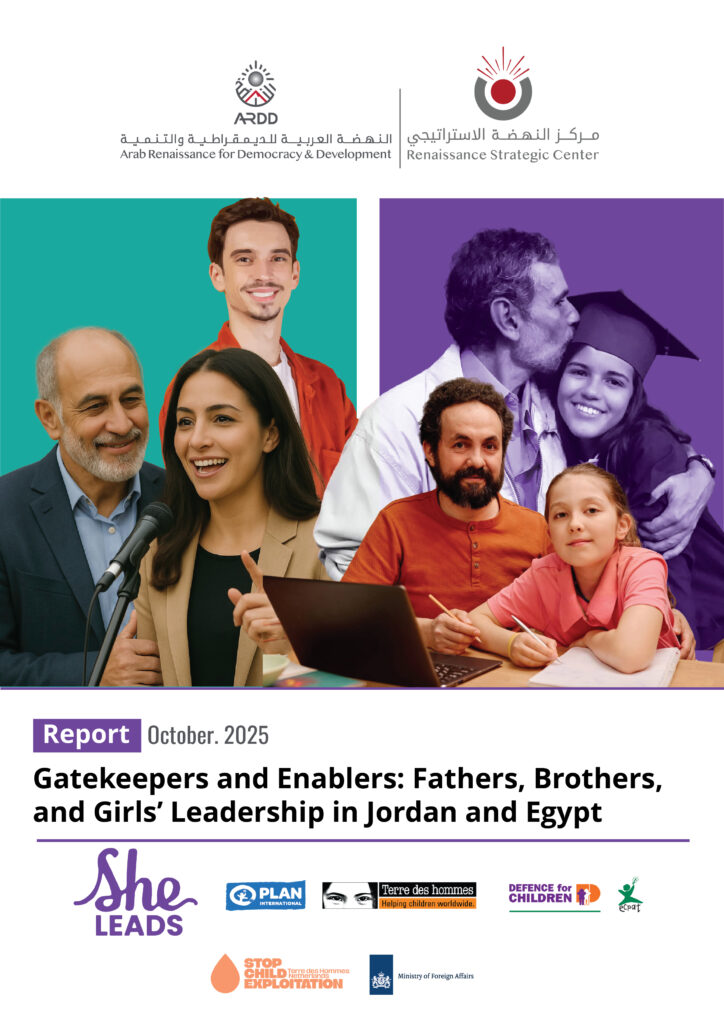
In both Jordan and Egypt, fathers and brothers play a pivotal role in fostering girls’ and young women’s leadership in the Arab world. According to the survey, 99% of respondents – including fathers, brothers, and girls from Jordan and Egypt – recognized the father’s role as important in supporting girls and young women to assume leadership positions within their families and communities, with 91% describing it as very important. Similarly, 83% of participants identified the role of brothers as either very important (56%) or important (28%), while a small proportion remained neutral (13%) or considered it not important (2%). Fathers, in particular, are seen as key guiding figures in their daughters’ professional development, providing both financial support and mentorship, especially in education and career advancement. In the in-depth individual interviews, all fathers (5/5) emphasized that they encourage their daughters to take on leadership roles within the family, with the goal of becoming self-reliant and financially independent. A main sphere of support provided by male family members is the investment in girls’ educational journeys. As confirmed by all girls during individual interviews (18), their fathers cover university fees and actively support additional educational opportunities, such as trainings and workshops, contributing to build girls’ independence and self-confidence. Nonetheless, while male figures provide considerable support, challenges remain for their engagement in women’s leadership. Social and cultural norms continue to shape men’s perceptions of women’s roles and capacities. For instance, only a minority of fathers expressed support for their daughters’ freedom to travel for study or work reasons, citing among the concerns potential social judgment from community members. Moreover, interviews with brothers reflected social stereotypes as they reiterated the belief that, to assume leadership positions, women should “set aside their emotions,” or work in socially accepted fields, such as education. As societal norms gradually evolve, fathers and brothers often find themselves mediating between traditional expectations and emerging realities. By involving their daughters in decision-making processes and supporting their economic independence, fathers and brothers can play a pivotal role as intermediaries, bridging traditional social norms with more equitable divisions of roles within the family and society. According to the research, in contexts where social and cultural norms continue to restrict women’s opportunities, particularly in rural areas, fathers often serve as key allies, supporting young women in pursuing educational and leadership opportunities.
Evolving Perspective: Leadership Qualities among Young Men and Women in Jordan
What does leadership mean to young women and men in Jordan today—and how are they redefining it in the face of societal norms and challenges? As part of the New Generation (GenG) program, ARDD conducted action research to explore youth perceptions of leadership, with a particular focus on gender dynamics, civic engagement, and the role of social capital. The study reveals both persistent barriers and promising change. While traditional expectations continue to shape attitudes toward leadership, youth are increasingly emphasizing qualities such as empathy, inclusivity, cooperation, and ethical decision-making. The findings also highlight the importance of female role models, intergenerational dialogue, and civic participation as key drivers of more inclusive leadership. This research contributes to the growing movement for gender justice and youth empowerment. It calls for new models of leadership that go beyond stereotypes, embrace diversity, and enable young women and men alike to play an active role in building fairer, more participatory, and more just societies.
Passive or Restrained?
Youth civic engagement and political participation
This research is the first in a series of research works that will be conducted within the framework of New Generation project. It focuses on the meaning of political participation for youth, building on the findings of the Generation G baseline report. The objective of this study is to identify the obstacles and opportunities for enhanced youth civic participation in Jordan and the forms of civic engagement most conducive to the interests. It breaks down and demystifies the concept of political participation by working on defining with youth to define various concepts that relate to political participation and the possible role of youth in making change happen. The research focuses on the needs and perspectives of the Jordanian youth as the principal target of the project, and explores what underlies their needs, expectations, and perspectives. It was conducted between July and November 2022 in Jordan amongst members of five youth networks across the country. The research methodology built on networks and groups engaged with ARDD in various projects and activities, and the process of data collection was itself part of the raising awareness pathway. The methodology for the research used mixed tools, including a survey, eight focus group discussions and 26 semi-structured interviews. The analysis and findings of the report build on the results of the 2021 baseline report and a brief literature review on the topic of MENA youth political participation and civic engagement. Moreover, policy labs and awareness-raising sessions were organized to engage youth in a more meaningful and participatory manner during the research process. Incorporating youth’s perspectives, this research seeks to clarify different political participation concepts and explore the potential role of youth in driving societal change.
Walking On Eggshells: Pathways to Equality in Jordan
A Civil Society Perspective on the Beijing Declaration Commitments
This Shadow Report is an independent civil society assessment of Jordan’s progress over the past five years in implementing the commitments of the Beijing Declaration and Platform for Action (BPFA). It provides an evidence-based perspective rooted in grassroots voices and feminist advocacy. Civil society organizations (CSOs) are crucial in translating policies into practice, advocating for reforms, and addressing gender inequalities through community-based approaches. Their contributions ensure that national achievements align with the lived realities of women across various Jordanian communities. This report is a collaborative effort led by the Arab Renaissance for Democracy and Development (ARDD) and the Jordanian National NGOs Forum (JONAF), reflecting diverse perspectives. Through their grassroots networks, JONAF provides a platform for community organizations and women’s rights groups to engage in political advocacy and accountability efforts. While national and regional reports on “Beijing+30” highlight legislative progress and institutional reforms, they may not fully capture implementation realities or the daily struggles of women and marginalized groups. This shadow report serves as a civil society accountability mechanism, evaluating Jordan’s commitments under the Beijing Declaration through an inclusive, rights-based lens. It focuses on the voices of women from diverse backgrounds, aiming to bridge the gap between political commitments and on-the-ground realities by assessing progress, identifying key obstacles, and providing evidence-based recommendations.
Advancing Equality: Assessing Women’s Machineries in the Arab Region
The establishment of women’s machineries has been prioritized since 1975 by the international community when the United Nations held the first World Conference on Women in Mexico. In 1995 the Beijing Platform for Action (BPA) acknowledged that most member states established machinery for the advancement of women in their countries but noted that these machineries are “diverse in form and uneven in their effectiveness”. The Arab Renaissance for Democracy and Development (ARDD)´s think tank; The Renaissance Strategic Center (RSC) is undertaking this regional review, with a focus on women’s machineries in the Arab world, as part of the review of the implementation of the Beijing Platform for Action (BPA) thirty years after its adoption. The role of women’s machineries in promoting gender justice and the empowerment of women and girls is crucial. These institutions can create impactful changes for women, girls, and the most vulnerable among them. They serve as the entry point for mainstreaming gender in public policies and legal frameworks. Efforts to establish national machineries for the advancement of women’s and girls’ rights in the Arab world began as early as the 1990s. However, the effectiveness of these women’s machineries remains a significant question for the women’s movement in the region. Considering the importance of these machineries for the advancement of women in the region ARDD takes the opportunity of the Beijing + 30 review to assess where they stand, how they dealt with the challenges identified in previous review processes, and develop a reflection that could frame and support women’s movements advocacy in the region.
Raising Tomorrow’s Leaders
Family plays a crucial role in fostering female leadership in the Arab world, providing emotional, financial, and psychological support that enables young women to navigate societal challenges and pursue leadership roles. Acting as the primary support system, families shield young women from community judgment and foster environments fertile for success. This support is crucial in societies where traditional norms might sometimes limit women’s opportunities in the public sphere. While Family support is integral to the leadership development of young women, the Arab Renaissance for Democracy and Development (ARDD) within the “She Leads” program conducted an action research that highlights the role of families in Jordan, Lebanon, and Egypt in shaping female leadership. The report aims to provide insights and recommendations for policymakers and stakeholders on how families can contribute to and support young women’s leadership and to Inform policymakers and stakeholders on enablers of and barriers to women’s leadership in society, in addition to understanding how shifts in social dynamics and regional trends influence leadership roles for girls and young women in Jordan Lebanon, and Egypt. The report also provides several recommendations for family support for Women’s public engagement, paving the way for young women’s leadership, education, and intergenerational exchange. The “She Leads” project, is a joint program of Plan International Netherlands, Defense for Children – ECPAT Netherlands (DCI-ECPAT), African Women’s Development and Communication Network (FEMNET), and Terre des Hommes Netherlands (TdH) targeting social norms in formal and informal institutions in East Africa (Uganda, Ethiopia, Kenya), West Africa (Ghana, Mali, Sierra Leone, Liberia) and the Middle East (Lebanon, Jordan, Egypt).
ARDD-JONAF Report on the New Legal Requirements for Regulating the Work of Local and Foreign Associations in Jordan
The Arab Renaissance for Democracy and Development (ARDD) is following up on several civil society issues to promote the work of Jordan NGOs Forum (JONAF) and its member and affiliated associations. In this brief report, ARDD reviews the most significant updates on the legal status of associations. Since 2023 to date, many decisions have been issued and several measures have been taken that are directly related to local and international organizations registered within the Register of Associations in Jordan, whether they are local associations of different kinds or branches of international associations. These procedures and requirements exclude United Nations agencies, organizations established under a special law, non-profit companies, and organizations registered under a direct agreement with the Jordanian government. Gratitude and appreciation are due to the Ministry of Social Development, the Register of Associations, and all the relevant authorities for their constant efforts to develop, update, and simplify procedures for associations. ARDD and JONAF would like to offer support hereby by elaborating on these developments to the concerned parties, in addition to highlighting some notes to work on to facilitate implementation and follow-up.
Localisation Baseline Report
The localisation of humanitarian work in Jordan is an ongoing process that requires collaboration and co- operation among local and international actors. This baseline report provides an overview of the current status of localisation efforts in Jordan in-line with the Jordan Localisation Monitoring, Evaluation, Accountability and Learning Framework and the global Grand Bargain commitments. The survey results highlight both progress and challenges in the efforts to promote the implementation of the localisation agenda. This baseline also provides an important evidence base to inform the way forward for advancing localisation efforts in Jordan, notably in a gender-responsive and inclusive manner. In summary, the analysis of the various outcome areas reveals both positive developments and areas requiring further attention in the International Actors-Local and National Actors (IA-LNA) localisation relationship dynamics. While progress has been made in implementing accountability systems and supporting community-led projects, power differentials persist and need more mitigation, and efforts should be focused on contextualizing agreements, integrating, and empowering LNAs, and involving them in decision-making processes.