What happens when state authority weakens or fragments, yet communities cannot wait for peace agreements or political settlements to rebuild their lives? Across societies affected by conflict, political transition, and state fragility, schools reopen, health services resume, disputes are resolved, and new systems of public authority emerge, often long before formal state institutions recover.
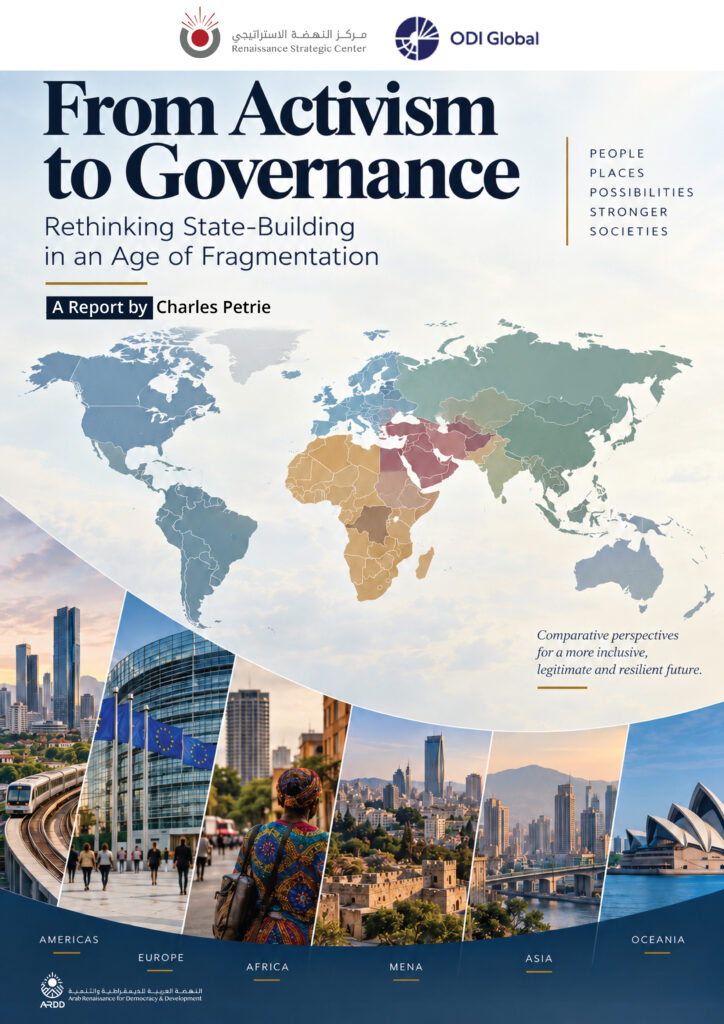
The report From Activism to Governance: Rethinking State-Building in the Age of Fragmentation examines how civic movements and local institutions evolve from protest, resistance, and emergency response into actors responsible for services, justice, security, and public decision-making. Drawing on three comparative seminars convened by the Renaissance Strategic Centre at ARDD in partnership with ODI Global, it brings together the experiences and insights of activists, researchers, and governance practitioners from Africa, Asia, and the Middle East.
Authored by Charles Petrie, the report challenges conventional state-building approaches that focus primarily on restoring authority from the center. It argues that governance does not always wait for government and that legitimacy is often earned before it is formally recognized, through accountability, meaningful participation, fair treatment, reliable services, and public trust.
Through comparative experiences from Myanmar, Lebanon, Syria, Sudan, Yemen, Afghanistan, and other contexts, the report considers the opportunities and risks involved in locally emerging governance. It also examines questions of sustainable financing, diaspora engagement, transitional justice, and the danger of romanticizing local authority.
Ultimately, the report calls on international actors to identify, strengthen, and connect legitimate forms of authority already taking root within societies, recognizing them as potential foundations for rebuilding more accountable, inclusive, and sustainable states.