International aid is increasingly shaped by shifting political priorities, competing global crises, and growing pressure on donor budgets. Funding can expand rapidly when a crisis attracts international attention, enabling humanitarian and development organizations to scale up their operations, recruit staff, and extend essential services. Yet when attention moves elsewhere, resources often decline abruptly, even though the needs of affected communities remain. Local organizations are frequently left to manage the consequences, maintaining their responsibilities to communities with fewer resources and limited institutional support.
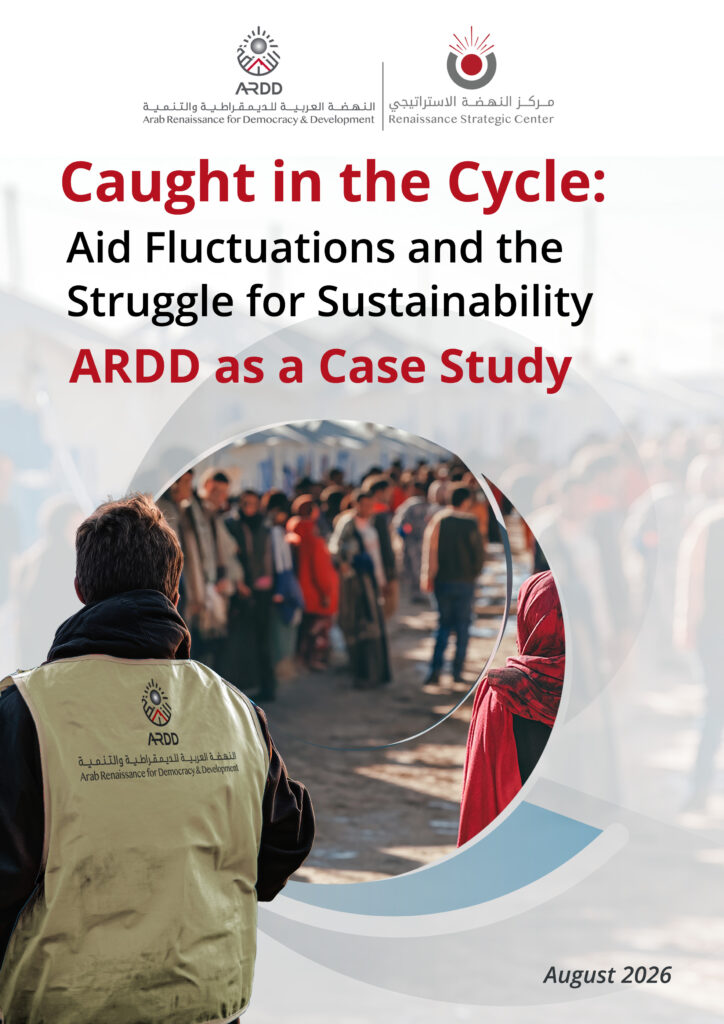
This study, published by the Renaissance Strategic Center (RSC), the think tank arm of the Arab Renaissance for Democracy and Development (ARDD), examines how these fluctuations affect the sustainability of local organizations in contexts of protracted crisis. Focusing on Jordan and drawing on ARDD’s institutional journey, it traces the cycle from rapid expansion during the Syrian refugee crisis to consolidation, funding contraction, and strategic adaptation. The analysis is informed by humanitarian financing trends, sector reports, and interviews with representatives of local NGOs, international organizations, donor agencies, and ARDD staff.
ARDD’s experience demonstrates the important role that strong internal systems, diversified funding, staff capacity, and long-term community relationships can play in sustaining a local organization through periods of uncertainty. At the same time, it shows that resilience should not be romanticized. Funding cuts have tangible consequences, including reduced services, staff losses, office closures, weakened institutional memory, and growing pressure on the teams that remain.
The study argues that aid volatility is not only a question of declining resources, but also of how risk is distributed across the humanitarian system. While international actors may scale down, redirect resources, or leave, local organizations remain rooted in the communities they serve. Meaningful localization must therefore extend beyond transferring implementation responsibilities. It requires direct and flexible financing, multi-year institutional support, responsible transition planning, and more equitable partnerships that recognize local organizations as strategic actors and decision-makers.
Drawing lessons from ARDD’s experience, the study offers recommendations for donors, international organizations, and local NGOs to strengthen institutional sustainability and build a more responsible and equitable aid system.