
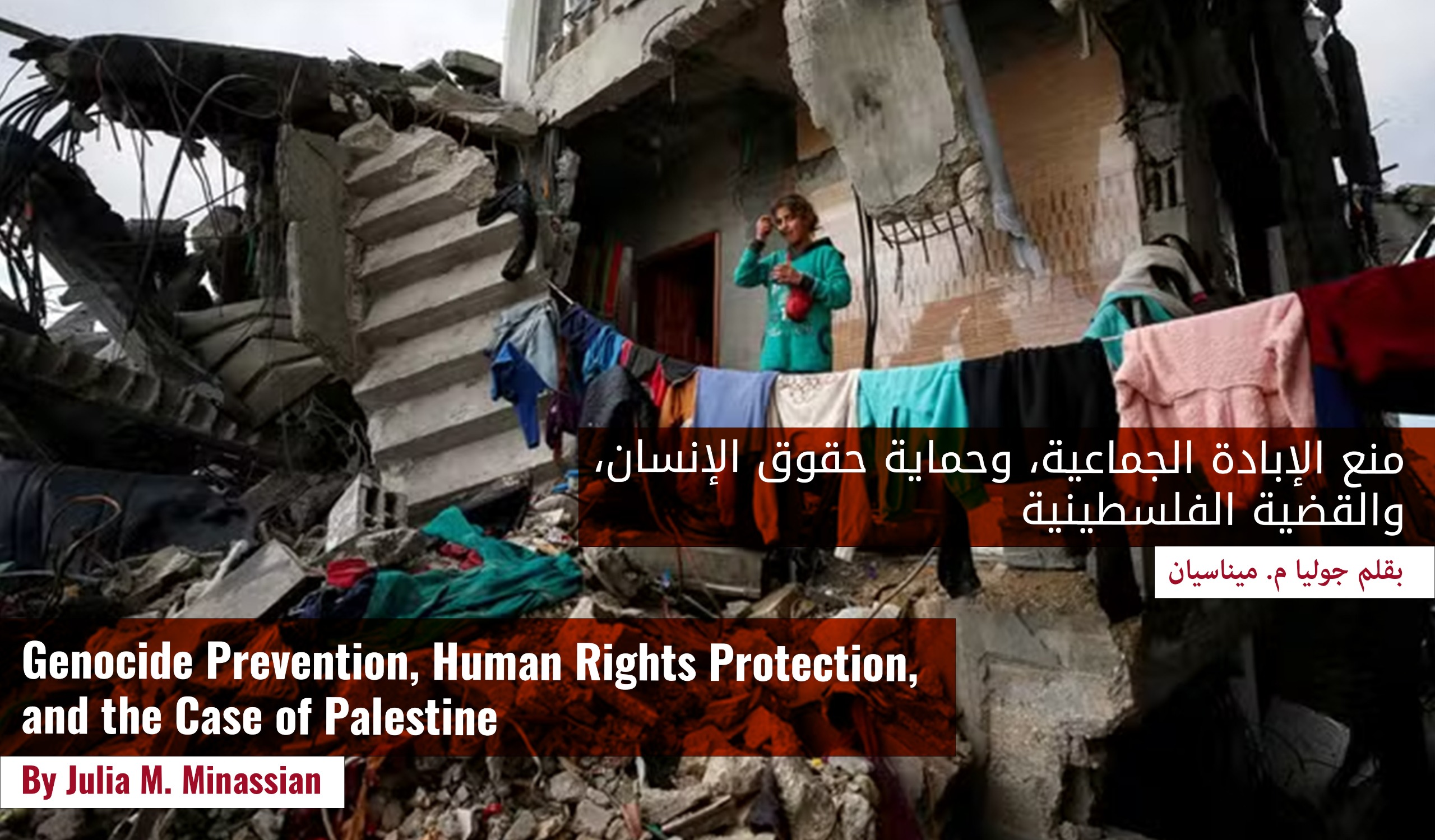
Written by – Julia M. Minassian (RSC Intern)
“Never again” is a promise the international community reiterates each December 9th on the International Day of Commemoration and Dignity of the Victims of Genocide and the Prevention of this Crime. Established by the United Nations (UN) General Assembly Resolution 69/ 323, the day coincides with the adoption of the 1948 Convention on Prevention and Punishment of the Crime of Genocide, the first legally binding international human rights treaty. The following day, December 10th, marks Human Rights Day, recognizing the anniversary of the Universal Declaration of Human Rights (UDHR). Observed consecutively, these two days underscore the fact that genocide prevention is intrinsically linked to the protection of fundamental human rights.
The 1948 Genocide Convention defines genocide as “acts committed with the intent to destroy, in whole or in part, a national, ethnic, racial, or religious group,” including “the deliberate infliction of conditions of life calculated to bring about physical destruction.” Such conditions, as the UN Framework of Analysis for Atrocity Crimes clarifies, represent cumulative patterns of systematic human rights violations. Genocide must therefore be understood as a structural and systematic process rather than an isolated event, which is currently unfolding in the Occupied Palestinian Territories. For decades before October 2023, the Palestinian people survived under multilayered systems of legal and physical occupation. Israel’s blockade of Gaza since 2007 has posed challenges to Palestinians’ free movement and access to essential services, including food, water, and medical supplies. Moreover, military occupation of the West Bank, coupled with illegal settlements and dispossession, has been continuously contributing to human rights violations. These structural conditions, described by the UN Special Rapporteur as an “institutionalized regime of systematic racial oppression and discrimination,” set the foundation of the Israel’s military offensive.
The intensification of violence over the past two years has further increased harm to civilians. Since October of 2023, more than 65,000 Palestinians have been killed with over 167,000 injured. Approximately 90% of Gaza’s population (approximately 1.9 million people) faces forcible displacement while 80% of civilian infrastructure, including schools, hospitals, and water facilities, has been destroyed. Moreover, the violence against Palestinians specifically targets their survival. Reproductive violence specifically represents a gendered form of erasure, as more than 150,000 pregnant and lactating women live without essential care while miscarriages have increased 300% since October 2023. Israel’s war on Palestinian education is one more strategy to further erode Palestinians’ fundamental rights: shutting down universities, criminalizing teaching, blocking students from traveling, burning archives, and now dismantling Gaza’s entire school system (80% of Gaza’s schools have been destroyed and 97% of education facilities damaged). None of these actions is new but they are just a continuation of a long-standing policy of systematic violence and destruction, erasing the culture and breaking the future of a population.
The deliberate destruction of humanitarian aid has posed another central concern. According to UN OCHA, Israel also blocked 6,480 metric tons of humanitarian aid from entering Gaza between October and November 2023 alone, while the March 2025 siege on Gaza closed border crossings and continued to limit humanitarian supplies. Moreover, international judges and scholars point to statements from the perpetrators of the violence against Palestinians as evidence of their intent. Nissim Vaturi, the Deputy Speaker of the Israeli legislature, stated, “[Now] we all have one common goal — erasing the Gaza Strip from the face of the earth.” Such rhetoric, coupled with the realities on the ground, including mass displacement, deprivation of essential services, destruction of civilian infrastructure, and the infliction of conditions of life incompatible with human survival, meets several parameters outlined in the genocide convention.
In December of 2023, South Africa initiated proceedings before the International Court of Justice (ICJ), arguing that Israel violated its obligations under the Genocide Convention. While not adjudicating the merits of the genocide claim at the provisional stage, the court concluded that Palestinians’ rights to protection under the Convention were at risk. The ICJ imposed provisional measures requiring Israel to prevent acts that could amount to genocide, facilitate humanitarian access, and investigate incitement. International Humanitarian Law (IHL) also obliges occupying powers to safeguard civilian life and maintain access to essential services. However, Israel has repeatedly failed to comply with the ICJ provisions and its duties as an occupying power under internal humanitarian and human rights law, despite the recent ceasefire.
Political inaction has also deepened the crisis. Since October 2023, multiple UN Security Council resolutions aimed at protecting Palestinian civilians have failed due to vetoes by powerful states. This paralysis entrenches impunity and alludes to a broader global trend where the political interests of powerful states supersede legal obligations. As a result, global actors tend towards indifference and selective engagement, while impunity for perpetrators in addition to a lack of accountability, allows mass atrocities to unfold unabated. The twentieth century offers numerous examples of this trend, from the Holocaust to genocides in Armenia and Rwanda.
In response to these past events, legal frameworks have been planned and adopted to cement states’ responsibility and prevent further escalation of violence. In particular, the Responsibility to Protect (R2P), adopted unanimously by the UN General Assembly, asserts that states must protect their populations from atrocity crimes. The framework also obliges the international community to take collective action when national authorities fail. Yet, despite clear warning signs and unequivocal standards, the international community stay indifferent, distracted and in silence.
On the other hand, civil society is attempting a change, filling the political and diplomatic gaps in global action. As individuals, human-rights defenders, and grassroots organizations document abuses, they also support humanitarian efforts and mobilize global attention. Activism has historically played a significant role in demanding accountability from governments, and the mass protests for Palestine reflect a growing transnational movement for accountability. Public engagement is thus a critical form of resistance that can influence the adoption of human rights norms and drive policy change in the long term.
Overall, human rights are deeply woven into our daily lives. Our rights are so essential to us that we may only notice them when they’re taken away. Preventing genocide depends on firmly confronting the gradual erosion of human rights, systematic and persistent discrimination, and impunity. If the December 9th and 10th commemorations are intended to honor the victims of past atrocities, then they also compel meaningful action when faced with violence today. “Never again” cannot remain a retrospective declaration. It must function as a present-tense imperative, guiding policy and collective responsibility wherever populations are exposed to existential harm.