
Introduction
This analysis article examines the Palestinian right of return not simply as a legal clause in international instruments, but as a central pillar of a long anti-colonial struggle over land, belonging, and political imagination. It argues that the right of return is best understood as a justice claim grounded in Indigenous attachment to place, in collective memory, and in decolonial visions of the future, rather than as a technocratic “final status issue” to be deferred to the end of negotiations.
The argument proceeds from three related observations.
First, when one centers Palestinian and Arab scholarship and political practice, the right of return emerges not as a residual humanitarian demand, but as a constitutive element of any just post-colonial order in Palestine. Authors such as Salman Abu Sitta, Nur Masalha, Rosemary Sayigh, Karma Nabulsi, and Leila Farsakh have insisted that return is inalienable, collective as well as individual, and structurally tied to questions of sovereignty, citizenship, and restitution (Abu Sitta 1997; 2005; 2016; Masalha 1992; Sayigh 1979; Nabulsi 2006; Farsakh 2021).
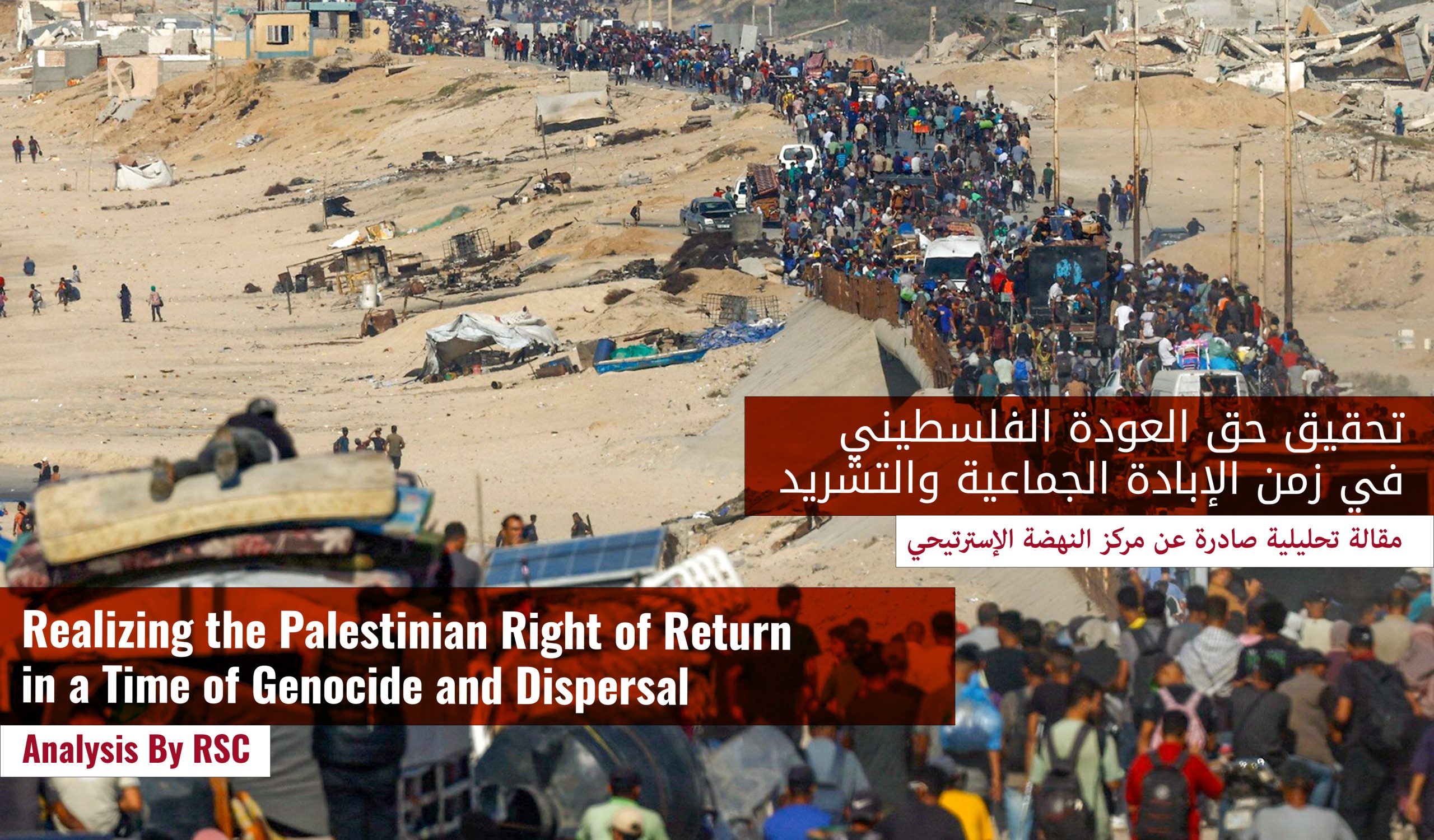
Second, the current conjuncture, marked by an even more brutal phase of genocide in the Gaza Strip and colonial violence in the West Bank with coordinated repression on Palestinians in 48 as well as control arrests and threat of deportation for many Palestinians in the different geographies of the shataat (diaspora), must be read as part of a longer settler-colonial project aimed at erasing Palestinians from their land and making return materially, institutionally and imaginatively impossible. More than 90 per cent of Gaza’s population has been displaced at least once since October 2023; approximately 92 per cent of homes and other structures have been damaged or destroyed (OCHA 2024–25; UNRWA 2024–25). These are not isolated humanitarian crises but structural assaults on the population that holds the right of return.
Third, contemporary schemes of coerced emigration, including recent charter flights transporting Palestinians from Gaza to South Africa and other third countries under opaque and monetized arrangements, represent a new modality of forced displacement. Investigations by South African authorities and international media indicate that these flights—organized by a shadowy entity known as Al-Majd Europe—require Palestinians to pay substantial sums to leave Gaza, and may form part of broader efforts to “empty” the Strip under humanitarian cover (Le Monde 2025; Al Jazeera 2025; Anadolu Agency 2025; Financial Times 2025). Such schemes directly target the bearers of the right of return.
At the same time, the institutional infrastructure of Palestinian refugeehood—UNRWA—is under escalating attack. Funding suspensions, Israeli legislation banning UNRWA in all of historic Palestine, and forced evictions from premises in occupied East Jerusalem are widely interpreted by Palestinian and regional organizations as attempts to erase refugeehood as a recognized legal category (ARDD 2024; BADIL 2025).
The question this article seeks to address is therefore not simply whether the Palestinian right of return exists in international law—a point extensively analyzed elsewhere (Albanese and Takkenberg 2020)—but how we might think about its realization now, at a moment when Palestinians are being killed, displaced and dispersed on a massive scale and when the institutional frameworks that have historically recognized and supported refugeehood are under sustained attack.
The first section reconstructs how the right of return has been conceptualized in Palestinian and Arab thought as an anti-colonial principle. The second reads the Gaza genocide and new forms of coerced migration as contemporary expressions of a long-standing project of elimination. The third examines the war on UNRWA as a struggle over the infrastructure of refugeehood itself. The fourth reflects on the ambivalent role of international law, which functions both as a resource and as a constraint. The final section sketches some elements of what “realizing the right of return” might mean in practice, beyond a single diplomatic event.
Throughout, the article adopts a justice-based and decolonial lens, treating international law as one repertoire among others rather than the sole or ultimate arbiter of legitimacy.
1. The Right of Return as an Anti-Colonial Principle
Palestinian and Arab scholarship approaches the right of return first and foremost through the experience of expulsion and enduring attachment to land, not through abstract readings of treaty texts.
1.1 Analytical approaches: the settler colonial project and the political and material significance of return
Salman Abu Sitta’s work is paradigmatic in this respect. Over several decades, he has reconstructed the geography of the Nakba, mapping more than 500 depopulated villages and towns, documenting their lands and analyzing their present-day uses. On this basis he argues that the Palestinian right of return is “sacred, legal and possible”: sacred, because it inheres in an Indigenous relationship between a people and their land; legal, because it is grounded in multiple strands of international law; and possible, because the spatial distribution of current populations in historic Palestine allows for large-scale return without reproducing mass expulsion of others (Abu Sitta 1997; 2005; 2016). In his reading, the common assertion that return is “demographically impossible” is less an empirical statement than an ideological one: what is at stake is not physical capacity but the refusal to relinquish a project of demographic engineering characteristic of settler colonialism.
Nur Masalha’s work brings this colonial structure into focus. In Expulsion of the Palestinians (1992), he traces the idea of “transfer”—that is, the removal of the Indigenous population from Palestine—as a persistent theme in Zionist political thought and planning from the late nineteenth century onwards. On this view, the expulsions of 1948 are not accidental by-products of war but the implementation of a long-standing blueprint. Post-1948, policies of denial—to refuse the term “Nakba”, to deny responsibility, to insist that the refugees are an external humanitarian problem—function to stabilize the new demographic order. The right of return appears, in this light, as a direct refusal of transfer: an insistence that those who were meant to be eliminated or rendered permanently external remain the land’s rightful inhabitants.
If Abu Sitta and Masalha foreground land and planning, Rosemary Sayigh’s classic oral histories focus on the subjective experience of exile. Working in the camps of Lebanon and Syria, she documents how Palestinian refugees, from the 1950s onwards, understood themselves as a people in political exile, not as generic “war victims” (Sayigh 1979). They recognized projects of “integration” or “resettlement” in Arab host societies as attempts to depoliticize their condition and to sever their relationship to places of origin. The camps, for all their precarity, thus became spaces where return was preserved as a political horizon, transmitted through stories, rituals and everyday references to lost villages and towns.
Karma Nabulsi extends this analysis from memory to representation. In research on refugee political conceptions, she finds that refugees tend to articulate return as part of the reconstitution of a political community rather than as an individualized process of readmission to a hostile state apparatus (Nabulsi 2006). Return, in their accounts, is bound up with questions of democratic representation, including the right of refugees in exile to participate in collective decision-making—and with the rebuilding of national institutions that include displaced populations rather than erasing them.
Leila Farsakh situates return within a broader critique of partition and the two-state orthodoxy. In Rethinking Statehood in Palestine (2021), she argues that a just resolution requires moving beyond a statist logic premised on separation and demographic engineering, toward political forms in all of historic Palestine that dismantle racial hierarchies and guarantee equal citizenship for Palestinians and Jews. In this horizon, the right of return is not a negotiable add-on to be modulated for the sake of “demographic balance”; it is a constitutive principle that shapes who the citizenry is and how land and resources are redistributed (Farsakh 2021).
1.2 A Palestinian framework of return
Taken together, these works suggest a distinctive Palestinian and Arab theoretical framework of return. Several characteristics are particularly salient:
- The right of return is inalienable. It cannot be bargained away by political elites or extinguished by time; it is grounded in an enduring relation between people and territory (Abu Sitta 1997; 2005).
- It is both individual and collective. Each refugee holds specific claims, often linked to particular plots or dwellings; together, these claims express the collective right of a people subjected to expulsion.
- It is anti-colonial. Return is not reducible to compensation or humanitarian alleviation; it is a demand to undo, or at least structurally redress, a settler-colonial project of transfer and replacement (Masalha 1992).
- It is justice-based. International legal arguments matter, but they are consistently read through a lens of substantive justice and historical repair, rather than treated as self-grounding.
The ambivalence of international institutions’ approaches has often been pointed out by Palestinian scholars. International law appears as a terrain of struggle: it can be instrumentalized for anti-colonial purposes, but it also encodes and stabilizes imperial hierarchies. The challenge is to mobilize legal norms—including those recognizing the right to enter one’s own country, or prohibiting apartheid and genocide—without allowing the horizons of justice to be reduced to what the existing order is willing to concede.
From this vantage point, the right of return exists, first, because Palestinians refuse to relinquish their relationship to their land, and only second because certain states, at certain moments, have endorsed formulations such as General Assembly Resolution 194.
2. Gaza: Genocide, Serial Displacement and Coerced Emigration
When one adopts this anti-colonial frame, Gaza ceases to be a peripheral “front” or an exceptional case. It emerges as the epicenter of Palestinian refugeehood and of contemporary efforts to defeat the right of return.
2.1 Gaza as a refugee space
Before October 2023, the majority of Gaza’s roughly 2.2 million residents were refugees or descendants of refugees from 1948. Since 2007, they have lived under a comprehensive blockade, with severely restricted movement and recurrent large-scale military assaults. This has produced what UN agencies and scholars describe as a regime of “de-development”, in which infrastructure is repeatedly destroyed faster than it can be rebuilt and civilian life is kept in a state of permanent precarity.
The genocidal assaults launched after 7 October 2023 radically intensified this regime. By early 2025, UN OCHA and UNRWA estimated that over 90 per cent of Gaza’s population had been displaced at least once, often multiple times, and that approximately 92 per cent of homes and other structures had been damaged or destroyed (OCHA 2024–25; UNRWA 2024–25). Health, water, and sanitation infrastructures have been devastated; universities and schools have been repeatedly hit; famine conditions, particularly in northern Gaza, have been widely documented.
Palestinian organizations such as Al-Haq and Al Mezan interpret evacuation orders and constantly shifting “safe areas” as tools of forcible transfer, designed to empty parts of Gaza of their inhabitants rather than protect civilians.
From a Palestinian standpoint, as Khalidi (2020) has argued in a broader historical frame, this violence is the predictable outcome of a settler-colonial project that has repeatedly chosen expulsion and massive force over equality and decolonization.
Within this landscape of destruction and internal displacement, forms of forced displacement have proliferated. In the West Bank and East Jerusalem constant destruction of refugee camps and villages, annexation of land, destruction of homes and settler violence are a daily reality. Since late 2025, a series of charter flights has transported Palestinians from Gaza, via Ramon airport, to South Africa and other third countries. These initiatives echo earlier episodes in which coerced “voluntary” departure has been used to consolidate faits accomplis of dispossession. They illustrate how “humanitarian” or “individual” solutions can become vectors of ethnic cleansing, especially when combined with long-term plans to render Gaza uninhabitable and to block future return.
Seen together—genocidal violence, internal displacement, infrastructural destruction, and new forms of coerced exit—the picture that emerges is of a multi-layered attempt to make return impossible: physically, by killing and scattering potential returnees; materially, by destroying the places to which they might return; and discursively, by reframing departure as the rational or inevitable choice.
3. UNRWA and the Struggle over the Infrastructure of Refugeehood
UNRWA occupies a central place in this conjuncture. It is at once a humanitarian service provider and an institutional embodiment of Palestinian refugeehood.
On the humanitarian side, UNRWA is the primary provider of education, health care, relief, and social services to registered Palestinian refugees in Gaza, the West Bank (including East Jerusalem), Jordan, Lebanon, and Syria. In Gaza in particular, its schools, clinics, and distribution centers have been a mainstay of civilian survival. During the current war, its facilities have repeatedly served as shelters for displaced people, often with devastating consequences when they have themselves been attacked (UNRWA 2024–25).
On the political and legal side, UNRWA maintains the official refugee rolls, linking individuals and families to places of origin in 1948. It gives concrete institutional form to the category of the “Palestine refugee”, signaling that the question of their displacement remains unresolved. Created by General Assembly Resolution 302 in 1949 as a temporary agency pending a just solution, it functions as a reminder that the promise of Resolution 194—return and compensation—has not been fulfilled.
Precisely for these reasons, UNRWA has become the target of a sustained political campaign. In early 2024, following Israeli allegations that a handful of UNRWA staff in Gaza had participated in the 7 October attacks, major donor states suspended funding, despite the absence of publicly shared evidence at the time, UNRWA’s immediate dismissal of the accused staff, and the swift launch of internal and external investigations. The resulting financial crisis threatened to collapse key services across all fields of operation at the very moment when needs in Gaza were at their highest (UNRWA 2024–25). Palestinian and international human-rights networks characterized these funding cuts as a form of collective punishment directed at refugees themselves (BADIL 2025).
More structurally, the Israeli Knesset has passed legislation banning UNRWA from operating within Israel and the occupied Palestinian territory, and the government has ordered the agency to vacate its premises in occupied East Jerusalem. Municipal authorities have moved to close UNRWA schools in the city and to repurpose its headquarters. These steps are part of a longer series of measures designed to restrict or eliminate UNRWA’s presence, particularly in East Jerusalem and areas targeted for intensified colonization (ARDD 2024).
Palestinian and regional organizations read these moves as attempts not only to shift responsibility for service provision, but to erase the institutional trace of Palestinian refugeehood. If UNRWA’s rolls are dismantled, if the very phrase “Palestine refugee” disappears from official vocabularies, it becomes easier to insist that there is no specific population with specific rights, only generic “residents” to be managed in line with the territorial ambitions of the occupying power (BADIL 2025; ARDD 2024).
From an anti-colonial perspective, UNRWA is thus a contradictory site of struggle. On the one hand, it is a product of the same UN order that oversaw partition and admitted Israel without enforcing return. It has at times participated in depoliticizing refugee claims, treating the population primarily as a humanitarian client. On the other hand, it holds records, practices and symbolic capital that are indispensable for any future process of return and reparations. Defending UNRWA, for many Palestinian scholars and organizations, does not mean romanticizing the agency; it means recognizing that allowing it to be dismantled or hollowed out would amount to cooperating in the erasure of refugeehood as a recognized legal and political condition (BADIL 2025).
4. International Law: Tool Rather than Horizon
In this context, international law occupies an ambivalent position. On one level, it offers important resources for articulating and defending the right of return. On another, it remains deeply implicated in the colonial and imperial structures that produced Palestinian dispossession in the first place.
The legal basis for the right of return is well-rehearsed. General human-rights instruments, notably Article 13(2) of the Universal Declaration of Human Rights and Article 12(4) of the International Covenant on Civil and Political Rights, recognize a right to enter one’s own country. General Assembly Resolution 194 (III) affirms that refugees wishing to return to their homes and live at peace with their neighbours should be permitted to do so “at the earliest practicable date”, and calls for compensation for those who choose not to return and for loss of or property damage. A series of subsequent resolutions on Palestinian properties and revenues reiterate that Palestinian owners retain legal title to their homes and lands and that their right is inalienable (UNGA 1948; 1949; various years). Contemporary legal syntheses, such as the second edition of Albanese and Takkenberg’s Palestinian Refugees in International Law, draw on human-rights law, humanitarian law, refugee law and the law of state responsibility to argue that the right of return is supported by multiple, overlapping regimes and is necessary to realize the right of self-determination of the Palestinian people, which is the juridical expression of liberation (Albanese and Takkenberg 2020).
Recent developments in international judicial and quasi-judicial fora add further layers. The 2025 Commission of Inquiry report and the findings of the Special Rapporteur on the occupied Palestinian territory explicitly name genocide and apartheid, and insist on the responsibility of third states not to aid or assist such regimes (UN COI 2025).
Yet, as Palestinian jurists and organizations insist, these legal advances must be approached with caution. As BADIL (2025) has argued, the continuity of colonization and displacement in Palestine is rooted in a global imperial order that has, for decades, shielded Israel from meaningful accountability.
In a justice-based, anti-colonial perspective, international law is therefore a necessary tactic but not sufficient. It can provide concepts, norms, and fora through which to challenge colonial violence, but it cannot be the sole horizon of political imagination. The legitimacy of the right of return does not derive from legal recognition; rather, legal texts are valuable insofar as they can be harnessed in the service of a prior, substantively grounded claim to decolonization and repair (Erakat 2019).
5. Realizing the Right of Return: Beyond a Single Diplomatic Event
If the right of return is to be treated as a central anti-colonial principle rather than a rhetorical flourish, what might its “realization” entail?
One way to answer this is to think in terms of layers of action, rather than a single moment of diplomatic closure.
A first layer is knowledge and planning. Decades of Palestinian scholarship and grassroots documentation have already built a substantial archive of displacement and attachment: Abu Sitta’s maps and return scenarios (1997; 2005), Walid Khalidi’s encyclopedic account of depopulated villages (Khalidi 1992), camp-based oral histories (Sayigh 1979), family trees, keys, deeds, and photographs. These materials form a distributed knowledge infrastructure for return. Their preservation, digitization, and enrichment—through geospatial analysis, updated demographic data, and scenario modelling—are not purely archival tasks; they are forms of planning that demonstrate, in concrete terms, that return is technically and spatially possible, and that the main obstacle is political will.
A second layer concerns political imagination. If, with Farsakh (2021) and others, we accept that the fundamental problem is settler colonialism rather than “lack of a Palestinian state” as such, then the horizon of justice cannot be reduced to the creation of a small, fragmented Palestinian entity but the provision of justice and the dismantlement of structures that reproduce oppression and prevent return.
A third layer concerns Gaza and the wider camp system. In their work on rights-based reconstruction, Palestinian organizations such as BADIL emphasize that Palestinians displaced within Gaza itself have a right to return to their original homes and neighborhoods, and that reconstruction policy must be guided by principles of reparations and self-determination, not simply by donor convenience or the security preferences of the occupying power (BADIL 2025).
A final layer concerns global solidarity and complicity. The Gaza genocide has prompted an upsurge of transnational mobilization: student encampments, trade-union resolutions, professional statements, calls for arms embargoes and corporate divestment, and legal initiatives by states such as South Africa. For Palestinian scholars and activists, these are not merely gestures of sympathy; they are part of a larger global anti-colonial front, in which Palestine resonates with other struggles against racialized dispossession and imperial violence. At the same time, they pose hard questions for universities, professional organizations, and governments about their own entanglement in militarized economies and colonial policies (BADIL 2025).
To frame the right of return as a living political project is therefore to insist that its realization depends not only on negotiations “in the region” but also on the reconfiguration of power and complicity in the wider world.
Conclusion
The Palestinian right of return has often been marginalized in diplomatic and policy discourse, treated as a symbolic claim or an intractable obstacle to “realistic” peacemaking. This article has suggested that, when one centers Palestinian and Arab scholarship and the anti-colonial framework it articulates, the right of return appears instead as a core measure of justice in the Palestinian question.
In the current conjuncture—marked by genocide in Gaza, systematic destruction and displacement, proliferating schemes of coerced emigration, and efforts to dismantle UNRWA—the stakes of return are particularly stark. To insist on the right of return in such a moment is not to indulge in utopianism; it is to refuse the normalization of a crime and institutionalized injustice. It is to affirm that Palestinians are not a surplus population to be redistributed across the globe, but a people with a prior and enduring claim to their country, from which they have been unjustly removed.
Realizing that right will not happen through conferences or an unbalanced accord. It will require the continued consolidation of knowledge infrastructures that make return thinkable and plannable; the elaboration of decolonial political projects in which return and justice are foundational; the defense and transformation of institutions such as UNRWA; and the development of global movements willing to confront their own complicities and to treat Palestine as central to contemporary struggles over law, empire and justice.
If the right of return is allowed to disappear—if genocide, forced displacement and institutional erasure succeed in transforming a colonized people into a dispersed, rightless diaspora—the consequences will reach far beyond Palestine. They will mark a profound narrowing of our collective political imagination, a tacit assent to the idea that colonial crimes are simply irreversible and acceptable. In this sense, the struggle over the Palestinian right of return is not only about Palestinians. It is a test of whether we can still conceive of a world in which reversal and repair of historical injustice remain possible, and not only its management.
References
Abu Sitta, Salman. 1997. “The Feasibility of the Right of Return.” In The Palestinian Exodus, 1948–1998, edited by Naseer Aruri et al. Ithaca Press.
———. 2005. “Is the Palestinian Right of Return Feasible?” The Electronic Intifada, 31 May.
———. 2016. Mapping My Return: A Palestinian Memoir. London: Bloomsbury.
Albanese, Francesca, and Lex Takkenberg. 2020. Palestinian Refugees in International Law. 2nd ed. Oxford: Oxford University Press.
Al-Haq; Al Mezan. Various reports on Gaza, 2023–25.
Al Jazeera. 2025. “What’s the Shadowy Organisation Taking Gaza Palestinians to South Africa?” 16 November.
Anadolu Agency. 2025. “All You Need to Know About Palestinian ‘Mystery’ Flights to South Africa.” 16 November.
ARDD (Arab Renaissance for Democracy and Development). 2024. “Israel’s UNRWA Ban: Undermining the Right of Return and Reinforcing Settler-Colonial Erasure.” Amman.
BADIL Resource Center for Palestinian Residency and Refugee Rights. 2025. Rights-Based Reconstruction: Decolonization and Reparations. Bethlehem.
Erakat, Noura. 2019. Justice for Some: Law and the Question of Palestine. Stanford, CA: Stanford University Press.
Farsakh, Leila. 2021. Rethinking Statehood in Palestine: Self-Determination and Decolonization Beyond Partition. Oakland, CA: University of California Press.
Financial Times. 2025. “The Brokers Offering to Spirit Palestinians from Gaza.” 22 November.
ICJ (International Court of Justice). 2024. Application of the Convention on the Prevention and Punishment of the Crime of Genocide in the Gaza Strip (South Africa v. Israel), Order on Provisional Measures.
Khalidi, Rashid. 2020. The Hundred Years’ War on Palestine: A History of Settler Colonialism and Resistance, 1917–2017. New York: Metropolitan Books.
Khalidi, Walid, ed. 1992. All That Remains: The Palestinian Villages Occupied and Depopulated by Israel in 1948. Washington, DC: Institute for Palestine Studies.
Le Monde. 2025. “The Mysterious Relocation of Palestinian Survivors from Gaza to South Africa.” 19 November.
Masalha, Nur. 1992. Expulsion of the Palestinians: The Concept of “Transfer” in Zionist Political Thought, 1882–1948. Washington, DC: Institute for Palestine Studies.
Nabulsi, Karma. 2006. “Palestinian Representation in the Refugee Camps.” Various reports and articles.
OCHA (UN Office for the Coordination of Humanitarian Affairs). 2024–25. Gaza Humanitarian Situation Updates and related data.
Sayigh, Rosemary. 1979. Palestinians: From Peasants to Revolutionaries – A People’s History. London: Zed Books.
UN COI (UN Independent International Commission of Inquiry on the Occupied Palestinian Territory, including East Jerusalem, and Israel). 2025. Report of the Independent International Commission of Inquiry on the Occupied Palestinian Territory, including East Jerusalem, and Israel.
UN General Assembly. 1948. Resolution 194 (III), “Palestine—Progress Report of the United Nations Mediator.” 11 December.
———. 1949. Resolution 302 (IV), “Assistance to Palestine Refugees.” 8 December.
———. Various years. Resolutions on “Palestine refugees’ properties and their revenues” and on UNRWA.
UNRWA (United Nations Relief and Works Agency for Palestine Refugees in the Near East). 2024–25. Situation Reports on Gaza and East Jerusalem.