
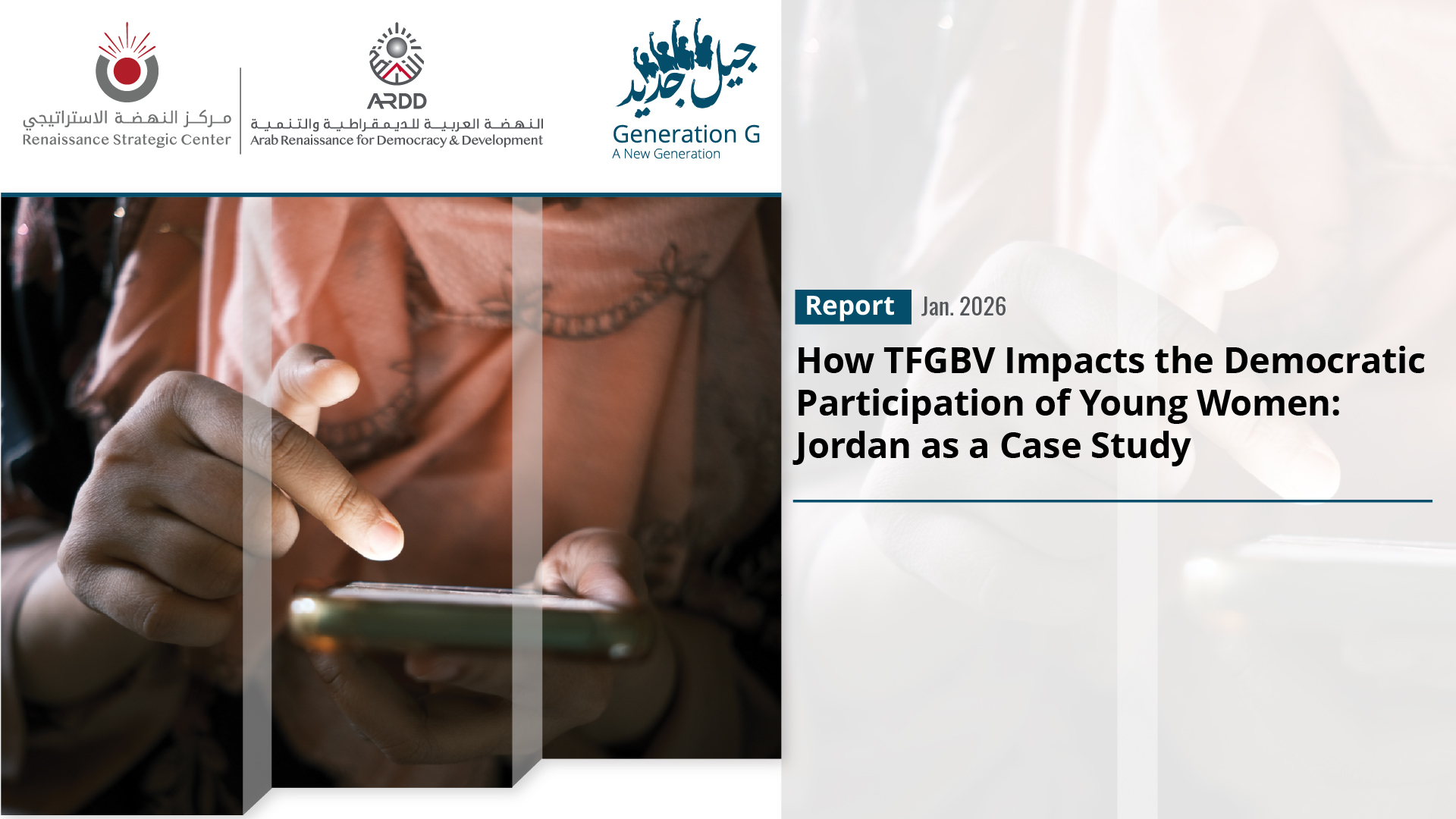
Digital spaces have become vital arenas for democratic participation in Jordan, particularly for young women who face structural exclusion from traditional public life. Yet these same spaces are increasingly weaponized through Technology-Facilitated Gender-Based Violence (TFGBV), a growing form of harm that undermines women’s safety, voice, and political agency.
This research is conducted as part of the New Generation Project (GenG), an initiative focused on strengthening youth civic engagement, inclusive participation, and democratic governance. Within this framework, the study examines how TFGBV functions as a mechanism of democratic exclusion, systematically pushing young women out of online public spaces and into silence.
Drawing on mixed-methods research, including surveys, interviews, focus group discussions, and expert consultations, the study documents how online harassment, blackmail, defamation, and digital shaming intersect with social norms of honor and stigma to produce severe offline consequences, ranging from psychological harm to withdrawal from education, activism, and political life.
The findings reveal a powerful “chilling effect”: fear of violence leads young women to self-censor, anonymize their identities, or disengage entirely from digital platforms that are central to modern civic participation. In this way, TFGBV is not only a gender-based violence issue, but a democratic one, eroding digital citizenship and deepening existing political inequalities.
The report also maps legislative, institutional, and sociocultural barriers to reporting TFGBV in Jordan and offers actionable, multi-level recommendations for government institutions, the justice sector, civil society, digital platforms, and communities. It calls for gender-sensitive legal reform, survivor-centered reporting mechanisms, decentralized support services, and long-term social change to protect women’s rights online and safeguard the democratic potential of digital spaces.
This study aims to contribute to national and regional debates on youth, gender, digital governance, and democratic participation, reinforcing ARDD’s commitment to amplifying young people’s voices and advancing inclusive, rights-based democracies in the digital age.