By Abigail Harper, Intern at RSC
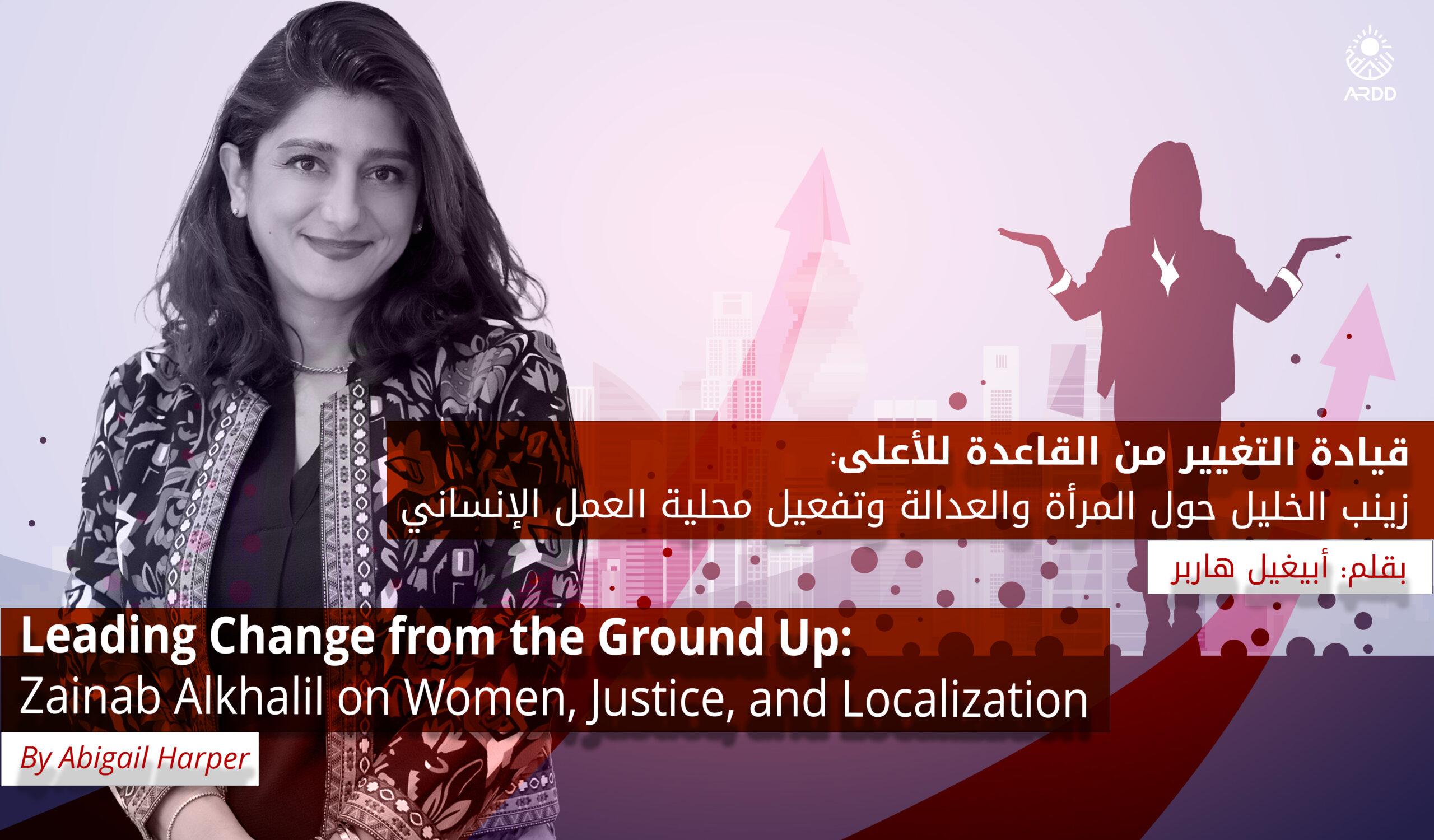
This Women’s Month, we spotlight Zainab Alkhalil, Manager of the Education and Women’s Access to Justice Programs at ARDD, who recently marked 11 years of impactful humanitarian and development work with the organization.
With over six years at UNESCO advancing Iraq’s National Literacy Strategy and expanding access to education for vulnerable communities, Zainab brings deep expertise in driving inclusive, community-centered change. Her leadership continues to champion gender justice, localisation, and resilience across the region. We began by asking her what inspired her journey.
What inspired you to work in education and women’s access to justice?
I was inspired to work in education and women’s access to justice, both personally and professionally. I was raised by two teachers, and from an early age, I saw education not simply as schooling, but as a foundation for dignity, critical thinking, and independence.
Later, when I left my home country, Iraq, it became even clearer that without the education I had received, I would not have been able to navigate displacement, adapt to new contexts, or continue contributing meaningfully to my field.
Education gives women the language, confidence, and critical thinking needed to understand their rights, while access to justice determines whether those rights can actually be exercised. Throughout my work—particularly with marginalized and crisis-affected communities, I have seen that when women are informed and supported, they not only seek services; they become advocates for themselves, their families, and their communities.
Was there a moment in your career that reaffirmed your commitment to this field?
Yes. While working with women in community learning, awareness, and capacity-building settings, I met women who had lived for years believing exclusion and injustice were simply “normal.”
When they began to understand their rights and saw even small pathways to claim them, their sense of agency shifted. Seeing education translate into confidence and collective action reaffirmed for me that sustainable change begins when women are equipped to lead their own journeys.
What does International Women’s Day mean to you personally?
For me, it is both a moment of recognition and reflection. It is a day to honor the resilience, leadership, and agency of women, particularly those contributing quietly but powerfully at the community level.
It celebrates how women lead, advocate, and drive change not only for themselves, but for the well-being and peace of their communities. At the same time, it is a reminder that progress is not automatic. It calls for accountability, ensuring that commitments to women’s rights, equality, and justice translate into tangible improvements in women’s everyday lives and their ability to participate fully in decision-making and peacebuilding processes.
Despite UNSCR 1325, where do you see the biggest gaps between policy and practice?
The biggest gap lies in implementation at the local level. While policies recognize women’s participation, women—especially those from marginalized communities—are often consulted symbolically rather than meaningfully.
Another major gap is funding. Women-led and community-based organizations, particularly those led by persons with disabilities, remain under-resourced despite being closest to realities on the ground.
Bridging these gaps requires genuine localisation, long-term investment, and trust in women as decision-makers—not just beneficiaries
What does meaningful localisation look like for women’s leadership and access to justice? What has working closely with women taught you that policies alone cannot?
Meaningful localisation is about creating spaces where women-led organizations, local authorities, and communities collaborate effectively, enabling women to exercise real agency and leadership.
Policies and commitments, such as UNSCR 1325, are essential, but working directly with women has shown me that laws and legislation alone are not enough. Women need knowledge, practical support, and safe spaces to claim their rights and participate in decision-making.
Engaging with women on the ground reveals what works, what barriers remain, and how community-driven approaches can translate policy into real change.
What practical approaches have you seen work in translating women’s rights into real community-level change? How can institutions better support women leaders in fragile contexts?
At ARDD, we adopt a multi-layered approach that combines legal empowerment, community awareness campaigns, capacity-building for women-led CBOs, and advocacy for gender-sensitive local policies.
This enables women to access justice, lead initiatives, and actively contribute to peace and development in their communities.
Institutions can strengthen this impact by providing mentorship, sustainable funding, safe decision-making spaces, and meaningful recognition of women leaders. Strong institutional backing not only empowers women to thrive but also reduces burnout and ensures long-term, sustainable impact.
What message would you share with young women aspiring to work in education, justice, and peacebuilding?
Meaningful change rarely happens overnight—but its impact can be profound and lasting. Your voice, perspective, and lived experience are invaluable, especially in spaces where decisions are made.
Invest in continuous learning, stay connected to your communities, and embrace collective action—these are the pillars that will sustain you.
True leadership is not about titles or recognition; it is about integrity, resilience, and a deep commitment to justice and equality. If you lead with courage and persistence, you can transform not only your own life but also the lives of those around you.
Never stop dreaming. Set your goals high and keep moving forward, even when the path is difficult. Every effort you make can create a lasting impact and inspire others to do the same.
EXTRA: What are the most common justice-related challenges women face in the communities ARDD serves?
Women often face a combination of legal, social, and structural barriers. These include limited access to legal information, fear or mistrust of formal systems, restrictive social norms, and economic constraints that limit mobility and choice.
At ARDD, we see that justice is not only about laws, it is also about whether women feel supported, safe, and empowered to seek redress and participate in decision-making spaces.