
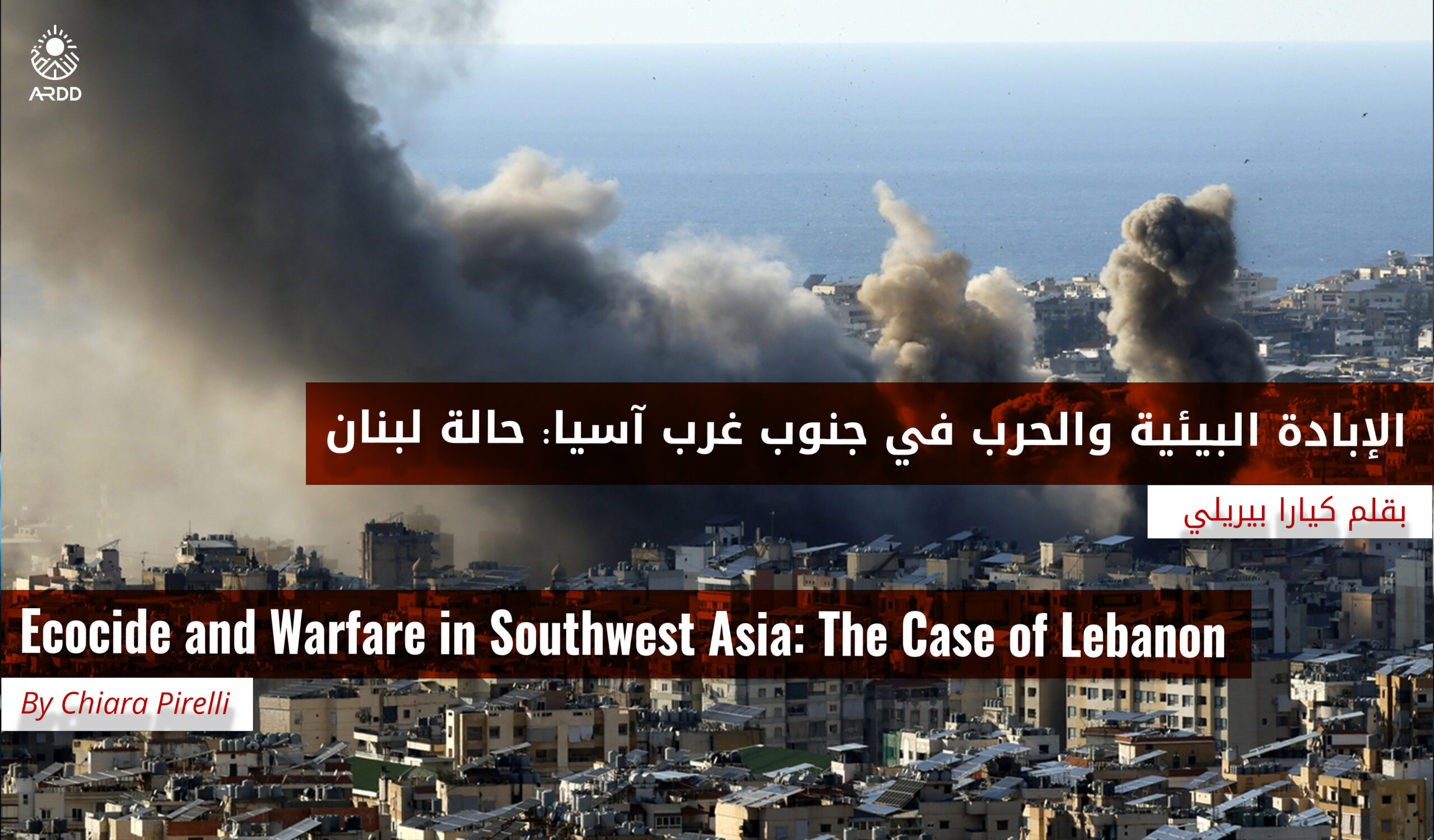
By Chiara Pirelli, RSC Intern
In recent years, the environmental consequences of conflicts in Southwest Asia have intensified dramatically. Grave geopolitical instability has affected the region for decades, causing recurrent and extensive humanitarian crises. Alongside, a new element has emerged: ecocide. Ecocide is defined as “unlawful or wanton acts committed with knowledge that there is a substantial likelihood of severe and either widespread or long-term damage to the environment being caused by those acts.” Chemical contamination, deforestation, water pollution, and the destruction of agricultural systems have completely transformed Southwest Asia.
This environmental destruction is not simply a consequence of conflict, but it is a deliberate strategy of warfare aimed at the eradication of indigenous populations from their land, by making large portions of territory inhabitable.
Increasingly, scholars have studied the phenomenon of ecocide alongside genocide and crimes against humanity. As genocide is defined as the group of actions perpetrated in order to destroy a national, ethnic, racial, or religious group, ecocide functions as a method of genocide by undermining the ability of ecosystems and communities to sustain life, therefore threatening their survival altogether.
Just last month, we observed Land Day, reminding us a reality that many are unfortunately overlooking: the Palestinian right to exist on their own land and the violence directed at them for their determination to remain there, despite the catastrophic situation affecting even the soil.
The Gaza Strip, where Israeli high-intensity military operations resumed in 2023, is arguably the area that has suffered the most from “ecocidal” harm in the region. As of April 2025, the UN Food and Agriculture Organisation (FAO) found that less than five percent of Gaza’s cropland remained available for cultivation. All of the greenhouses, as well as most of the agricultural wells, have been destroyed. Together with mass displacement and Israel’s hindrance of humanitarian aid, this has increased the risk of famine for the 2.1 million people living in Gaza. In a region where land is closely linked to identity and survival, the destruction of the environment is heavily weighing on the ongoing genocide of Palestinians.
Similarly, in Syria, the civil war and the current political instability have damaged the ecological system severely. A study has found that irrigated land has decreased by 50% because of the conflict. Between 2011 and 2016, the agricultural sector in Syria lost $16 billion, 41% of the GDP. While agriculture suffered profoundly, air pollution is another significant issue. Aerial bombardments, especially the ones targeting oil facilities, cause wildfires, dust storms, chemical spillovers, undermining agricultural activity, and resulting in high levels of PM2.5, inhalable particles that cause respiratory and cardiovascular diseases. The contamination also affects soil and groundwater. The deliberate burning of oil wells creats incalculable environmental damage as millions of barrels are spilled and pollutants damage the atmosphere and the surrounding ecosystems, making life unlivable for future generations.
Moreover, Southern Lebanon represents another areas most affected by “ecocidal” harm, largely traceable to Israeli military operations. In 2024, the World Bank (WB) estimated environmental damage at $221 million and agricultural loss at over $1 billion. While these numbers express monetary losses, they suggest the size of the systemic destruction of Lebanon’s environment and, therefore, its economic sector. Farmland, especially olive groves, represents the main source of sustainment of many communities in the area. These operations have rendered large patchworks of land unusable: just one strike in February of 2026 has affected 540 hectares. The use of the herbicide ‘glyphosate’ has played a significant role in enabling this level of environmental degradation. While glyphosate is usually employed in agriculture to eliminate weeds, in southern Lebanon this chemical has been systematically used by the Israeli army as a weapon to destroy crops and reduce soil fertility. In addition to the destruction of agricultural practices, studies have proven how glyphosate is toxic for humans, and, as a result, the contamination of soil carries direct implications for food security. Regarding the use of glyphosate, president Joseph Aoun denounced the Israeli attacks as “environmental and health crime[s] against Lebanese citizens and their land.”
Alongside the dispersion of chemicals over large areas, ecocide can also be observed in the destruction of infrastructures that support environmental stability. The 2024 attacks in the city of Tyre are an example of this. Part of the strikes targeted water distribution facilities, which resulted in safe-water scarcity for around 400,000 people, and for agriculture and farming. However, this is not an isolated episode: it has been estimated that between October 2023 and April 2025, Israeli military operations have destroyed at least 34 pipeline networks crucial for irrigation, which suggests a systemic pattern of disruption that undermines both agriculture and civilian access to essential resources.
Additionally, the alleged extensive use of white phosphorus (WP) has further contributed to the destruction of ecosystems in Lebanon. WP is a chemical substance mainly used as an incendiary and it is “harmful to humans by all routes of exposures” causing “deep and severe burns, penetrating even through the bone” according to the World Health Organisation (WHO). Beyond the severe danger for civilians, the incendiary nature of WP has caused large fires throughout the region and has left toxic residues in the environment, leading to soil infertility and the destruction of biodiversity. In many incidents throughout the years and most recently after the start of the war in Iran in 2026, it has been reported Israel’s use of the substance over populated areas. Research by the Lebanese Ministry of Agriculture has found that more than 800 fires have been caused by white phosphorus use, damaging approximately 20 million m² of land.
Furthermore, the debris caused by the attacks introduces another layer to the environmental harm. Apart from the cost of removal and rebuilding, rubble in Lebanon is often laced with high-risk carcinogenic materials such as asbestos, which are released into the environment. The Lebanese construction industry extensively uses asbestos, especially for roofing and pipes. A study has estimated that in November of 2024 the construction demolition waste was up to 100 million tons. The study also notes that “rubble generated from wars and conflicts particularly have an extra hazardous component… of unexploded ordinance, human remains, white phosphorus, e-waste, and heavy metals…”. In September 2025, 150,000 tons of waste contaminated with asbestos were stored in Beirut’s Karantina area. Asbestos, in all its forms, has been recognised as a carcinogenic substance.
These cases illustrate how ecocide is a recurring feature of conflict across Southwest Asia. In all Southwest Asia, the collective impact of warfare goes beyond destruction. Soil infertility, contaminated water, and air pollution undermine the ability of communities to sustain themselves in their lands. In this context, ecocide is not only a byproduct of conflicts, but a strategy that reshapes ecosystems and life conditions, often reinforcing patterns of displacement and destruction associated with genocide.
Past conflicts show how the ecological footprints of military operations can persist for decades, impeding the possibility of recovery of pre-war livelihoods. The current bombing of oil infrastructures, as in Tehran in March 2026 and in other SW areas, is another illustration of this ecocide systematic attacks. The environmental impacts extend to water pollution, long-range transport of smoke, and different climate implications such as accelerated warming and greenhouse gases emissions. It is essential to note that modern warfare heavily contributes to environmental damage, accounting for 5.5 percent of the global greenhouse gas emissions.
This impact is often overlooked and just assessed generations afterwards.
Taken together, these dynamics highlight the urgent need to incorporate environmental protection into conflict frameworks. This includes monitoring and accountability procedures, as well as the recognition of ecocide within international legal systems. Without such measures, the consequences of ecocide will continue to be endured uniquely by the native communities, disproportionally affected and targeted for living in their own land.