Amid the growing challenges facing education systems in the region, particularly regarding inclusion and equity, the need for new approaches is becoming increasingly urgent. Such approaches must reposition girls and young women as key actors in shaping the future of education, rather than merely beneficiaries. In this context, the Arab Renaissance for Democracy and Development (ARDD) concluded, on Tuesday, 28 April 2026, the activities of the “Nidaa’ for Change” project under the title: “Young Women’s Journey in Leading Advocacy for a More Inclusive Educational Future.” This closing event reflected a clear strategic orientation toward empowering young leadership and strengthening women’s roles in the public sphere.
The event brought together partners of the IGNITE project, the Rene Moawad Foundation, and the National Alliance for the Future of Education in Jordan, along with ARDD’s Women and Youth Networks, representatives from the academic sector, education experts, and the families of participants. It created a dynamic space for dialogue, reflecting the convergence of efforts between civil society, policymakers, and knowledge actors.
The event was marked by a strong participatory spirit. Participant Alaa Danoon served as the event moderator, signaling a gradual shift toward engaging young women in leadership roles. In her opening remarks, Project Manager Malak Suleiman emphasized that investing in girls’ capacities and leadership constitutes a key entry point for strengthening inclusive educational governance and for developing policies that are more responsive to the needs of diverse groups.
The event also featured the launch of findings from an analytical study presented by researcher Lin Masoud from the Renaissance Strategic Center. The study explored the relationship between education systems and the development of girls’ leadership skills, highlighting existing structural gaps and proposing practical pathways to reorient education policies toward greater inclusion and empowerment.
Participants’ experiences stood out as a practical translation of this vision. Miral Al-Zoubi, Majd Al-Masaeed, Sadeen Hassouneh, and Leila Hindi presented their field initiatives during a panel discussion moderated by Dr. Marwa Khamis, representing NAFE. These initiatives reflected a diversity of interventions, including promoting the inclusion of students with disabilities, developing digital learning tools, drug prevention, and youth skills development, demonstrating a clear shift from training to direct community impact.
During the graduation ceremony, graduate Aryam Al-Daadoosh shared a powerful testimony on the transformation experienced by participants. Meanwhile, coach and mentor Emad Abu Saleh, specializing in leadership and advocacy campaigns, offered an analytical reflection on the capacity-building journey and how it has strengthened young women’s confidence in engaging with decision-makers.
In this context, Carina Elia, representative of the Rene Moawad Foundation, highlighted the transnational dimension of the experience, stating: “What is emerging from this collaboration goes beyond being a local intervention in Jordan. It presents a model that can be adapted and scaled across the Arab region to empower girls as agents of change and partners in shaping policies and alternatives. This experience holds real potential to inspire similar initiatives that strengthen the role of young women as drivers of change across diverse Arab contexts.”
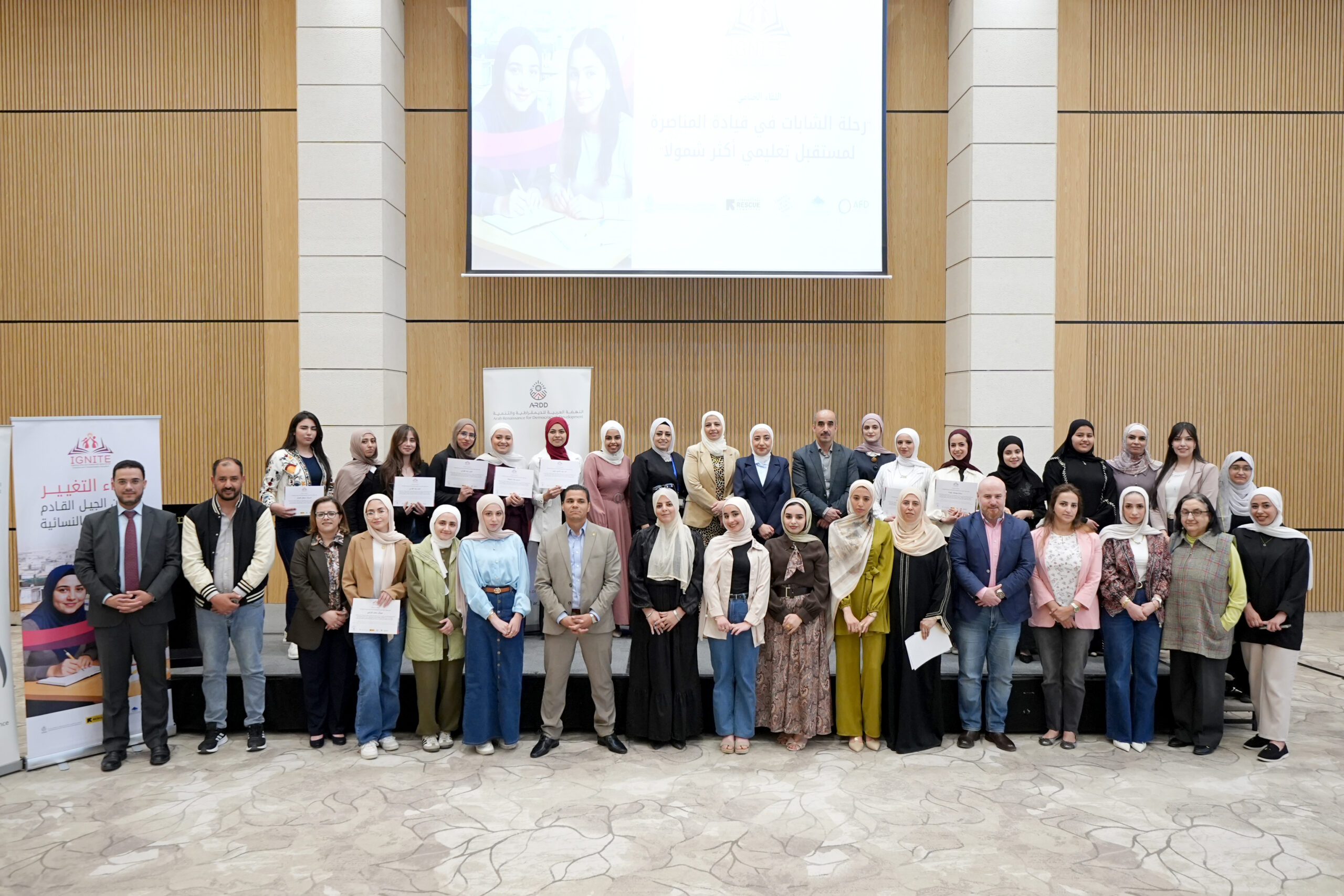
The event concluded with the graduation of the participants and the distribution of certificates, reaffirming that “Nidaa’ for Change” is not merely an endpoint, but rather a cumulative pathway for investing in young women leaders and strengthening their presence in public spaces and decision-making processes.
It is worth noting that the “Nidaa’ for Change” project was implemented by Arab Renaissance for Democracy and Development (ARDD) as part of the IGNITE project – Inspiring Girls and Grassroots Networks for Inclusive and Transformative Education – with support from the Rene Moawad Foundation, funded by the Agence Française de Développement, and in partnership with the International Rescue Committee. The project targeted girls aged 15 to 19 from refugee and marginalized communities in Amman and Mafraq.