
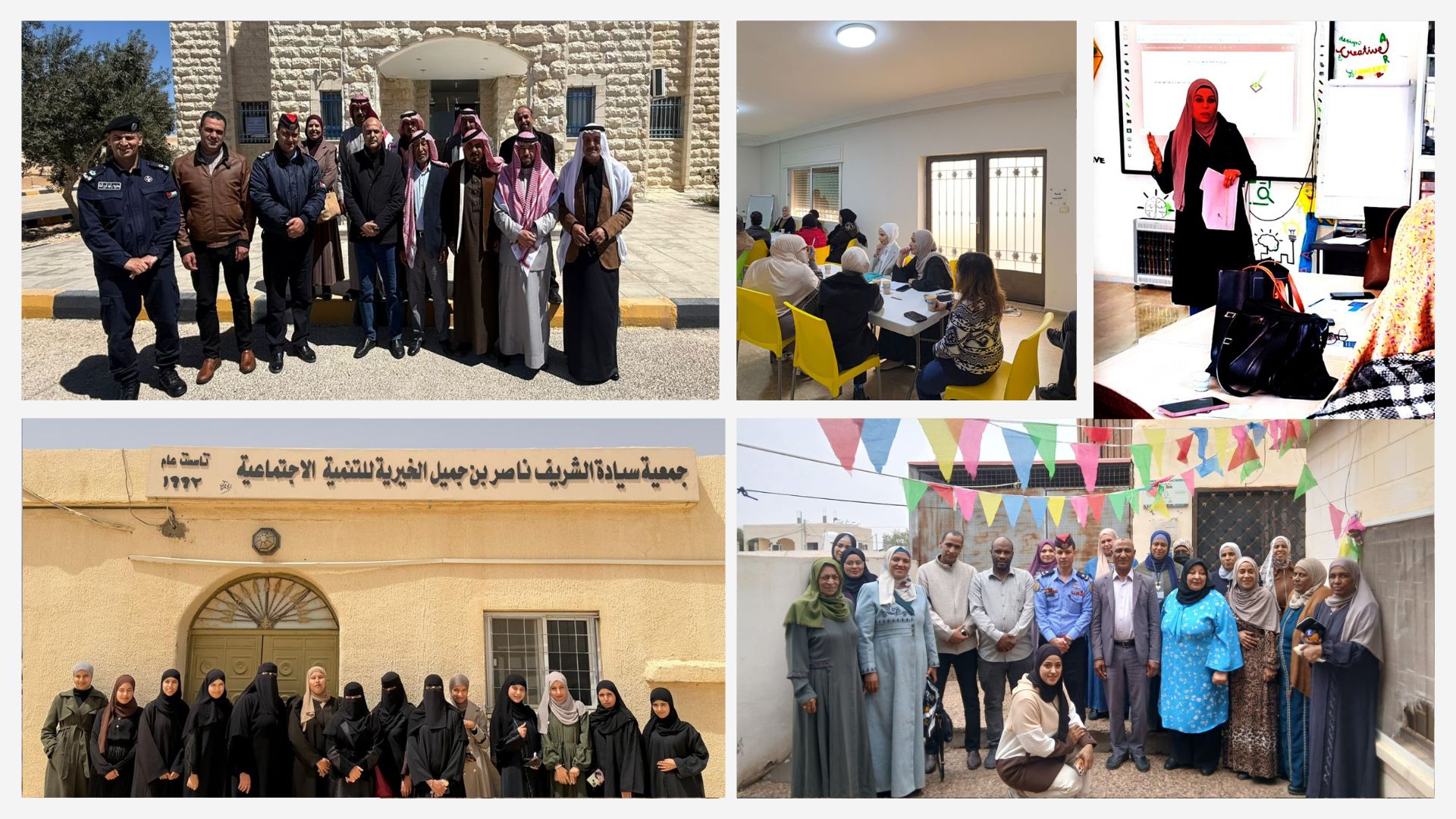
The Arab Renaissance for Democracy and Development (ARDD), in cooperation with UN Women Jordan and in partnership with the following local associations: Jordanian National Forum for Women – Tafila, Shuqeira Association for Social Development – Karak, Al-Jawhara Association – Ma’an, Be Positive Association – Amman, Ghor Al-Safi Women’s Association for Social Development – Southern Jordan Valley, and Ashareef Naser Ben Jameel Association – Aqaba, all members of the Tawasol Network, implemented a series of strategic awareness sessions on crisis management and early warning during March and April 2026 in Tafila, Karak, Ghor Al-Safi, Ma’an, Aqaba, and Amman.
These strategic sessions aimed to enhance community awareness on crisis management and early warning systems, strengthen community preparedness, and build a shared understanding of response and coordination mechanisms among local actors, contributing to stronger integration between community and official roles in local crisis management.
The sessions targeted around 120 participants from Tawasol Network members, local community representatives, and civil society organizations, in addition to women, youth, and persons with disabilities. The aim was to strengthen knowledge and understanding of crises, early warning concepts, and community response mechanisms, while raising awareness and developing an initial understanding of possible local-level procedures and roles to ensure a more effective and inclusive response.
The sessions witnessed broad participation from local community members, employees from the public and private sectors, and representatives of official entities such as the Ministry of Agriculture, the Ministry of Education, environmental directorates, and municipalities, in addition to charitable associations and university students.
The sessions also engaged diverse groups of young men and women, university students, housewives, community activists, and representatives from municipalities and local administrative bodies, with the aim of enhancing community participation and exchanging experiences among different groups.
These sessions were implemented within the framework of the Tawasol Project, where member associations of the network, after receiving intensive training on crisis management, leadership, and UN Security Council Resolution 1325, directly conducted the sessions within their local communities. This strengthened their role as active actors in disseminating knowledge and promoting effective local crisis management practices.
The sessions focused on introducing participants to the concepts of crises and disasters and differentiating between them, while reviewing different types of crises, including economic, health, environmental, and social crises. They also highlighted the importance of early warning systems and their role in reducing the escalation of crises.
In addition, the sessions addressed community response mechanisms through awareness-based approaches, enhancing participants’ understanding of possible community-level roles and the importance of initial coordination with official entities such as municipalities, governorates, and crisis management bodies, without the sessions constituting direct operational training.
In this context, participants emphasized the pivotal role of women in strengthening community response and reaching the most vulnerable groups. They highlighted successful women-led initiatives in Jordan related to crisis and disaster adaptation, including water harvesting projects as a tool for adapting to water scarcity and drought, awareness-raising on early warning, and support for small businesses to enhance economic resilience.
Participants also stressed the importance of engaging women, youth, and persons with disabilities as active partners in local decision-making and strengthening the role of civil society organizations as active actors in crisis prevention and response. Participants noted that “every crisis has early warning signs, and understanding these signs saves lives,” emphasizing that “the participation of women and youth strengthens community resilience.”
At the conclusion of the sessions, participants proposed a number of recommendations through interactive discussions among different community groups. Key recommendations included developing clear emergency plans for various types of crises, enhancing transparency in information-sharing, supporting the most affected groups, investing in infrastructure and technology, and promoting community values based on cooperation and responsibility.
These recommendations reflected local community priorities and needs and were documented as inputs that will contribute to strengthening future programmatic planning at the network and local partner levels, linking the outcomes of the sessions to future pathways of action within the Tawasol Network framework.
These efforts reaffirm the role of the Tawasol Network as a collaborative platform that contributes to empowering local organizations, particularly women-led organizations, and strengthening their contribution as active actors in building more resilient and inclusive communities, in line with Jordan’s peace and security priorities.
This initiative comes within the framework of ARDD’s “Women’s Access to Justice” program and as part of implementing the Jordanian National Action Plan on UN Security Council Resolution 1325 (JONAP II), with support from the JONAP Pooled Fund, reaffirming the importance of strengthening women’s roles in peacebuilding and enhancing community preparedness in responding to crises.