
By Matilde Picarazzi, RSC Intern
Climatic, economic and political crises rarely occur in isolation. Droughts, food shortages and conflicts often combine to create cascading humanitarian emergencies for already vulnerable communities. The situation along the Jordan-Syria border is a clear example of how deteriorating water quantity and quality place an enormous burden on an already fragile food system. Agriculture is no longer a reliable source of income for many families, pushing them to migrate to cities or to depend on unstable cross-border trade routes, frequently subject to political tensions. Ongoing conflict, rising violence and drug trafficking have brought tighter security controls, making trade even more unreliable. Moreover, even if coordinated action and community-led adaptation are essential to reduce disaster risks in this fragile region, persistent geopolitical tensions complicate the negotiation of balanced cooperation frameworks, highlighting the sensitive trade-off between Syria’s land recovery that could bring regional stability, and Jordan’s access to vital transboundary water resources, as Syria’s agricultural revival may also intensify Jordan’s water scarcity downstream. The convergence of these factors is reshaping socio-economic conditions in northern Jordan and forcing adaptation in household livelihoods.
Jordan freshwater supply originates in transboundary basins, leaving the country mainly dependent on upstream neighbors. This dependence is especially visible in the Yarmouk-Jordan River system (the Jordan and Yarmouk Rivers are critical water sources in the Middle East), where reduced flows, over-extraction, and recurring disputes have progressively undermined water security. Jordan’s water scarcity, indeed, is not solely a product of absolute shortage but also of inequitable distribution and limited regional cooperation. The Jordanian government has pursued supply-side measures such as new desalination projects, reductions in leakage, and the Red Sea–Dead Sea pilot water transfer program. Yet, in borderland areas far from major cities, these interventions often are unresponsive to the real needs, disproportionately affecting rural households and aggravating inequalities. Groundwater resources, are now extracted at nearly twice their sustainable capacity, while rainfall-fed recharge continues to decline. In this context, agriculture stands at the center of the dilemma, consuming over half of national freshwater but contributing only about 5% to GDP. The situation is particularly acute in northern governorates bordering Syria, such as Mafraq and Irbid. Here, dependence on transboundary water coincides with socio-economic pressures, refugee inflows, and heightened security measures along the border. These factors increase costs and uncertainty for smallholder farmers. Deteriorating water quality further undermines agricultural viability, especially for small-scale producers unable to afford desalination, pumping, or water-saving technologies, and forced to rely on treated wastewater.
Jordan and Syria’s 1953 and 1987 accords on the Yarmouk River left water-sharing ambiguous. Syria and its 42 dams now claim 80% of the Yarmouk’s water, undermining Jordan’s ability to meet its commitments. This imbalance reflects a broader asymmetry of power and political maneuvering rather than purely technical disputes. The influx of 1.3 million Syrian refugees further exacerbated the region’s water crisis in northern governorates, causing severe environmental and health concerns for refugees and locals. The Syrian conflict has profoundly reshaped the shared water and land resources along the southern Syria-northern Jordan border, as forced displacement, with little prospect of an immediate return, dismantles agri-food system livelihoods and reduces food production. Years of violence, displacement, and the decline of irrigated agriculture land use in southern Syria following the upsprings and crisis have unintentionally led to increased flows in the Yarmouk River, temporarily easing water stress for Jordan. However, this situation reflects disruption rather than sustainable management. Research shows that if agriculture in southern Syria recovers to pre-conflict levels, transboundary flows to Jordan will be critical.
At the same time, Syrian refugees play a significant role in the local agricultural labor force. Receiving direct support from UN agencies, they may accept lower wages and informal employment, giving them an advantage on the labor market compared to local workers, as farm owners can thus reduce production costs. However, about one third of Syrian refugee households are female-headed, which means that the agricultural labor force is also composed mainly of women employed as casual and seasonal workers. Yet they earn only half the wages of men, have little bargaining power, and remain underrepresented. Their access to work is limited due to social norms, mobility constraints, and household responsibilities and safety is also a concern, as exposure to agrochemicals is very dangerous for fertility. All these factors contribute to high food insecurity rates that exponentially increases as farm owners are able to exploit refugee workers.
Recently, UNHCR Jordan has begun offering assistance to refugees who choose to voluntarily return to Syria, and this may have significant implications for reshaping local agricultural economies, even though data is still being collected. In a possible future scenario, the absence of the labor force on which the sector has long relied will force farm owners to employ more locals, requiring higher wages and increasing production costs as well as product prices. Moreover, producers are relying on short-term coping strategies rather than long-term stability plans. For example, the use of contaminated water for irrigation increases the presence of insects, prompting greater use of pesticides, which in turn worsens the quality and taste of products. These production difficulties also have commercial repercussions, as failing quality tests makes products unsuitable for export.
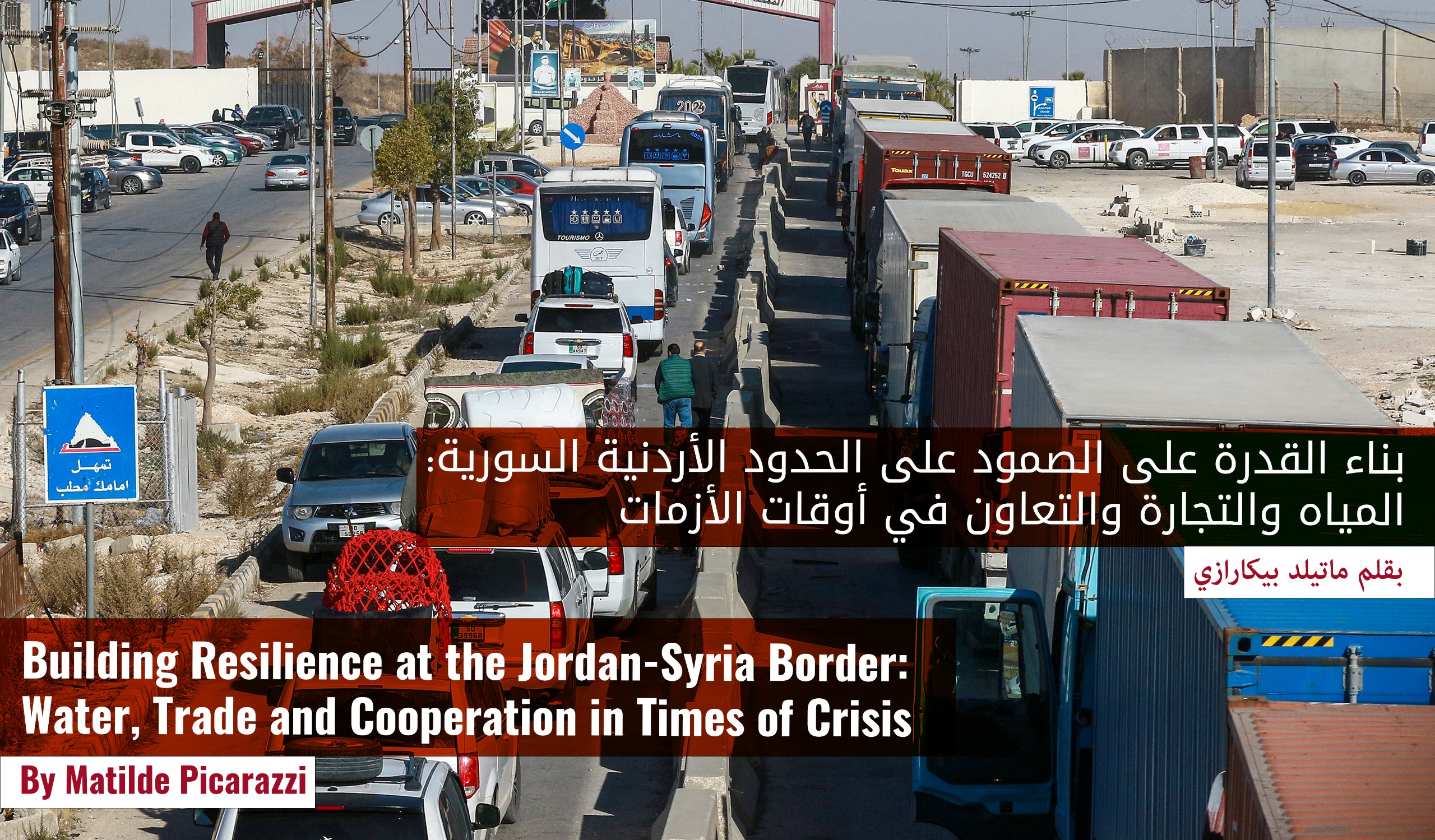
As the agricultural sector collapses, northern communities are relying on international markets for their food supply, since products imported into Jordan are usually less expensive than those sold in the country’s local markets. However, even this system is becoming increasingly fragile: the conflict in Syria has disrupted traditional trade routes, and the growing politicization of food exposes the population to major price fluctuations. Known as the “country’s northern lungs,” the Jaber/Nassib border crossing between Syria and Jordan clearly illustrates how sudden policy shifts at borders can act as economic shocks equivalent to a drought. The inability of states to replace their dependence on this route during its periodic closures, caused by the Syrian war (April 2015 – October 2018), COVID-19 restrictions (July 2020 – June 2021), and tighter security measures due to drug and weapons smuggling and Iranian militant activity in Syria’s southern borderlands, resulted in food price spikes and rising anemia rates among women and children, as households were forced to reduce dietary diversity. Conversely, when border controls eased, trade flows and prices stabilized quickly, with an immediate positive impact on livelihoods.
Recent studies in Jordan have focused on exploring how host communities and refugees are co-generating livelihoods in the agri-food sector, seeking science-based solutions for rural resilience in conflict-affected areas. In fragile border regions, disaster risk is multidimensional: climate, conflict, displacement, and governance are deeply intertwined. Reducing risk therefore requires a whole-of-system approach. Water resource allocations should reflect current realities rather than outdated treaties, and they must incorporate climate projections. Stable and predictable border routes should enable traders and farmers to plan ahead, minimizing economic shocks caused by abrupt closures. Policies should also strengthen the role and agency of women farmers. Moreover, National Adaptation Plans, disaster risk reduction strategies, and early warning systems should fully include the voices and specific needs of affected communities.
The choice is no longer between short-term coping and long-term stability: communities living at the margins deserve more than mere survival. Yet without prompt intervention, the cycle of vulnerability will only deepen. What is needed now is a shift from emergency response to structural resilience, so that borderland populations can gain not only the means to withstand shocks, but also a future grounded in dignity, security, and lasting stability.