By Abigail Harper, RSC Intern
“Education for all” is a commitment the global community renews every year on 24 January – the International Day of Education. Established by the United Nations General Assembly Resolution 73/25 in 2018, the day emphasises the central role of education in achieving equality, resilience, and long-term well-being, particularly for communities suffering from displacement, violence, and instability. By marking the day, the UN seeks to raise awareness and encourage global action and investment to ensure inclusive, equitable, and quality education for all. Observed annually, this day underscores that access to education is not merely a policy objective but a fundamental human right and a cornerstone for building inclusive societies.
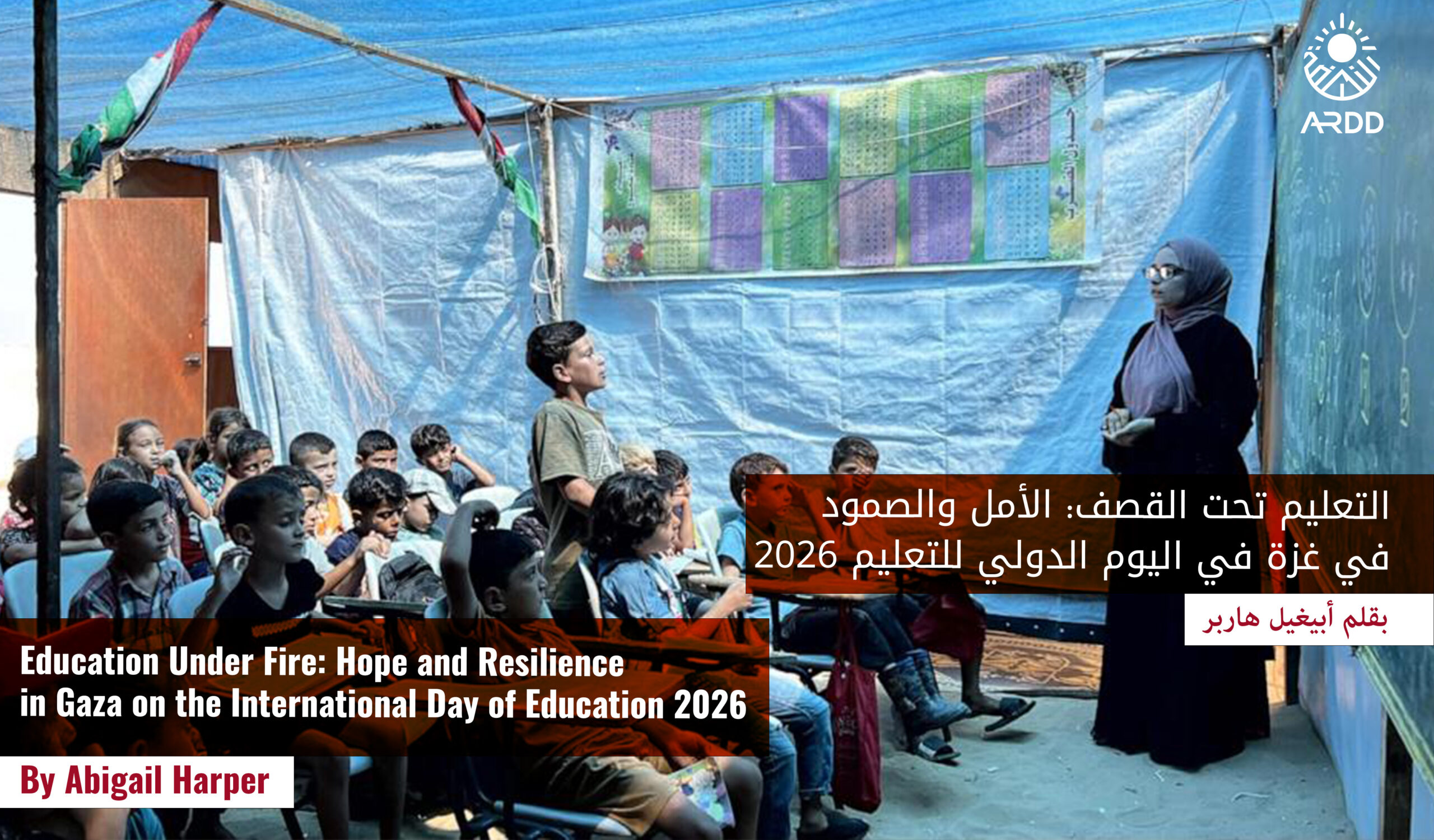
This year, the International Day of Education coincides with global efforts to rebuild education infrastructure in Gaza, where 408 000 school-aged children (62% of the total population) have been unable to access any form of learning in the past two years. What little education is on offer for the remaining 250 000 has been provided by Temporary Learning Spaces, including those managed by UNRWA, as well as the UNRWA Remote Learning Programme. The official beginning of the school year in the Occupied Palestinian Territory in September marked the beginning of the third consecutive school year in which some 658 000 children in Gaza will be deprived of their right to a complete education.
The impact of this deprivation cannot be overstated. A recent international study by the University of Cambridge, in partnership with the United Nations Relief and Works Agency for Palestinian Refugees, has warned of the risk of a “lost generation” of children in Gaza. The study, released in early 2026, highlights the real scale of the education crisis in the conflict zone. As of 1 October 2025, OCHA had reported the deaths of 18 069 students and 780 education workers, as well as injuries to 26 391 students and 3 211 teachers. Moreover, approximately 92% of all schools in Gaza require complete physical reconstruction as a result of damage from airstrikes.
The two years of conflict in the Occupied Palestinian Territory have had serious educational, physical, and psychological effects on students and teachers, such that even during a ceasefire, reopening schools is not straightforward. In September, at the start of the school year, the UNRWA Commissioner General stated: “Today, instead of going back to school, like most children around the world, around 660 000 girls and boys in Gaza will be sifting through the rubble, desperate, hungry, traumatized, and mostly bereaved. The longer they stay out of school with their trauma, the higher the risk they become a lost generation, sowing the seeds for more hatred and violence.”
Lack of infrastructure is not the only barrier to education. Other factors that limit access include the fear that causes thousands of teachers to abandon their posts, or prevents parents from sending their children to school out of fear of the physical danger their children face, both when travelling and while in the classroom.
Despite the dangers, many families persist in sending their children to schools, aware that education is the key to unlocking their future. This is the case in Gaza’s “yellow zone”, where families have been forced to create makeshift “tent schools” in dangerous proximity to Israeli forces, which are often exposed to gunfire, forcing the children to interrupt their learning to lie on the ground until the shooting stops. “The destructive impact of conflict is being felt by children right across the region,” said Peter Salama, Regional Director for UNICEF in the Middle East and North Africa. “It’s not just the physical damage being done to schools, but the despair felt by a generation of schoolchildren who see their hopes and futures shattered.”
It is important to note that the destruction of education infrastructure is not a side-effect of the conflict. Scholasticide– the systematic and deliberate annihilation of the education system in a region – is part of a long-term plan to erase Palestinian knowledge, culture, and people’s capacity to rebuild both physically and intellectually. UN experts expressed concerns about the pattern of attacks on schools, universities, teachers, and students in April 2024, calling for parties to comply with the measures ordered by the ICJ in January. Despite this, over a year and a half later, the international community has done little to prevent Israeli forces from targeting educational facilities in an attempt to hobble the cultural and intellectual development of a generation of Gazans. As recently as 6 January, eleven Palestinian students were injured when Israeli forces raided the campus of Birzeit University north of Ramallah, firing live ammunition and tear gas.
Nonetheless, amid the gloom, there is some cause for hope. Flagship initiatives such as the Better Learning Programme, funded by Education Cannot Wait, are bringing together teachers, caregivers, and counsellors to create safe, supportive learning environments that can help children to cope. Combining basic education – including Arabic and mathematics – with therapeutic tools like breathing techniques, storytelling, and guided drawing helps children to process trauma and stress, restore a sense of normalcy, and nurture hope.
During the ceasefire at the start of 2025, schools reopened with remarkable speed. In September, despite overwhelming challenges, 28 200 students in Gaza sat their Tawjihi exams for high school graduates online. Achieving this milestone, which one teacher described as “a miracle”, is a testament to the extraordinary resilience of young Palestinians.
There is also positive news in the realm of higher education. At the end of December, a graduation ceremony was held for 170 newly qualified doctors in the remains of Al Shifa Hospital in Gaza City. Despite the extensive damage – most of the hospital’s buildings and equipment destroyed or rendered inoperative by Israel’s attacks during the genocide – friends and families gathered to celebrate the achievement – the Palestinian Board Certification, the highest medical specialty credential in the Occupied Palestinian Territories.
These successes are evidence that hope persists in Gaza. Yet three key challenges continue to block students’ access to education: security risks, lack of infrastructure, and severe teacher shortages – all problems that are being exacerbated by the ongoing conflict. Recent announcements regarding President Trump’s Board of Peace have so far failed to clarify whether any plans exist to address these obstacles when approaching the task of reconstructing Gaza’s education system. Even so, a lasting and sustainable peace agreement remains the essential first step towards this goal. Only once this has been achieved can the extensive resources required to repair the conflict’s physical and psychological toll be mobilised, allowing schools, teachers, and students the chance to recover. Until that time, charities and local volunteer networks offering temporary learning spaces remain the primary source of educational hope for young Gazans.
For children and young people growing up amid prolonged conflict and humanitarian crises, quality inclusive education can be a lifeline. It offers a sense of safety, routine, and hope in the midst of trauma, while providing students with the knowledge and skills they will need to heal and rebuild their communities once the conflict is over. Education in conflict zones is more than just a fundamental right; it is a crucial tool for peacebuilding, resilience, and hope. Recognising the challenges and successes around education in Gaza is a key step in identifying the next stages needed to restore a community that can support the development of future generations. Acknowledging this fact on the International Day of Education reaffirms that education is not merely a technical service – it is a key humanitarian tool for rebuilding lives and sustaining hope in otherwise desperate environments.