
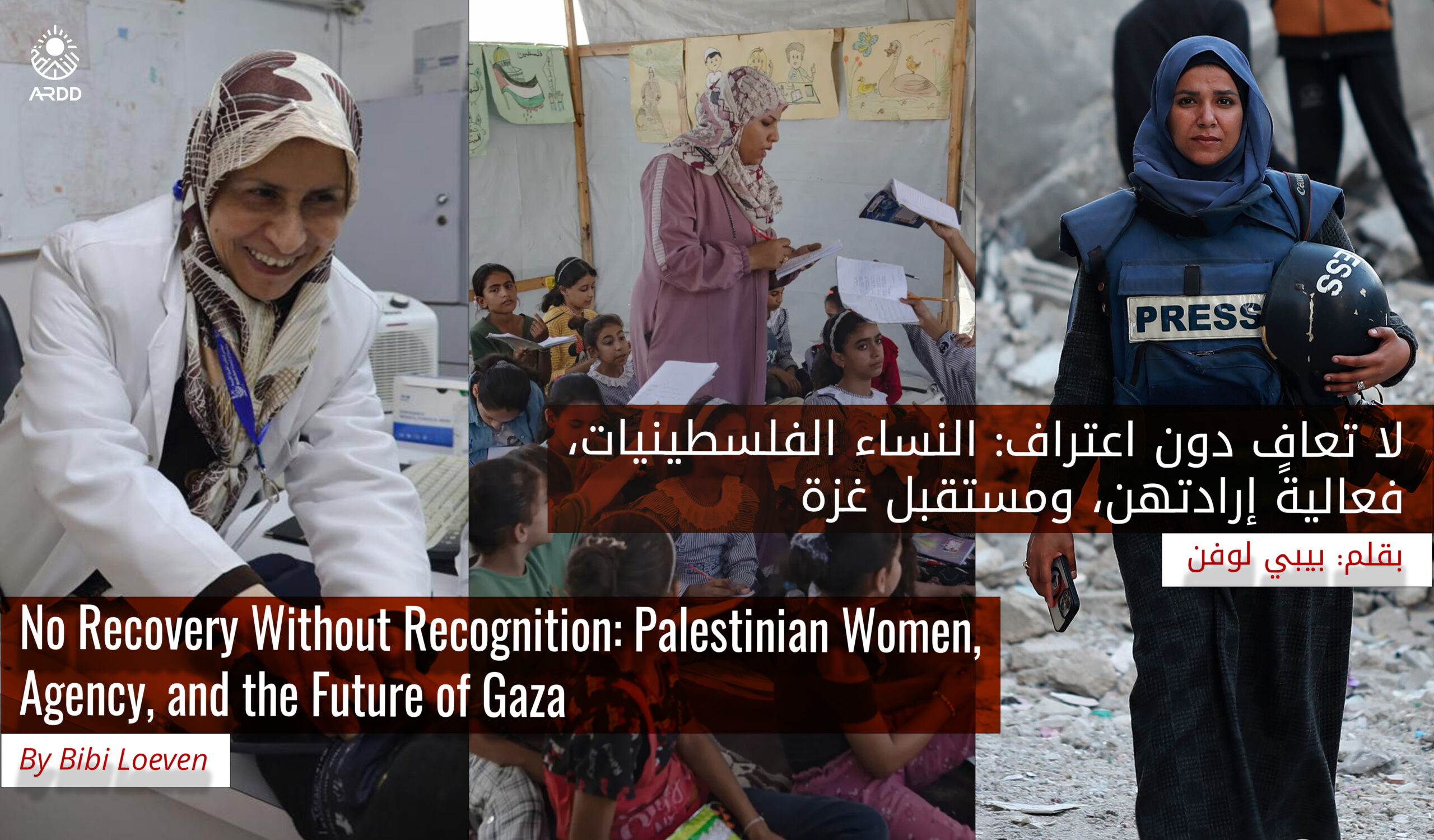
By Bibi Loeven – RSC Intern
Palestinian women have historically been central to the national struggle, organizing at the grassroots level, driving political mobilization, and safeguarding Palestinian identity and culture under occupation. During the ongoing genocide in Gaza, they have continued to serve as the primary anchors of family and community survival, while enduring extreme hardship and heightened risks of gender-based violence. Yet their forms of agency, informal, non-institutional, and deeply rooted in everyday resistance, remain largely invisible to Western media and international institutions, which persist in framing Palestinian women primarily as victims rather than actors. Before Gaza begins its long and arduous reconstruction, this must change. Meaningful recognition of the agency and leadership of Palestinian women is a prerequisite for any recovery process that is truly inclusive, equitable, and gender-sensitive. Without it, reconstruction risks solidifying the very social injustices it should seek to dismantle.
First Manifestations of Female Resistance
In 1936, simmering resentment at British rule in Palestine erupted into the Great Revolt, an uprising in which women played a central role. Fellahast, peasant women, concealed weapons beneath their clothing and traversed the terrain to relay intelligence on British troop movements to guerrilla fighters, often finding themselves caught in crossfire. In the cities, women took to the streets, raised funds for the rebellion, and submitted written demands to the British authorities calling for an end to their violent policies.
Although female resistance proved crucial during the Great Revolt, Palestinian women had already begun organizing as early as 1920, primarily through non-institutional channels. The killing of nine Palestinian women during protests against British colonialization in 1929 directly prompted the founding of the first Arab Women’s Association and the Arab Women’s Union, both of which mobilized demonstrations and lobbied Arab leaders for support. Some organizations went even further: Zahrat al-Uqhawan — “the Chrysanthemum Flower,” founded by Moheeba and Arabiya Khursheed as a social NGO — eventually transformed into an armed group, taking up weapons against British forces.
These patterns of non-institutional political organization are characteristic of contexts in which an exclusionary national or foreign power oppresses a minority or disempowered majority. Excluded from formal political institutions, Palestinian women found ways to resist colonial oppression from outside those structures, through both peaceful and armed means.
Resistance Against the Occupation
As Israeli occupation took hold, female resistance evolved accordingly — driven not only by a nationalist agenda, but also by the impact of occupation on women’s daily lives that persist until this day. The demolition of homes disproportionately affects women, stripping away spaces of bodily safety, privacy, and the familial networks that form their social support systems. Checkpoints and curfews severely curtail women’s mobility, limiting their access to essential services such as healthcare; in extreme cases, women are forced to give birth at checkpoints. Curfews and the constant risk of being unable to return home also led families to keep their daughters out of school. Furthermore, the occupation heightens exposure to sexual harassment — for instance, when women are compelled to remove their veils or clothing at checkpoints during security inspections.
Resistance to these oppressive conditions initially included women who had already been mobilized. They participated actively in the struggle against Israeli occupation, engaging in strikes, demonstrations, media outreach, and even military training in both the West Bank and Gaza. In 1965, the General Union of Palestinian Women was established as a mass organization aimed at contributing to the liberation of the Palestinian homeland while providing services to women. By 1978, the Union of Palestinian Women’s Working Committees had been founded — an organization that placed gender issues at the forefront of its agenda alongside its charitable and political objectives.
In 1987, an Israeli vehicle rammed into cars carrying Palestinian workers heading back to Gaza, killing four people. This incident proved to be the spark that ignited a widespread uprising against Israeli occupation, known as the First Intifada. The Intifada marked a transitional moment for Palestinian women’s agency: the popular struggle expanded beyond official women’s organizations and permeated the household level. Women who had previously remained on the sidelines joined protests, acts of civil disobedience, and boycotts of Israeli products, while simultaneously producing everyday necessities at home to bolster Palestinian national production. They supported families living under curfew and filled positions left vacant by the mass detention of men.
Yet the First Intifada also gave renewed force to a more foundational form of resistance: Sumud. This is a dynamic concept describing the continuous struggle of living under occupation while preserving the Palestinian culture in the face of systematic erasure. Sumud can manifest in quiet, non-violent acts, such as passing on the Palestinian language and history to the next generation, yet it simultaneously constitutes a constant, enduring revolution — one that sustains and protects a culture and identity beyond the reach of the oppressive regime. In this way, Sumud directly challenges existing power relations, rendering Palestinian women not merely subjects of occupation, but active and indispensable agents of resistance
The Continued Agency of Palestinian Women Amid Genocide
As Palestinians in Gaza endure mass atrocities amid the ongoing genocide, the agency of women has once again asserted its profound significance. In a context defined by extreme violence and mass displacement, women have mobilized their roles as caregivers to sustain family cohesion, preserving the emotional and social ties that hold households together, and extending this function outward to serve as a connective foundation for broader community solidarity. As the formal service infrastructure has collapsed entirely, women have assumed critical responsibilities by establishing shelters, coordinating the distribution of supplies, and delivering psychosocial assistance. It is through their demonstrated resilience and steadfastness that these acts of Sumud persist, even under the most extreme conditions.
Palestinian women are assuming these indispensable roles as community leaders while simultaneously being exposed to heightened risks of gender-based violence, driven by forced displacement, acute resource scarcity, and the breakdown of protective family and community structures. Delivering aid to survivors of gender-based violence has become near-impossible.
The Perception of Palestinian Women
While Palestinian women have been central to the survival of Palestinian identity, culture, and community for decades, patriarchal norms and the ongoing occupation systematically exclude them from official decision-making institutions. Palestinian political representative bodies remain manifestations of male dominance, continuously reaffirming rather than challenging these patriarchal structures. Meanwhile, the occupation has erected practical yet deeply structural barriers to women’s access to education, economic participation, and public life, compounding their exclusion from political power.
This exclusion is further entrenched by the failure of international interventions to achieve meaningful structural gender equality. That failure stems from a persistent refusal to recognize Palestinian women as political agents. Its effects are wide-ranging, most visibly in how international interventions routinely sideline women’s insights, ignoring the firsthand knowledge women hold about urgent community needs. This tendency is compounded by Western media, which consistently portray Palestinian women as passive victims of conflict rather than as actors shaping their communities.
Towards the Recognition of True Agency
Any meaningful rebuilding and recovery of Gaza must begin with recognition of how Palestinian women have demonstrated agency and sustained entire communities throughout the genocide, a role deeply rooted in their long history of resistance and organizing within the Palestinian liberation movement. Despite bearing disproportionate burdens of emotional and physical care, while enduring extreme hardship and heightened risks of gender-based violence, they continue to be framed as victims rather than as the political agents they are. Rectifying this demands transformation on multiple fronts: in how Western media depict Palestinian women, and in how international interventions are designed and implemented. Without the insights and leadership of women embedded at every level of reconstruction, efforts to foster genuine community survival and prevent the entrenchment of existing inequalities are doomed to fail.