
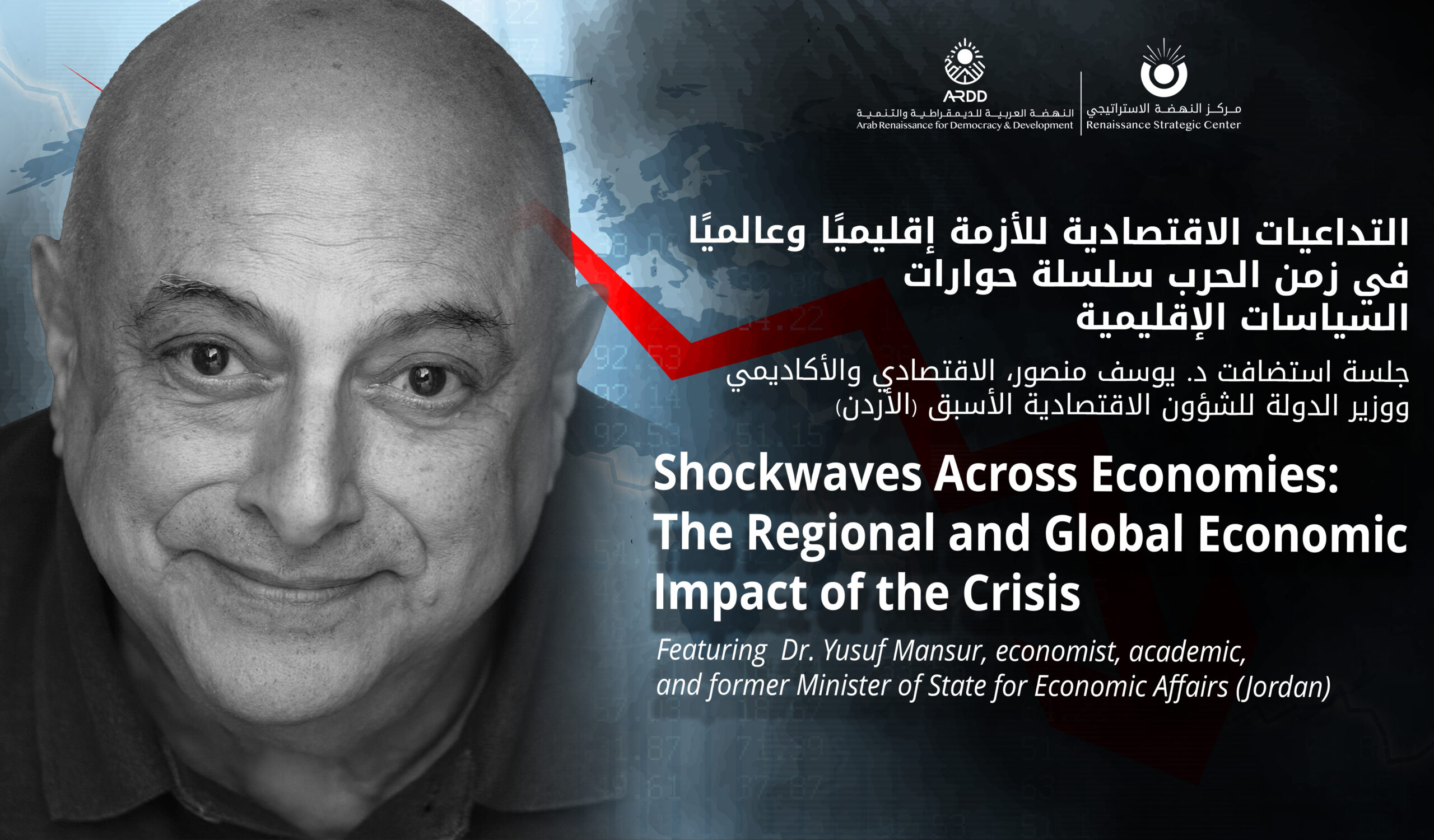
Times of War: Regional Policy Dialogue Series Session featuring Dr. Yusuf Mansur,
economist, academic, and former Minister of State for Economic Affairs (Jordan)
Overview
As the current regional escalation continues to unfold, its economic consequences are echoing far beyond the immediate theatre of conflict. Disruption of energy markets, trade routes, and financial systems is increasingly shaping both global and domestic economies.
To examine these developments, the Renaissance Strategic Center (RSC) at the Arab Renaissance for Democracy and Development (ARDD) is hosting Times of War: Regional Policy Dialogue Series, a set of webinars to analyze the geopolitical, economic, and societal dimensions of the evolving regional crisis. The second session featured Dr. Yusuf Mansur, economist, academic, and former Minister of State for Economic Affairs (Jordan), specializing in micro/macroeconomic reform, industrial modernization, economic development, and policy advice. The discussion focused on the structural economic implications of the ongoing conflict, with particular attention to its impact on Jordan and the wider region.
A Cumulative Crisis
Dr. Mansur began by situating the current crisis within a sequence of systemic shocks: the COVID-19 pandemic in 2020, the Russia-Ukraine war started in 2022 with its impact on wheat and fuel markets, and subsequent regional escalation in particular Israeli aggressions to the Gaza Strip and Southern Lebanon. These overlapping crises have transformed what might have been temporary disruptions into a structural global economic strain. Dr. Mansur noted that the current conflict can also be seen as a form of “global economic war,” marked by high market volatility and limited predictability. Additionally, unpredictable political decision-making in the United States adds another layer of risk to the current landscape.
At the global level, the response of major actors remains cautious. China and Russia have expressed support for Iran while avoiding direct confrontation, applying instead economic and strategic support. The trajectory of the crisis will depend in part on energy flows and the broader evolution of the geopolitical confrontation.
Transmission Channels: Energy, Trade, Investment, and Food
Dr. Mansur identified four key channels through which the crisis is propagating:
- Energy markets: rising oil and gas prices, amplified by market distortions and collusive behaviors among major producers.
- Global trade: increased shipping costs due to rerouting, insurance premiums, and maritime insecurity.
- Investment flows: heightened uncertainty that reduces capital inflows, particularly in the Gulf, with implications for labor-importing countries.
- Food systems: rising global agricultural prices driven by increased fertilizer costs and disrupted supply chains.
These dynamics are deeply interconnected. For instance, increased gas prices directly affect fertilizer production, while disruptions in Gulf economies contribute to reduced remittances and investment flows across the region.
Energy Markets and the Role of the Gulf
A central theme of the discussion was the shifting role of the Gulf economies in the current crisis. Traditionally, regional conflicts have driven up oil and gas prices in ways that benefit Gulf exporters. However, this pattern has changed now.
Although oil prices have risen to approximately $107 per barrel until now, Gulf countries are facing increased transportation and insurance costs, particularly due to risks around the Strait of Hormuz, closed by Iran less than a week after the US-Israeli attack. Alternative export routes, such as Saudi Arabia’s east-west pipeline to the Red Sea, introduce higher costs and logistical challenges, especially given the security concerns in strategic passages, such as Bab al-Mandab.
This shift underscored a critical transformation: Gulf economies, historically structured around rentier models, now are no longer insulated from geopolitical shocks in the same way as they used to be prior the war. Instead, they are increasingly exposed to disruptions in trade routes, insurance costs, and global demand fluctuations.
Jordan in a Gulf-Centered Economic System
Dr. Mansur analyzed Jordan’s position within this regional framework. The country is highly dependent on external flows, importing approximately 87% of its consumption and around 83% of its energy needs. As a result, it is particularly vulnerable to imported inflation, driven by rising global prices.
The Gulf plays a critical role in this system: remittances from Jordanians working in Gulf countries account for an estimated 7-8% of GDP. A slowdown in Gulf economic activity therefore, has direct effects on Jordan, including potential labor repatriation, although present trends remain less severe than previous crises.
At the same time, rising shipping and insurance costs are raising import prices through key entry points such as Aqaba, further amplifying inflation. These challenges are compounded by structural issues, including persistent unemployment and poverty, and high public debt, estimated at approximately 118% of GDP.
Dr. Mansur also mentioned precedents such as the 2003 Iraq War and the 2008 price surge, noting how Jordan has overcome previous oil price shocks. Regarding this, he also stressed the importance of government intervention in this context, especially in controlling prices to prevent speculation.
Policy Constraints and Strategic Opportunities
Dr. Mansur underscored that Jordan’s policy options are limited. With public debt exceeding GDP and a concentrated economic structure that is heavily reliant on tourism, banking, and government activity, fiscal flexibility is limited.
Monetary policy remains relatively stable, supported by approximately $28 billion in foreign reserves, covering up to 10 months of imports and potentially extending to two years, when accounting for external inflows. However, this stability does not eliminate underlying vulnerabilities.
In this context, Dr. Mansur argued that growth cannot rely on conventional private sector dynamics alone. Instead, the government must take a leading role in initiating large-scale projects, particularly through public-private partnerships (PPPs), despite their current political sensitivity.
Although the challenges, the crisis also offers strategic opportunities. Rising fertilizer prices, for instance, could offer Jordan a comparative advantage, although this is constrained by declining demand and high transport costs.
More broadly, Dr. Mansur highlighted the need for structural transformation:
- Infrastructure development: expanding transport networks, including railway systems, and strengthening Aqaba as a logistics hub.
- Energy transition: reducing dependence on imported energy, with existing agreements with Israel set to expire by 2030, and intensifying the development of renewable energy systems, such as solar and wind-generated energy.
- Water security: linking energy reform to desalination capacity.
- Industrial diversification: shifting toward manufacturing and knowledge-intensive sectors.
These measures are essential to reducing vulnerability to external shocks and enhancing long-term resilience. According to Dr. Mansur, Jordan’s short-term growth projections range around 2%, while a prolonged conflict could significantly undermine the stability of the economy. He also noted that economic development ultimately depends on human capital, highlighting the importance of creating domestic opportunities to retain skilled labor and reduce brain drain.
Conclusion
The session concluded with a call for a shift from reactive to proactive economic and fiscal policy. For Jordan, this involves leveraging its position in the Gulf-dominated economic system while simultaneously reducing dependency on external factors.
Some of the key priorities Dr. Mansur mentioned include accelerating infrastructure development, expanding energy independence, mobilizing investment through PPPs, and encouraging a more resilient economic base.
At the regional level, the crisis is reshaping the economic role of Gulf countries, exposing their vulnerability, particularly regarding the energy sector. These shifts are likely to have lasting implications for investment patterns, labor mobility, and economic interdependence across the regional system.
The Dialogue Continues
The Times of War: Regional Policy Dialogue Series will continue to explore these dynamics in the sessions ahead. Subsequent sessions will bring together additional expert voices and guest speakers to offer their perspectives on the evolving crisis – examining its humanitarian consequences, economic ramifications, and the prospects for regional and international diplomacy. Together, these sessions aim to build a more comprehensive and grounded understanding of what this conflict means for the region and for the world.