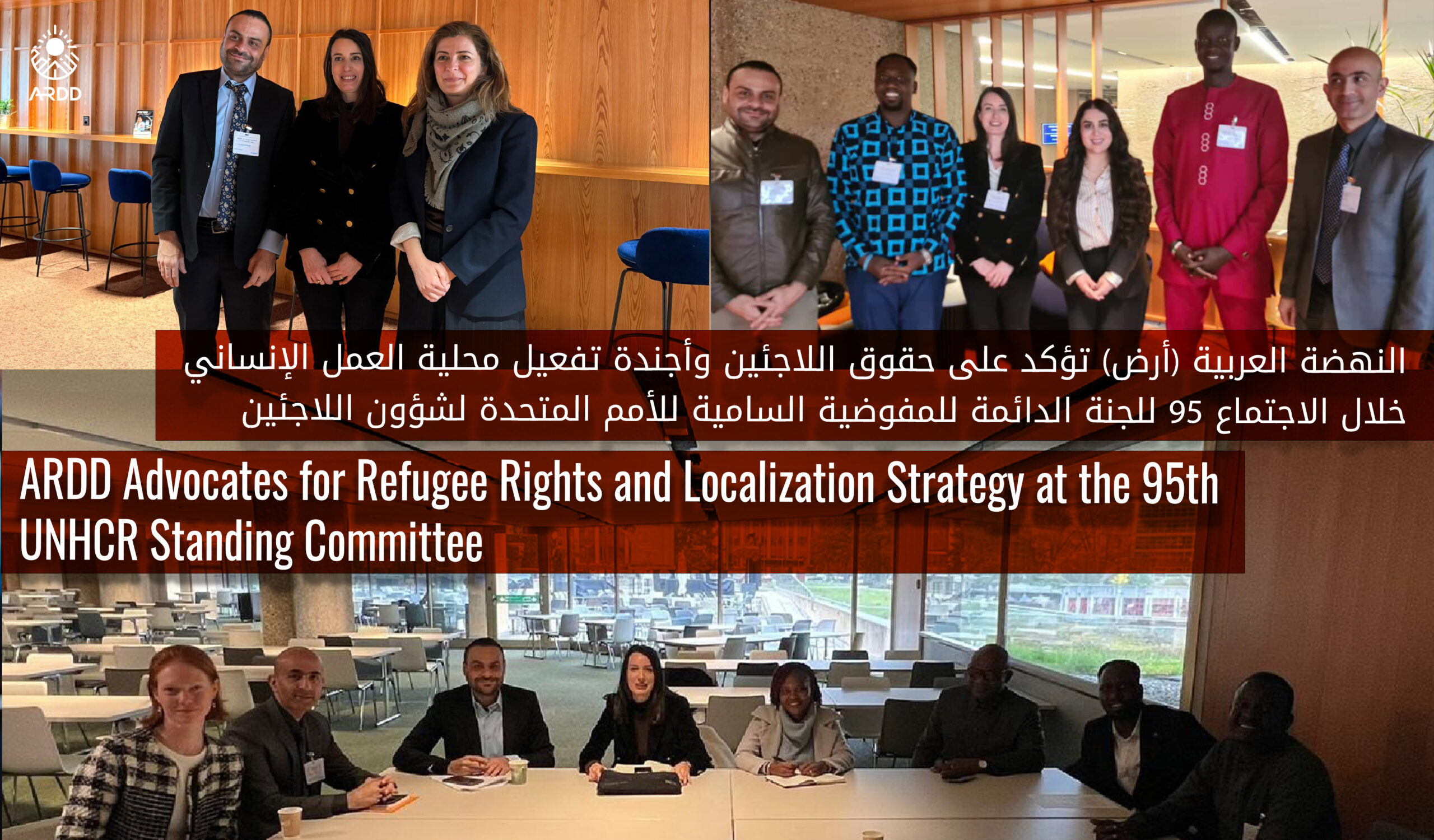
In the final week of March 2026, the Arab Renaissance for Democracy and Development (ARDD) participated in the 95th UNHCR Standing Committee meeting. This high-level gathering served as a critical forum for addressing urgent humanitarian needs and provided a strategic platform to engage with diplomatic missions, international partners, and UNHCR officials dedicated to the protection of refugees and displaced persons. The discussion sadly remarked the ongoing challenges, especially those faced by the Middle East and North Africa (MENA) region, where persistent instability, conflicts, and economic pressures have left 4.2 million refugees and 14.6 million internally displaced persons (IDPs) grappling with increasingly dire circumstances.
Invited by Independent Diplomat (ID), as part of a collaborative initiative with the International Council for Voluntary Agencies (ICVA), ARDD’s participation underscored its impactful work in Jordan and affirmed its role as a leading civil society organization. The ARDD delegation highlighted its vital approach to refugee protection and support, by emphasizing legal protection, evidence-based research and advocacy carried out by its Legal Aid Department, further amplified through ARDD’s think tank hub, the Renaissance Strategic Center (RSC).
The 95th UNHCR Standing Committee occurred at a pivotal juncture, shaped by heightened regional geopolitical tensions and a challenging financial landscape marked by significant funding shortfalls. It also followed a major leadership transition: Barham Salih assumed office as the 12th UN High Commissioner for Refugees on January 1, 2026. Under his new administration, UNHCR is navigating a strategic restructuring to improve operational efficiency and implement a “humanitarian reset” to modernize the agency’s operations amidst severe financial constraints. UNHCR is currently navigating a significant funding gap for 2026, with a 20% decrease from the previous year. This bleak reality has prompted a strategic restructuring focused on efficiency, private-sector partnerships, and a shift from direct aid delivery to supporting national systems and local actors.
While UNHCR noted positive impetus following the December 2025 Global Refugee Forum, where ARDD was also participating, stakeholders cautioned that these gains remain fragile. Rising operational costs and the scale of ongoing displacement crises continue to place immense pressure on host nations, necessitating sustained and flexible international support. A central theme of the UNHCR plenary discussions was an ambitious global objective: the commitment to reverse the rising trend of forcibly displaced people, halving the number of them by 2035. Achieving this goal requires a huge, coordinated effort from all stakeholders, including international donors and host countries.
In Geneva, ARDD framed its contributions around a steadfast commitment to advocating for the rights of all refugees without discrimination. Through bilateral meetings with UN agencies and diplomatic missions, facilitated by ID, ARDD emphasized the strategic necessity of supporting local organizations in implementing effective humanitarian responses. As a leader and member of several national and regional networks, ARDD advocated for a more inclusive humanitarian architecture that elevates the voices of local actors in shaping the policies that directly impact their communities.
During the meetings, ARDD had the opportunity to explain how its initiatives are specifically tailored to the Jordan’s complex legal landscape, where refugees often face significant barriers to legal recognition. Through its Legal Aid Department, ARDD provides fundamental services, including: Pro Bono Representation & Protection: Ensuring the most vulnerable have access to justice; Civil Documentation Support: Securing vital records, such as birth and marriage certificates, that serve as the primary gateway to healthcare, education, and formal employment; Community Awareness & Policy Advocacy: Bridging the gap between grassroots needs and national policy-making to expand the “protection space” for civil society organizations.
ARDD emphasized that legal aid is a fundamental protection tool. This positively resonated with a broad consensus among participants. Furthermore, stakeholders underscored the urgency of enhancing the operational environment and the protection space for those organizations working with and for refugees, recognizing them as the primary drivers of community-led, context-responsive solutions.
In conclusion, ARDD remains committed to working alongside UNHCR and its partners, making sure that the 2035 objective of halving the number of forcibly displaced persons translates into tangible solutions and opportunities for both displaced populations and host communities throughout the MENA region. Central to this commitment is ARDD’s position in the localization agenda, which advocates for a fundamental shift in the humanitarian approach. By championing the unique role and agency of local actors, ARDD will continue to ensure that the new architecture of global humanitarian response is built upon the expertise, knowledge, resilience, and voices of the communities we serve.