
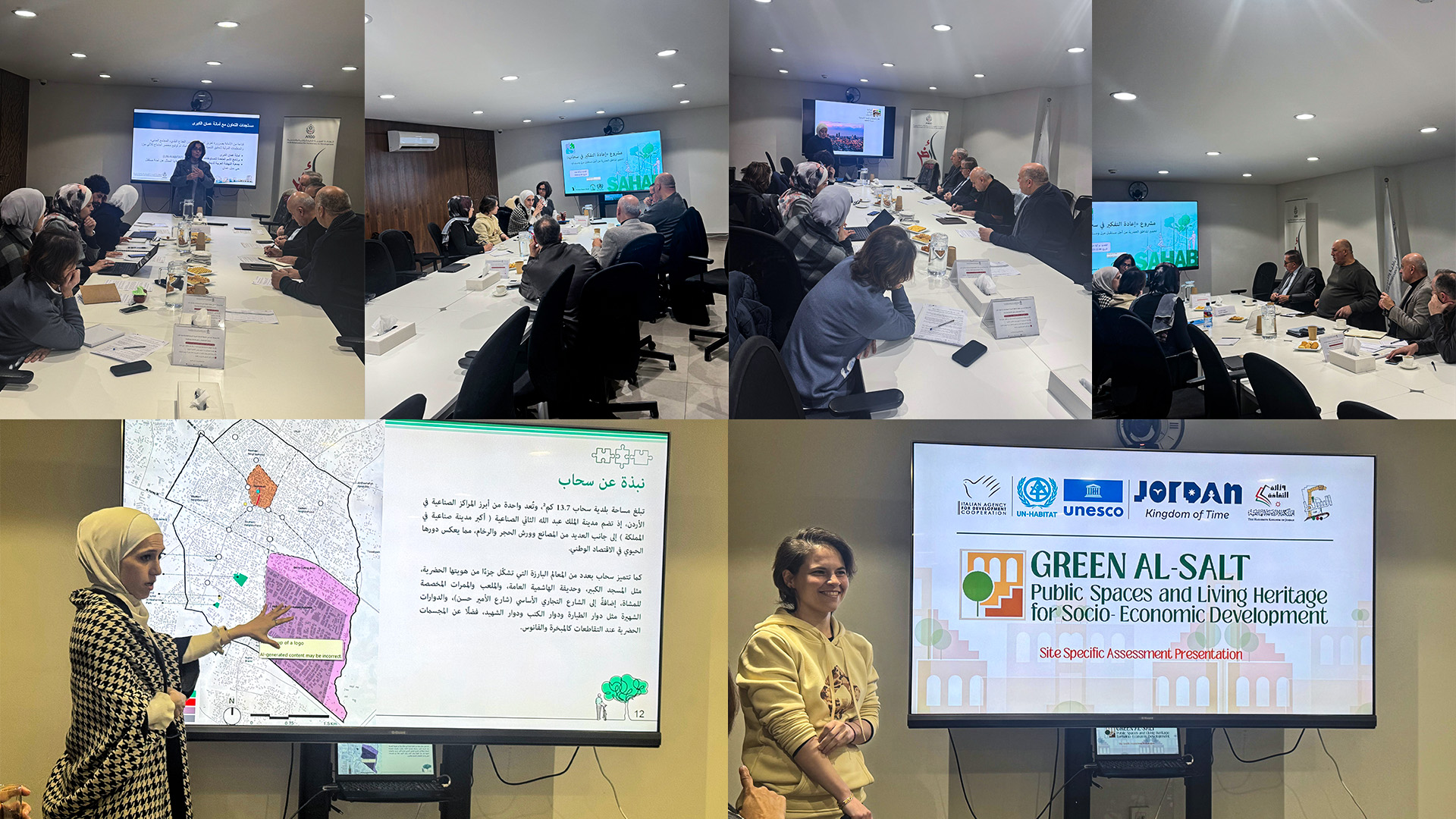
The Arab Renaissance for Democracy and Development (ARDD) convened two meetings of the Jabal Amman Future Committee between 14 and 19 January 2026, in cooperation with the Greater Amman Municipality and the United Nations Human Settlements Programme (UN-Habitat). These meetings were held as part of consultative dialogues aimed at exploring practical pathways to strengthen participatory governance and better align urban planning with the needs of the local community in the Jabal Amman neighborhood.
The discussions brought together representatives of public institutions, international organizations, committee members, experts, and local community representatives. They focused on the institutional and regulatory framework governing urban planning. A presentation was delivered on the 2026 Planning and Zoning System, highlighting proposed shifts in planning methodologies—most notably the gradual transition from city-level planning to more detailed, neighborhood-based approaches. The discussions also addressed mechanisms for community engagement, including the use of structured public hearings as a means to enhance transparency and improve the alignment of planning policies with local priorities.
In a related context, the ARDD team presented the key features of the project “CLOSER – Connecting LOcal proximity networks Sustaining participatory governance,” emphasizing its role in strengthening communication channels between local communities and public authorities, as well as the contribution of community committees to supporting participatory decision-making processes at the urban level.
The meetings also included a presentation by the UN-Habitat team on comparative urban experiences, showcasing planning initiatives in Sahab and Al-Salt. These examples highlighted lessons learned in the repurposing of public spaces and in linking heritage preservation with economic and social development. They provided a basis for discussion on how similar approaches could be adapted to the Jabal Amman context, particularly with regard to the priority of developing a safe, inclusive public community space that responds to residents’ needs while preserving the neighborhood’s historical character.
The meetings concluded with the identification of a set of preliminary directions and proposed next steps for the coming phase. These will be further developed through continued coordination among relevant stakeholders and with the active participation of the local community.