
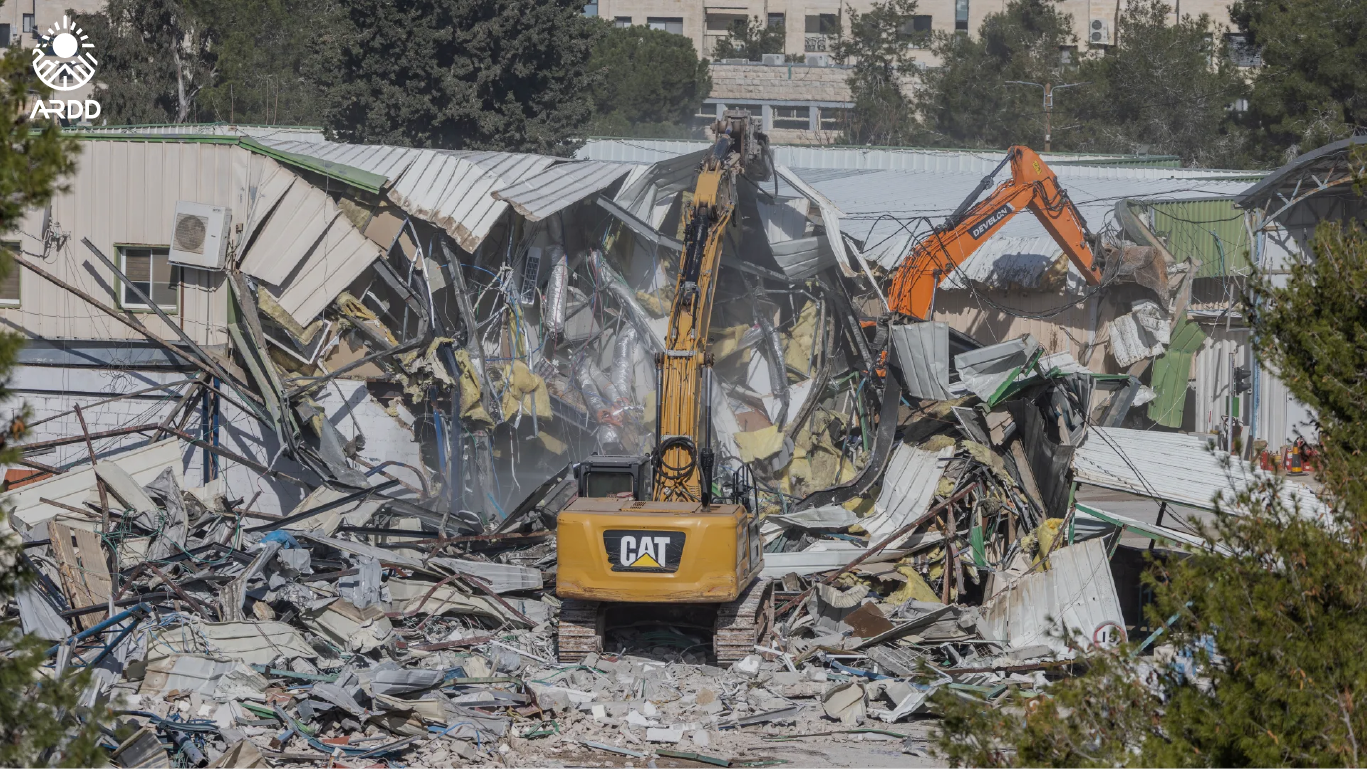
Israel started to demolish UNRWA’s headquarters in Jerusalem days after the agency’s leadership announced that, due to the unprecedented financial crisis it is facing, it is forced to reduce the opening hours of its schools and clinics to four days per week to avoid agency collapse.
Israel’s anti-UNRWA campaign reached another level of open and deliberate defiance of international law on 20 January 2026 when the Israeli government started demolishing UNRWA’s headquarters in Jerusalem. The compound, which UNRWA has leased from the Government of Jordan since 1952, housed the agency’s offices through which it managed its operations in the West Bank, along with several huge warehouses, cold storage facilities, a vehicle repair workshop, and a petrol station. It is now being seized in blatant breach of international law.
Israel’s latest attack on the agency has been widely condemned by Lazzarini as well as the UN Secretary General Guterres, the EU Foreign Affairs Chief Kallas, the EU Commissioner Lahbib, and others. It comes in the wake of other steps taken by Israeli authorities to erase the Palestinian refugee identity. On January 12, Israeli forces stormed into an UNRWA health centre in East Jerusalem and ordered it to close. Water, power supplies to UNRWA facilities – including health and education buildings – are also scheduled to be cut in the coming weeks. This is a direct result of legislation passed by the Israeli parliament in December, which stepped up existing anti-UNRWA laws adopted in 2024.
Israel’s anti-UNRWA campaign has been contributing to the severe financial crisis, which has now prompted the agency’s management to reduce its staff budget by 20%. In a message to staff sent on January 14, 2026, UNRWA Commissioner-General Philippe Lazzarini states that he is “fully cognizant that this cost control measure compounds the extraordinary hardships of the past two years, but to allow the Agency to collapse would be even worse,” he writes. “I must stress that this is a measure of last resort, taken to preserve the Agency and its mandate. If adequate funding is received in the coming period to cover the Agency’s 2026 programme budget shortfall, senior management will review the decision.
The dilemma at the heart of UNRWA’s financial crisis is that it has a mandate to provide public-like services to a vulnerable population, but no guaranteed source of income to finance these operations. Every three years, UN member states vote overwhelmingly to renew UNRWA’s mandate, but then do not provide the voluntary contributions necessary to carry it out. In other words, there is no direct correlation between political support for the mandate and financial support for the agency.
According to Lazzarini, the financial crunch that the agency is facing at the start of 2026 is “fundamentally different from crises of past years.” In addition to the anti-UNRWA campaign by the Israeli government, he points to two other contributing factors that explain the severity of the current crisis: the suspension of funding by the United States and Sweden, which together accounted for nearly one-third of the programme budget, and the overall reductions in official development assistance during 2025.
ARDD calls on the UN Secretary-General to refer Israel’s unprecedented violation of the 1946 Convention on the Privileges and Immunities of the United Nations to the International Court of Justice, as has been under consideration for some time. ARDD also urges the donor community, including Arab governments, to urgently increase their contributions to UNRWA to restore services and stabilize the agency.