In many communities across Jordan, social norms continue to influence perceptions of leadership and decision-making roles. “Empowering Each Other – Phase 8,” implemented by ARDD in partnership with UN Women, aimed to address these dynamics by engaging men and boys in structured dialogue on women’s leadership and gender roles.
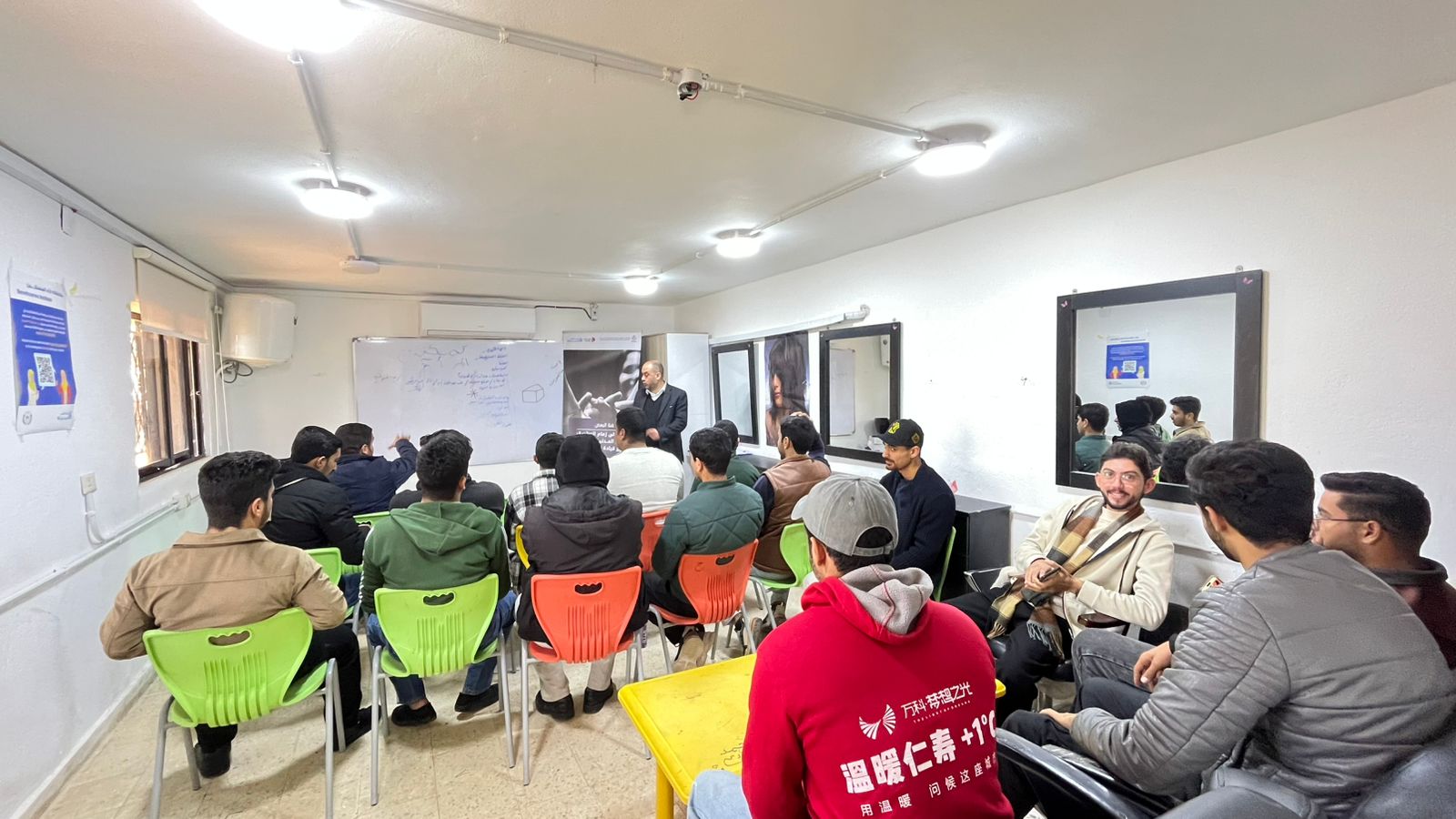
Between November 2025 and January 2026, ARDD conducted 11 two-day dialogue sessions at UN Women OASIS centers across Jordan. The sessions focused on examining the social and household-level factors shaping women’s participation in leadership and decision-making, emphasizing the role of men and boys in influencing these spaces.
Approximately 300 men and boys from diverse age groups and backgrounds participated in the sessions, which were held across southern, central, and northern governorates. The dialogues provided facilitated spaces for participants to reflect on prevailing norms, discuss community practices, and consider how these norms affect women’s opportunities for leadership at both family and community levels.
Facilitators incorporated examples of women leaders in Jordan, including the election of the Eman Futaimat (إيمان فطيمات) as the first female mayor in Khirbet Al-Wahadneh in 1995, to illustrate how leadership roles have evolved. These examples supported discussions on how leadership is shaped by social context rather than gender alone. As noted by Mr. Muath Jaraera, a facilitator in Karak, leadership dynamics are often first negotiated within households, where support for women can influence broader community engagement.
The sessions were designed as participatory workshops rather than lecture-based discussions. Participants worked collectively to identify social, economic, and structural barriers affecting women’s participation, and to outline practical actions that could contribute to more inclusive decision-making practices. Several facilitators observed changes in participants’ understanding over the course of the sessions. In Ajloun, Dr. Musa AlZyoud reported that while some participants initially expressed uncertainty about the purpose of the dialogue, many later articulated clearer perspectives on their role in supporting women’s civic engagement.
Facilitators also highlighted the contribution of older and retired participants, who provided historical and community-based perspectives that enriched discussions. According to Mr. Omar Abu Bakar, these perspectives underscore that responsibility for supporting women’s leadership spans generations. Participants further noted the importance of education and economic participation as enabling factors for women’s sustained engagement in leadership and public life.
Overall, facilitators observed meaningful shifts in participants’ understanding and attitudes regarding women’s leadership, highlighting how the dialogues supported reflection and awareness without attributing individual stories. As the program emphasizes the role of men and boys as partners in change, ARDD highlights that inclusive leadership requires collective responsibility.
“Inclusive leadership is reinforced when men and boys actively support women’s participation, contributing to stronger community governance and social cohesion.” Engineer Zainab Alkhalil, ARDD Programs Manager
Through Empowering Each Other – Phase 8, ARDD continues to explore approaches beyond women-focused interventions, particularly within family and community structures, positioning men and boys as stakeholders in efforts to expand women’s leadership opportunities.
This initiative was implemented in partnership with UN Women and supported by the valued donors, whose contributions have been instrumental in enabling these critical dialogues and community-level interventions.