
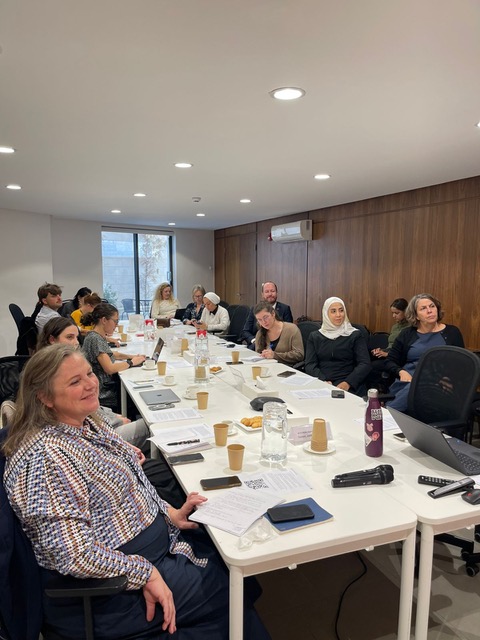
As part of ARDD’s Reclaiming the Future Campaign, and within the framework of the 16 Days of Activism against Gender-Based Violence, the Renaissance Strategic Center (RSC) held a dialogue session on Monday, December 1st, addressing the effects of technology-facilitated gender-based violence (TFGBV) on the civic and democratic participation of young women.
Dr. Miriam Abu Samra, Director of the RSC, opened the session by emphasizing the importance of raising awareness about the various forms of violence women face, stressing that the conversation must continue beyond the 16 Days of Activism.
Her remarks were followed by the launch of the RSC study titled “The Journey to Silence: How TFGBV Affects the Democratic Participation of Young Women.”
The study examines the nature and manifestations of TFGBV, particularly within the Jordanian context, and explores how societal expectations intensify its impact. It identifies two interconnected types of barriers that hinder reporting and response: legislative barriers and sociocultural barriers. Together, these barriers compound the effects of TFGBV, especially for young women who may lack the financial resources or social capital needed to combat such violence.
The study sought to answer the question: How does TFGBV affect the democratic participation of young women? Findings reveal that young women often withdraw from online spaces after experiencing harassment, cyberbullying, or blackmail, perceiving digital spaces as hostile and unsafe. Those who were previously outspoken on social issues reported resorting to anonymous accounts and limiting themselves to “apolitical content,” which significantly restricts their civic and democratic engagement.
Following the presentation of findings, a panel discussion was held featuring three speakers who shared insights from their respective fields.
Carla Ammary, a senior at Al-Mahreq Schools, presented research conducted as part of her curriculum on TFGBV and the lived experiences of digital natives. She explained that for her generation, the boundaries between the digital and physical worlds are blurred, with identities shaped by both local surroundings and global online interactions. Carla highlighted that increased time spent online exposes young people—especially young women—to a continuum of digital violence, exacerbated by both age and gender.
Yara Al-Rafie, researcher and project officer at the Jordan Open-Source Association (JOSA), offered a technical perspective. She discussed how algorithms contribute to the marginalization of women online, particularly Arabic-speaking women. She also addressed the limitations of content moderation systems, noting that cultural and linguistic gaps often lead platforms to dismiss reports of harmful content: “Sometimes you report something, and they say it doesn’t violate guidelines—but they don’t know it violates our community guidelines,” she explained. To address this gap, JOSA developed an open-source AI-enabled tool to help researchers detect online gender-based hate speech across various Arabic dialects as well as Kurdish.
Finally, Roa’a Abu Nada, a freelance journalist, shared her experiences working on sensitive issues in Jordan. She described the discouragement she faces as a woman pursuing investigative stories and emphasized the power of narratives and language in shaping public perceptions of violence. Phrases like “boys will be boys,” “what was she wearing?” or “why was she online?” normalize violence and shift blame to victims rather than perpetrators. Roa’a concluded by reflecting on the guilt she felt after deleting posts due to external threats, balancing her safety with the desire to ensure her work reached the public.