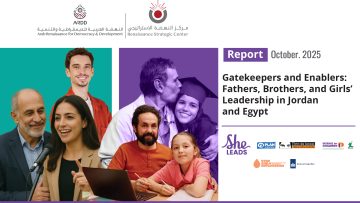
In both Jordan and Egypt, fathers and brothers play a pivotal role in fostering girls’ and young women’s leadership in the Arab world. According to the survey, 99% of respondents – including fathers, brothers,
Jordanian youth, as the country’s demographic majority, hold great potential to drive meaningful social change. They bring energy, creativity, and a strong awareness of community challenges, actively engaging in civic and social initiatives through
Jordanian youth, praised by His Majesty King Abdullah as the nation’s “greatest asset and hope for the future,” are energetic, creative, and socially aware. Their digital fluency enables them to mobilize, voice opinions, and
What does leadership mean to young women and men in Jordan today—and how are they redefining it in the face of societal norms and challenges? As part of the New Generation (GenG) program, ARDD conducted
This research is the first in a series of research works that will be conducted within the framework of New Generation project. It focuses on the meaning of political participation for youth, building on
Over the past five years, the Arab World has faced a series of multifaceted crises that have significantly impacted governance systems and legitimacy. These crises have led to a growing disillusionment among Arab youth
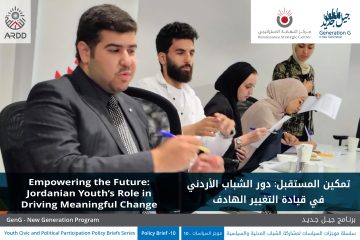
This policy brief explores the evolving dynamics of leadership among youth and women in Jordan, positioning leadership as a central enabler of civic and political participation. It draws on insights from the Youth Civic
The brief addresses the role of social and gender norms in shaping youth participation, with a focus on equitable access and political inclusion. Acknowledging barriers and opportunities, the brief provides recommendations for government institutions,
The international aid sector is in shock. The suspension of all, and subsequent cancellation of many, USAID contracts, and the dismissal of most of its staff, has an immediate impact on millions of people
This policy brief explores the integration of civic engagement and culture into urban planning in Jordan, using Jabal Amman as a case study to examine how art and cultural initiatives can reshape public spaces