JONAF raises reservations vis-à-vis amendment to the Companies Law No. 35 of 2010
Issuing a statement, the Jordan National NGOs Forum (JONAF) expressed reservations about an article in the amendments of Companies Law No. 35 of 2010. At a time when the Jordanian government seeks to secure for the civil society organizations an environment that enables them to practice their work within the local and international legal framework, the current House of Representatives approved an article that concerns foreign funding for non-profit companies. The article reads as follows: “If 30 days have passed from the date of submitting the application and no decision has been issued, the funding is considered rejected.” JONAF stressed in its statement that non-profit companies are an integral part of civil society organizations, and the amendment limits the freedoms stipulated in the International Covenant on Civil and Political Rights, which harms these companies’ interest and is, therefore, a violation of the law. JONAF firmly believes in the need to strengthen the rule of law and requests a reversal of the amendment based on the reasons and legal justification presented in its statement, to consider the failure of the minister to respond to the funding application as an approval or, otherwise, that the case is still open, as already stipulated in the Associations Law. JONAF also urges the government to strengthen the trust between it and the civil society organizations by presenting concrete and effective strategies to support and improve their efficiency, and that only can be achieved through enacting legislation that gives these organizations an enabling space in which to carry out their work, legally and under meaningful, constructive and transparent oversight. Full statement available in Arabic
Localizing Gender Agendas Position Paper
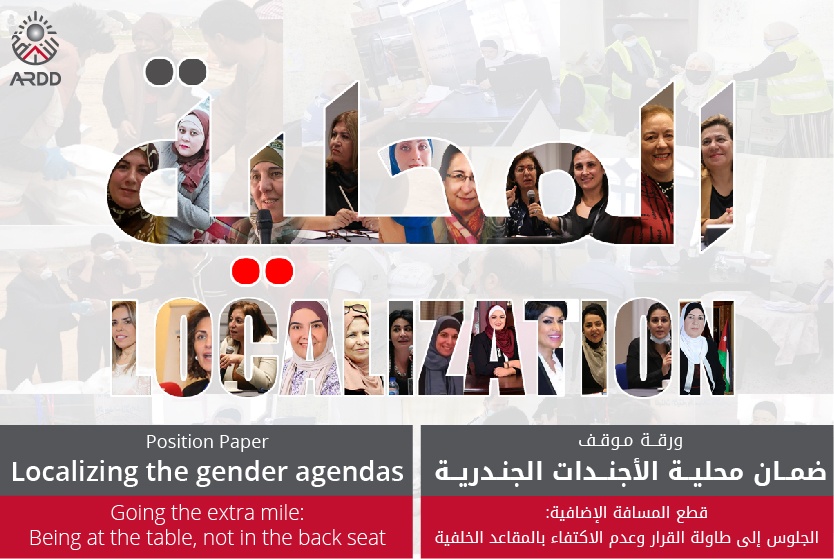
Local organizations’ agency must be strengthened if local communities’ needs are to be met The Arab Renaissance for Democracy and Development (ARDD) has launched a position paper, titled “Localizing the Gender Agendas”, calling on the local organizations to strive to reach decision-making positions at all levels and to set their priorities in their agendas in line with the concerns and needs of the communities they represent and help, and not be content with back seats and the role of the implementers only. The position paper’s launch comes in line with this year’s theme for International Women’s Day, “Women in leadership: Achieving an equal future in a COVID-19 world”. ARDD’s position paper sheds light on the work concerned with gender programming and advancing women’s rights in the country context. It explores the understanding of and approaches to gender programming and methods used to promote women’s rights. It documents experiences of women-led organizations working on women’s rights in selected countries in Africa, Asia and the MENA region, and the lessons learned from the undertaking of making issues appropriate to a country and its culture. The paper studies the examples of countries from regions with similar cultural contexts and that face similar issues. It also reviews donor policies and the approaches of aid organizations that support the women’s rights movement and implement feminist agendas. Most of the research on women-led organizations that have been published recently has been commissioned by international actors. ARDD’s paper is an attempt to add a voice from a local actor’s perspective. The paper criticizes the impact of unbalanced power relations between international agencies with relatively high levels of resources and authority on the world stage, and local organizations, which often leads to a feeling of having entered an “unequal partnership”, and the mission drift of the local organization during crisis and, over time, to the local organizations losing their identity, as well as of the current funding system, which is unreliable at a time funding is most needed, subject to growing transaction costs and suffering due to the power dynamics between patrons and their clients. One big challenge faced by the local NGOs is access to sustainable funding, especially in view of the high level of competition among these local organizations. Another challenge is the fact that INGOs provide project-based funding, while they should invest in capacity building as well. The report called on donors and governments to place the needs and priorities of local actors as a central objective, and for funders to act as active agents that collaborate to support local priorities, not make decisions on their behalf. It also called on donors and international organizations to show greater awareness of the way they practice, of their privileges and of some prejudices they might have, to show confidence in the ability of local actors to understand the needs of their communities and to adopt programs that work to meet these needs and achieve the desired results. It stressed that finding the right pace and strategies in the implementation of local agendas is a delicate balancing act that national and local actors are better equipped to execute. Gender equality agenda can be supported from outside but needs to be driven and led from within, asserts the paper. While the paper shows the positive impact of international conventions on women’s equality, it also believes that the manner in which they were conceived, the entities that control these agendas and the manner in which they are being implemented should be further discussed. At the same time, the paper asked that local and international organizations exhibit greater transparency and accountability and called on women-led organizations from the South to come together, show solidarity and be willing to act together while building a solid support base in their countries. These organizations, the paper believes, must strive to be well informed and willing to be critical of their partners. Solidarity amongst them is crucial if they wish to be able to stand up to their international partners and make them more accountable for the manner in which they deliver on their commitments. While International Women’s Day calls for women to assume more leadership roles and decision-making positions in local and national contexts, the paper stresses the need for better representation of women from various intellectual and cultural backgrounds, the need to listen to them with a holistic view and to take in the critical local voices that strive to tackle local issues, and to refrain from dictating agendas that do not have full consensus in their communities. Gender justice is one of the foundations of the renaissance. However, a true renaissance can only be achieved if it meets the consensus of local communities and makes their aspirations come true while refusing to follow foreign models in a local context.
How Women-led Civil Society Organizations Empowered Vulnerable Women During Covid-19 Pandemic: the Indebtedness of Women in Jordan
Indebtedness is one of the main factors that impact women’s economic empowerment in Jordan. Women in Jordan have one of the lowest labor participation rates in the world, double-digit unemployment rates reaching over 30%, and since they hold lower financial inclusion rates than men, they are more likely to be indebted. The COVID-19 crisis has only exacerbated this situation. The brief aims to evidence the impact the COVID-19 pandemic has had on women and to include the women’s specific needs. Women-led civil society organizations (CSOs) provided aid to women who have the opportunity to borrow money for small businesses and have specific regulations for loan types, grace periods, and loan repayment. Moreover, some CSOs provide legal counseling and aid, free of charge, to “Gharimat” through their organizations. However, women still face challenges related to loan repayment, which the policy brief addresses with a set of recommendations. The Arab Renaissance for Democracy Development (ARDD) is producing a series of policy briefs within the framework of the project “Strengthening the Capacities of Women-led CSOs in Evidence Based Advocacy and Women, Peace, and Security (WPS) Agenda” supported by UN Women with the generous funding of the governments of Canada, Finland, Norway, Spain, and the United Kingdom. ARDD acknowledges the support of the women-led civil society partners involved in the project implementation and thanks the representatives of the organizations for their meaningful contribution.
A policy brief calling for enabling social and political participation of Palestinian refugee youth in the MENA region
The brief calls for efforts to be exerted to enable the participation of Palestinian refugee youth in public governance within their communities, beyond traditional civic engagement approaches. Only by doing so can risks posed by general frustration, socio-political disengagement, and low levels of trust in institutions be avoided. The Policy Brief is based on Al Nahda Thought Center “Voices of Palestinian Refugee Youth across the Near East: Socio-Political Participation and Aspirations” Study and proposes five recommendations for programmatic interventions: 1-Enhance Palestinian refugee youth’s access to justice; 2-Strengthen their opportunity to participate in public governance within their communities; 3-Build on the opportunities provided by youth’s “wired citizenship”; 4-Support the rehabilitation of Palestinian cultural heritage and identity vis-à-vis host societies and among Palestinian refugee youth; 5-Promote opportunities for quality education with a view to enhancing opportunities for decent work. The brief also recommends the need to implement tailored youth-oriented data collection along with psychosocial support as needed within each of the programmatic areas. The Brief is written under the assumption that efforts to reduce the economic marginalization of Palestinian refugee youth must underpin programmatic initiatives regarding political participation efforts, as decent livelihoods lie at the basis of youth’s future in their communities and the region.
Decisions and measures taken by the Jordanian Government to respond to the COVID-19 health crisis (24/3/2020-30/4/2020)
This paper is part of a series that summarises the decisions and measures taken by various sectors of the Jordanian government in the face of the COVID-19 health crisis. This is the second summary that compiles and documents the decisions and actions taken by Jordanian officials, this time in the 24/3/2020-30/4/2020 period, with the aim of studying and analyzing them later. The original document is drafted in Arabic and contains a much more detailed account of these measures.
Legal Paper on children’s rights draft bill for 2020 in Jordan
The Convention on the Rights of the Child, one of the most important documents concerning children, was adopted in 1989, after the UN General Assembly approved making it into international law. It entered into force in 1990, having been ratified by most United Nations member states and is an international charter outlining children’s civil, political, economic and cultural rights. In 1991, Jordan was one of the first Middle Eastern countries to ratify the CRC. Over time, Jordan has continued to be a pioneer in ratifying international and regional human rights instruments related to children. In 2006, Jordan issued law 50/2006, which ratified the Convention on the Rights of the Child as after the legislature approved its adoption. However, no other law concerning the rights of children has been issued since then, despite many attempts throughout the years. On January 14, 2020, Jordan published a draft bill for children’s rights, to be promulgated pending the approval of the legislature[1]. This paper is part of Arab Renaissance for Democracy and Development’s (ARDD) efforts and programmes advocating for raising children in a safe environment and ensuring their protection and access to justice. In this paper, ARDD aims to present its legal opinion on the draft bill for children’s rights 2020, and to shed light on the main legal text as it pertains to the importance of this bill at the local level. This paper also considers the role of this legislation in creating a solid and clear legal text, and expanding the legislative framework concerning children’s rights and protection. The bill is also important internationally as it strengthens the main principles and commitments of the Convention on the Rights of the Child by implementing the international conventions on human rights. Finally, the bill is a positive addition to strengthening human rights in general, and children’s right in Jordan, in particular. [1] To read the full children’s rights draft bill, follow the link: http://www.lob.jo/View_LawContent.aspx?ID=1226
Legal Paper:New Procedures Home Based Businesses Professional Practice License For Syrians in Jordan
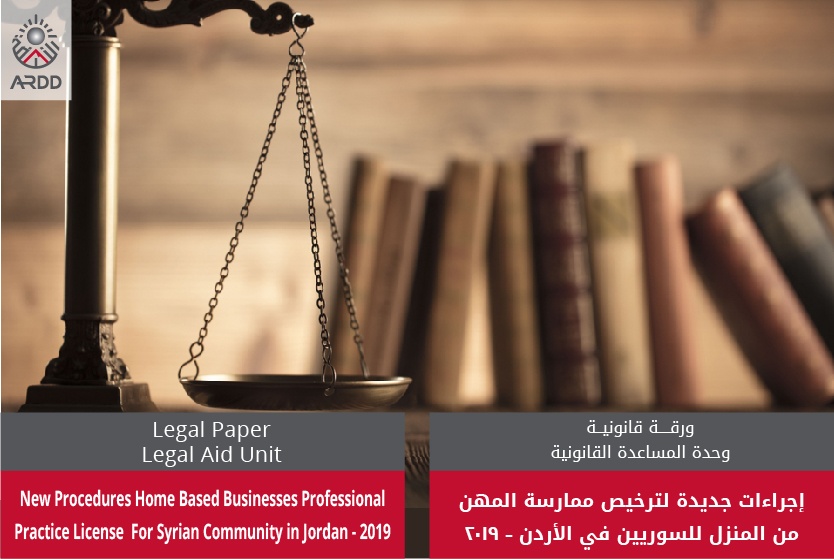
This paper addresses the recently amendments issued on the procedures of 2017 , which allows the practice of certain home-based professions, and their impact on Syrian women refugees’ economic participation and empowerment, the paper also discusses the summary of the development of these instructions, and how it affects Syrian refugees. It also clarifies the conditions of registration of such works and procedures, and the relevant challenges, in addition to discussing the general challenges and recommendations related thereto. Through its programs and services, ARDD seeks to establish a democratic society in which everyone enjoys social, economic and political justice regardless of their situation and background, including Syrian refugees. ARDD focuses its attention on the labor sector, especially with regard to the economic participation of refugee women, and therefore aims through its services, whether legal or other to promote women’s economic participation and support and strive to remove all challenges affecting the participation of refugee women in the labor market, and their economic participation as a whole. As part of its endeavors, ARDD conducts studies and research, holds legal awareness workshops, legal counseling, support and advocate to improve women’s economic participation and create a safe environment free of gender discrimination. ARDD also present opinion paper on all initiatives and decisions that it considers affect women’s economic participation, whether positive or negative.
Legal Paper: Non-Jordanian Work Permit’s Fee Regulation
In this paper we discuss the legal situation of migrant workers in Jordan, whose numbers has increased significantly in the last ten years, prompting the authorities to find legislative and regulatory solutions that seek to balance the situation of local and expatriate workers. The analysis below highlights the different stages the work permit Non-Jordanian Work Permit’s Fee Regulation for non-Jordanians went through, in terms of the adoption and amendment of texts, and their impact on the categories covered by this regulation, and examines its suitability to the needs of non-Jordanian workers in Jordan and the success the (free work permit) regulation has achieved in terms of facilitating their work and improve their economic opportunities. Arab Renaissance for Democracy and Development (ARDD) seeks through its programs and services to establish a democratic society in which everyone enjoys social, economic and political justice regardless of their situation and background, including Syrian refugees and other nationalities coming to Jordan. As part of its efforts in this regard, ARDD’s Legal Aid Department seeks to explain the legal procedures and labor rights of non-Jordanians and the conditions of work in Jordan, in addition to holding several awareness workshops in many regions of the Kingdom to clarify the most important and important points related to work permits.
Gendering decision-making in mobility and insecurity; the necessity for including Syrian women and girls in discussions on potential return
As part of its perspectives series, and after the paper “Jordanian youth and their decision-making processes regarding their futures”, in which Arab Renaissance for Democracy and Development (ARDD) addressed the phenomenon of increasing out-migration of Jordanian youth, and the second paper entitled “Regional Responses regarding the Integration of Europe’s Recently Arrived Arab Diaspora/Shataat” addressing the regional response to the integration of the recently arrived Arab diaspora into Europe and calls for more regional cooperation. In its third perspectives’ paper “Gendering decision-making in mobility and insecurity; the necessity for including Syrian women and girls in discussions on potential return”, ARDD calls for more efforts to be conducted to research the gender aspect in such decisions and demands that no such decisions should be made without inclusion of women and girls in the process and the guarantee of their voluntary return into safe and dignified conditions.
Regional Responses regarding the Integration of Europe’s Recently Arrived Arab Diaspora/Shataat
In this paper we address the potential for civil society organizations (CSOs) from the MENA-region to positively contribute to discussions in Europe about the most recently arrived Arab diaspora, or shataat. We explore if, and how, lessons learned from this region with regard to hospitality and refugee hosting can be of use for governmental and institutional bodies and for civil society elsewhere. We particularly question how we can respond to problems related to the integration of recently arrived Arab migrants, taking the MENA region – which consists of sending and transitioning countries – as the point of departure. As such, it is our hope to contribute to dialogue that fosters the building of bridges towards inclusion within European countries, and that further counters exclusionary, racist and xenophobic tendencies.