Strengthening Self-Reliance: TVET and Skills Education for Youth in Jordan
While the importance of TVET and skills education programs is emphasized as an effective pathway for providing Jordanians and refugees with technical and personal skills to facilitate their integration into the labor market and enhance their self-reliance, challenges remain. Limited access to vocational and technical education opportunities is increasingly recognized as a pivotal obstacle to addressing youth unemployment and poverty. Through TVET and skills education, Jordanian youth and refugees gain marketable skills, enabling them to access employment opportunities, establish businesses, and contribute to the local economy. Additionally, TVET programs offer refugees alternative livelihood options, reducing vulnerability to exploitation and abuse by providing economic independence. We are sharing research conducted by ARDD’s Renaissance Strategic Center (RSC), titled “Strengthening Self-Reliance: TVET and Skills Education for Youth in Jordan” within the framework of the “Investing in the Future: Improving the Livelihoods and Education of Minority Refugee Groups within Society in Jordan” project. This project, implemented by ARDD in collaboration with Vision Hope International, is funded by the German Federal Ministry for Economic Cooperation and Development. The research delves into the legal, economic, and educational vulnerabilities faced by Yemeni, Somali, and Sudanese asylum seekers and refugees (AS/R) in Jordan, provides an overview of the current TVET system in Jordan, and focuses on the challenges, opportunities, and gaps in TVET and skills for Yemeni, Somali, and Sudanese AS/R individuals. Lastly, it outlines the way forward, emphasizing key advocacy messages and offering essential recommendations to donors, civil society organizations (CSOs), the private sector, the Government of Jordan (GoJ), and TVET and skills providers. The study emphasizes the necessity of a strong, high-quality TVET system, from which refugees and Jordanians alike can benefit, to enhance the necessary skills for the labor market and increase the efficiency and productivity of the workforce, thereby contributing to economic growth.
Voices of the Marginalized: A Study of Migrant Workers and Refugees in Jordan
This study provides an in-depth analysis of the challenges faced by migrant workers and refugees in Jordan, particularly in terms of access to work and education. It offers comprehensive recommendations for policy reform and future research directions. It also sheds light on the voices and stories of migrant workers and refugees that reflect their realities. While Jordan has made progress in addressing the needs of migrant workers and refugees, significant challenges remain: Migrant workers and refugees in Jordan encounter significant discrimination, which hampers their access to work and educational opportunities. This includes legal barriers, wage disparities, and exclusion from certain job sectors; The kafala (sponsorship) system contributes to the exploitation and restricted mobility of migrant workers. Despite significant changes in the legislative framework to facilitate access to education for migrant and refugee children, the process for enrolling in schools is still heavily impacted by their parent’s legal status, leading to low enrolment and completion rates. The study suggests several recommendations including: advocating for an overhaul of the sponsorship (Kafala) system to protect migrant workers from exploitation and ensure their freedom of movement and employment; simplifying the permit process and allowing refugees and migrants to work in a wider range of sectors; implementing local educational programs, including language and vocational training, to improve access and integration for refugee children, and enhancing legal frameworks to combat discrimination and conducting awareness campaigns to reduce societal stigma. In conclusion, comprehensive policy reforms and further research based on the direct engagement and inclusion of migrant workers and refugees in policymaking, are essential to ensure their successful integration and contribution to Jordanian society. This publication has been produced as part of phase 3 of Haquna project, with the financial assistance of the Heinrich Böll Foundation – Palestine and Jordan. The views expressed herein are those of the author(s) and therefore do not necessarily reflect the opinion of the Heinrich Böll Foundation – Palestine and Jordan.”
Beyond ‘ink on paper’ The right to social protection of persons with disabilities in Jordan
This paper aims to analyze and critically examine the topic of inclusive social protection, delving into the policies and laws concerning persons with disabilities that are already in place in Jordan, as well as identifying the gaps that must be addressed in order to create an inclusive and rights-based system. The study delves into the rights of persons with disabilities in Jordan and the legal frameworks in place, exploring the predominant social model approach to disability that analyzes the interaction with physical, technological, and behavioral barriers. Although Jordan has made promising progress when it comes to persons with disabilities, it still has a long way to go. It is therefore of utmost importance that the gaps facing persons with disabilities in Jordan be recognized, in order to establish a dignified and rights-based inclusive social security system. For this to happen, a life-cycle approach must be adopted, specifically with regard to income security. Children, working-age adults, and the elderly with disabilities must be granted adequate incomes that take into account the additional costs of living with a disability.
The Quality of Health Services and Medical Liability: A Comparative Study of Jordanian and Palestinian Legal Frameworks Public Health and Law in Jordan Series No. 1
within public life, the medical sector is one of the most vital and sensitive sectors due to its direct dealing with individuals’ lives and mental and physical safety, which makes the issue of responsibility within this sector an essential issue that must be addressed to protect both patients and medical service providers. Jordanian and Palestinian legal systems are characterized by many similarities due to the deep relations that bind the two countries, especially in light of the Jordanian rule of the West Bank, which left many fingerprints in the adoption of Jordanian laws, many of which are still in force today in Palestine. More important, both Jordan and Palestine are among the first countries in the Arab world to have adopted special liability laws in the recent past. In addition, Palestinians benefit from medical services offered in Jordan either as medical tourists, residents, or refugees. . The study describes and analyzes how the medical responsibility of health service providers exists within three basic forms: criminal responsibility according to the Jordanian Penal Code No. 16 of 1960 and the Egyptian Penal Code No. 73 of 1936, civil responsibility according to the Jordanian Civil Law and the Code of Judicial Provisions, and administrative responsibility in accordance with the laws of the Medical Syndicate. In addition, the study analyzes the special laws regulating medical liability, namely, the Jordanian Medical and Health Liability Law No. 25 of 2018, and the Palestinian Decree No. 31 of 2018 regarding medical protection and safety. The study concludes that the issue of medical responsibility still faces many difficulties and obstacles in Jordan and Palestine, highlighting two aspects: a. Although there are special laws regulating medical liability cases, they did not address the issue of medical liability directly, which prompts the parties to return to the general civil, criminal, and administrative laws. b. Evidence and the burden of proof issues are one of the obstacles facing the parties, especially patients, in proving the occurrence of a medical error and the damage resulting from it. Based on the legal analysis, the study also offers a set of recommendations, the most prominent of which can be mentioned as follows: 1- A reformulation of the legal aspects of medical liability within a private law instead of keeping it under the general laws. 2- With regard to criminal responsibility, in particular, the legislator must create a legal template for a new crime in the special section of the Penal Code and not be satisfied with leaving the matter to the general rules. 3- Reconsidering the judicial readiness of the courts to consider cases of medical errors. 4- Reconsider the procedures followed before the courts and the competent authorities. 5- Pushing for more activation of the role of special committees in the health liability laws of 2018 in both Palestine and Jordan.
Unmet Legal and Protection Needs of Palestinian Refugee Youth
ARDD is committed to elevating the voices of Palestinian youth in the region and empowering them to achieve positive change in their communities. This study, which is part of that commitment, was an exploratory investigation into the unmet legal aid needs of Palestinian refugee youth living in camps in Jordan, Lebanon, and the Occupied Territories of the West Bank and Gaza. This report builds on a series of reports and briefs by ARDD on Palestinian Refugee Youth which highlighted the overall situation, needs, and aspirations of Palestinian refugee youth in camps in Jordan and the region. As part of ARDD’s commitment to engaging with and empowering young Palestinians, this report built on a one-month pilot aimed at training three young researchers from Palestinian communities on social action research. The questionnaire at the base of this study was developed in collaboration with the three young researchers. It sought to understand perceptions of demand and supply of legal aid services from the point of view of Palestinian youth in the region. The target respondents included youth aged between 15 to 29 as well as adults over the age of 33 years in order to obtain insight into the lifecycle of legal needs experienced by Palestinian youth. The questionnaire asked respondents about what they perceived were the most pressing legal needs of Palestinian youth and to what extent legal services were available to meet these needs. The questionnaire built on ARDD’s understanding of access to justice, which encompasses all the elements needed to enable citizens and residents to seek redress for their grievances and to demand that their rights are upheld. In its work, ARDD adopts and adapts the six elements, namely: justiciability, availability, accessibility, good quality, provision of remedies for victims and accountability of justice systems. Adapting these elements to understand youth’s perceptions of access to justice, the questionnaire explored issues of availability, affordability, and quality of services. The report presented three main recommendations concerning raising the legal awareness of Palestinian refugee youth, providing legal aid services to them and for greater inclusion and representation of Palestinian youth in all processes that impact them. This includes having a youth-oriented approach to research and data collection. Service providers must continue to engage youth in the research, design and implementation of projects addressing their situation.
The Actuality of the Palestinian Refugee Question: An International Law Perspective
In 2018, the unresolved exile of the Palestinian refugees entered its eighth decade, with refugees unto the third or even fourth generation. Nowadays, Palestinian refugees (around 7.5 million) account for the largest group of refugees globally, the majority of whom are also stateless, caught in the most protracted refugee situation in modern history. Unlike other refugees, their situation and status are often discussed in the realm (and through the lens) of politics instead of on the basis of their rights. This undermines both their quest for justice and day-by-day protection. In many respects, Palestinians have been the bête noire of refugee studies, with some still questioning whether they should be considered ‘genuine’ refugees at all, and therefore whether they deserve the protection that international law offers to refugees. For decades since their original flight, confusion around their status as refugees has made the application of the 1951 Convention Relating to the Status of Refugees (‘1951 Convention’) to Palestinian refugees problematic. Also, the relevance of other branches of international law has remained disputed or under-utilized in the case of this particular group. In fact for historical and political reasons, Palestinian refugees enjoy distinctive normative and institutional arrangements within the international refugee regime: these arrangements provide for their specific protection as refugees, rather than leaving them unprotected. Palestinians in general, because they lack a fully sovereign independent state, and refugees in particular, because of the additional issue of their dispersal, make for a difficult constituency to protect. They fall under a myriad of regimes, with different legal statuses and institutional arrangements, and are often discriminated against as Palestinians. This paper argues that, while international law is not a panacea for all problems and challenges with respect to the Palestinian refugees’ issue, awareness of their rights, status, and related vulnerabilities may help turn the tide of politics in favor of the realization of their effective protection. It clarifies who Palestinian refugees are, dispelling confusion about applicable definitions and institutional arrangements. Then discusses the origins and features of their ‘distinctiveness’ in the international refugee regime, which is fundamental to clarify their status under international law. Then it briefly sheds light on the relevance of various branches of international law for their protection. It also offers suggestions for renewed consideration of the pursuit of solutions for the Palestinian refugees. Some concluding observations are offered at the end.
Strengthening Localization in Jordan Localization: Reinforce and support do not replace or undermine
The Arab Renaissance for Democracy and Development (ARDD) initiated this research to create clarity, momentum, focus and meaningful action around “localization” in Jordan. The broad question underlying this research is whether and how the large presence of international aid agencies in Jordan over the past two decades has significantly reinforced the country’s collective capacities to deal with refugees and with (socio-) economic shocks. No research on localization can escape the question: What does one mean by localization? Four years after the World Humanitarian Summit and 13 years after the “Principles of Partnership”, it remains a confused, perplexing and contested policy and practice issue. This paper seeks to be an action research and offer clarification, structure and direction. It uses different frameworks for interpreting what was read and heard from many sources and offers them for use in the localization policy and practice conversations in Jordan. It works with an interpretation of localization, in line with the intent of the Grand Bargain, based not on ideological but on compelling strategic reasons, applicable to Jordan. The Grand Bargain is an outcome document of the 2016 World Humanitarian Summit. Its ten commitments, signed up by all the major humanitarian actors, constitute an agenda for reform of the international relief sector, to make it more cost-effective and more inclusive, with a much better distribution of power. One of the commitments is to provide “more support and funding tools for local and national responders”. This is now commonly referred to as ‘localization’
Voices of Palestinian Refugee Youth across the Near East: Socio-Political Participation and Aspirations
As part of “Voices and Future of Refugee Youth from and on the Arab World” week marking World Refugee Day and its ongoing programs to shed light on the conditions of refugees in the region and its research efforts aiming at amplifying the voices of the most marginalized groups among them, Arab Renaissance for Democracy and Development (ARDD) launched its new study “Voices of Palestinian Refugee Youth across the Near East: Socio-Political Participation and Aspirations” The study sheds new light on the Palestinian refugees, by focusing on a usually politically marginalized segment of their communities: refugee youth, whose perceptions and aspirations about their status within their communities and within their host societies, as well as about their future, are important albeit often muted. The study focused on youth who are –or aim to be– politically and socially active, primarily from camps, in Jordan, Lebanon, the occupied Palestinian territory, and Syria. By involving over one hundred young male and female Palestinians (most with current or past experience in social programmes or volunteer activities), the study tried to capture, through focus group discussions and eye-to-eye interviews, the voice of these youth on important issues. These included: their social and political status within their communities, the larger Palestinian ‘polity’ and the host society at large; the challenges and opportunities that shape their socio-political mobilization; their political consciousness as Palestinians and as young (camp) refugees; and how these factors intersect with and impact their aspirations. When it comes to the future, this study identifies some trends among youth. On the one hand, there is an organic connection between individual aspirations and collective issues concerning the future of Palestine and the Palestinian (refugee) people at large. As with past generations, youth remain vocal advocates of the right of return, which they describe as existential, sacred and not renounceable. On the other hand, they believe that the quest for the right of return and the right to self-determination cannot be achieved at the expense of their human rights, namely other rights. They also believe that pending a settlement of the Palestinian refugee question, UNRWA’s mandate should be preserved and its activities enhanced. This study indicates that youth see no future in remaining marginalized, poor, disenfranchised, stateless and “deprived of the right to have rights” in their (host) societies. Pending their ‘return’ to Palestine, they ask for their overall empowerment: capacity building good education, access to decent jobs and, last but not least, “political space”. This empowerment is seen as critical to the realization of their own aspirations. However, these aspirations are expressed in different ways according to the reality in which they live: “living one’s Palestinian-ness” while remaining “loyal to the state” in Jordan; getting “recognition” and “rights as human beings” in Lebanon and in the oPt; and “helping the [Palestinian] cause everywhere,” including from the diaspora as the respondents from Syria said. It remains unclear what opportunities young refugees can be offered in the current political context in Palestine and the region at large. Nonetheless, Palestinian refugee youth seem to have both the enthusiasm and the critical capacity to help revamp the Palestinian narrative and achieve historical justice through the realization of collective and individual human rights.
Perceptions and Experiences of Youth in the Palestinian Refugee Camps in Jordan Needs Assessment Report
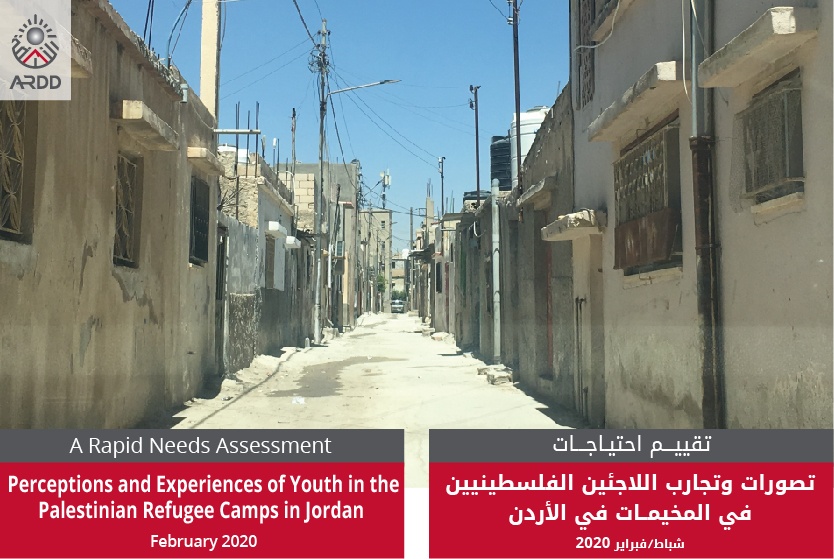
The Jordanian government, the United Nations Relief and Works Agency for Palestine Refugees in the Near East (UNRWA), and the Camp Services Committees / Department of Palestinian Affairs in Jordan have exerted tremendous efforts over more than 71 years to support Palestine refugees. However, an evaluation of the current situation is needed to advocate for the support and development of these efforts. This needs assessment was commissioned by ARDD with the intention of identifying the evolving needs in Palestinian refugee camps in Jordan in the current context of economic slowdown and the potential impact on the services in the camps and the well-being of young camp dwellers. The specific objective of this assessment is to provide updated insights about the socio-economic conditions and needs of Palestinian refugee youth in the refugee camps in Jordan. This is achieved by exploring perceptions and experiences of young Palestinian refugee men and women, complemented with information and perceptions of workers in selected Camp-based organizations. The assessment aimed to answer two key questions related to the youth’s perceptions and experiences of trends in socio-economic conditions and the implications on their psychological well-being, taking gender differences into account, and to explore what kind of interventions are needed to support Palestinian refugee youth that could contribute to positive change and mitigate potential risks. The findings of this needs’ assessment show that many of the problematic issues from the 2011 data and the 2016 discussions remain and include the following points: · Statelessness of Palestinian refugees from Gaza (ex- Gazans) remains a problem · The lack of job opportunities, even among the educate, remains a major issue in all camps especially for young men · There are prevalent perceptions that there is a problem in quality of and access to in basic higher education in all the camps and child labor is an issue · In some camps, bullying by school children, especially verbal, is common in schools and the community and is almost normalized · There are perceptions of insufficiency of health services, especially emergency and tertiary services · There are insufficient solid waste collection services, and the quality of streets and sanitation in some camps and overcrowding constitute a health hazard · There is a lack of social and cultural outlets for youth especially women · There are also perceptions of inequalities and differences within and among the camps · The conservative social culture is a major challenge for women which restricts their movement to varying degrees and accordingly impacts access to work and education. · The impact of the socio-economic conditions on psychological well-being include: feelings of emptiness, a dark outlook, hopelessness and frustration, a sense of stigma, a sense of insecurity about the future, hopelessness for change and psychological implications of bullying. Thus, ARDD calls for building on existing initiatives and developing new ones to contribute to bettering the refugees’ current conditions and opening the door for sustainable improvements that allow them to pursue their potential.
Palestinian Refugees: Is there the need for a new approach to solutions beyond the 70 year old impasse?
On 20 – 22 October 2019, as part of its Global Network of Experts on the Question of Palestine’s efforts, Arab Renaissance for Democracy and Development (ARDD) organized the Networks 2nd Annual workshop in Amman titled “Palestinian Refugees: Towards a New Approach to Solutions” workshop in which the Network proceeded as per its first workshop’s (held in October 2018) recommendation’s to discuss a number of novel ideas with respect to the durable solutions for the Palestinian refugee issue. During the workshop, 30 Palestinian and international experts, from academia, civil society organizations and the international community at large, explored ways that could revitalize discussions around Palestinian refugees. The workshop recalled that Palestinian refugees, including their descendants born in exile are recognized refugees under international law. As such, they enjoy fundamental rights under various bodies of international law, including human rights law and refugee law.