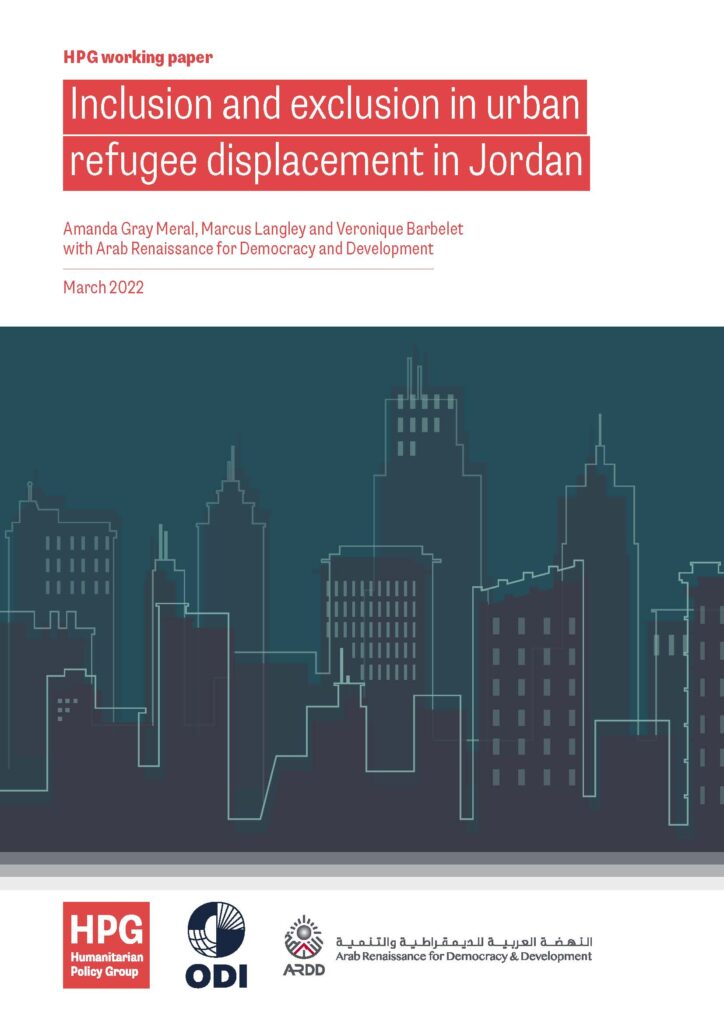
The response to displacement in Jordan presents an opportunity to examine some of the barriers to
a more inclusive response to a large-scale, protracted urban displacement crisis. This study explores
issues of inclusion and exclusion in an urban displacement response and interrogates what the drivers
of exclusion are for people affected by displacement, including those pertaining to humanitarian action.
It examines the extent to which the displacement response has been inclusive and identifies factors that
have either undermined or supported a more inclusive response in an urban displacement crisis.
Acknowledging the immense operational challenges aid workers and local government actors have
faced, this study finds that the response has not been systematically inclusive. Donors, agencies and
local actors have at times neglected the needs and concerns of certain communities, failing to adapt
adequately to the out-of-camp context in which they are working, reducing the overall quality of the
response. Drivers of exclusion and marginalisation in a city location, such as Amman, Jordan, have
traditionally not been well understood. Responding to mass displacement in an urban context shines
a light on the unique challenges facing operational agencies at the macro level, including the need for
greater emphasis on: impartiality; monitoring and addressing inequity in access to assistance; livelihoods
and services; ensuring effective and inclusive community engagement and participation; and dedicating
space to addressing specific and diverse needs.
This research also found that differences in the treatment of people of non-Syrian nationality – but who
had complex humanitarian needs and vulnerabilities – in the response has been a key driver of exclusion
for refugees and vulnerable migrants not from Syria. Those interviewed reported discrimination and
a perceived unfairness in their treatment. This was even more relevant because of the out-of-camp
context, since, in a camp context, refugees would typically all be served together. Legal status was
found to be a much greater predictor of exclusion in out-of-camp settings. While all refugees in Jordan
face some level of legal restriction to equal rights, which has impacted access to labour markets and
livelihoods, as well as essential services such as health and education, this was particularly pronounced
for non-Syrians who were not granted de facto refugee status and had to go through a lengthy asylum
process in order to identify their legal status.